
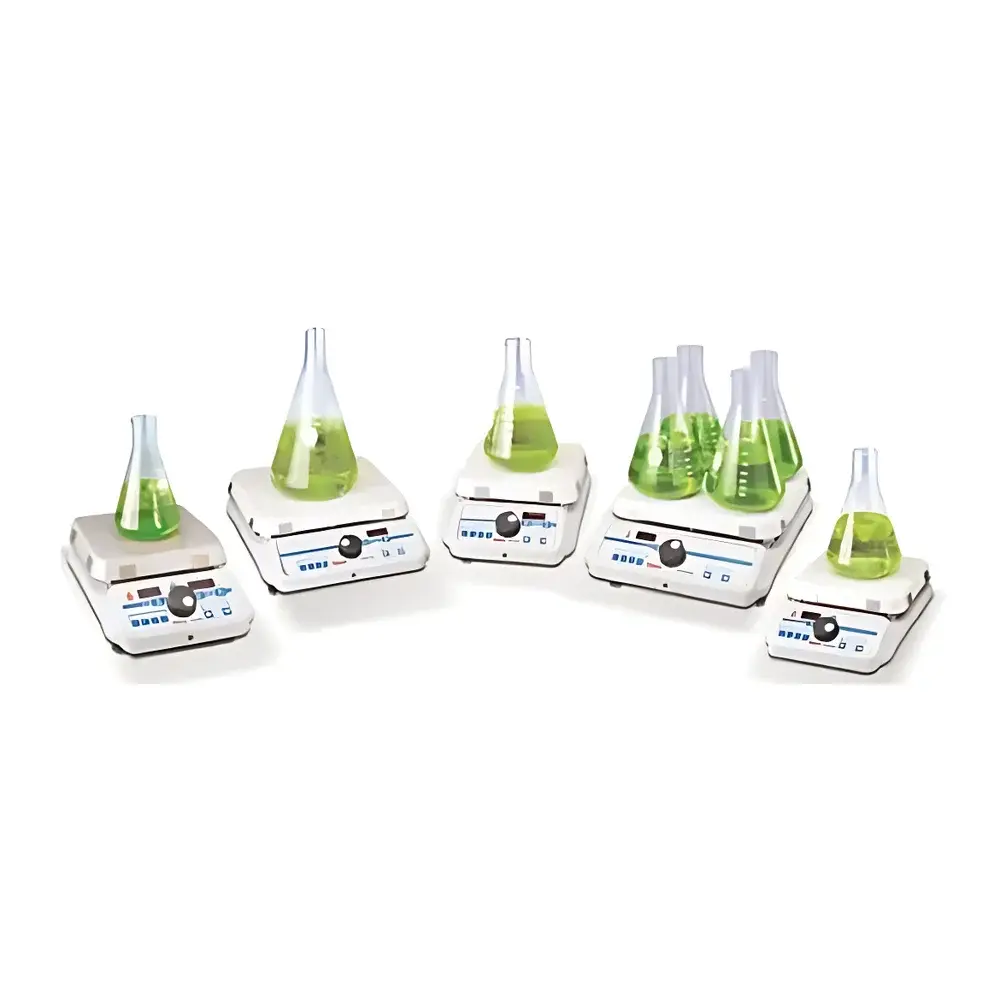
Thermo Scientific Super Nuova+ Series Hotplate Stirrer
| Brand | Thermo Fisher |
|---|---|
| Origin | Shanghai, China |
| Manufacturer Type | Original Equipment Manufacturer (OEM) |
| Product Category | Domestic |
| Model | Super Nuova+ |
| Instrument Type | Magnetic Hotplate Stirrer |
| Maximum Stirring Volume | 4 L / 6 L |
| Speed Range | 50–1500 rpm |
| Temperature Control Range | 30–300 °C / 400 °C / 450 °C |
| Panel Options | Ceramic or Anodized Aluminum |
| Standard Accessories | External Stainless Steel PT1000 Temperature Probe, Support Rod, Clamp Holder, LED Display, Integrated StirTrac Technology, Over-Temperature Alert (>50 °C Surface), Splash Guard (Optional), Assorted Stir Bars |
Overview
The Thermo Scientific Super Nuova+ Series Hotplate Stirrer is an engineered laboratory platform designed for precise, reproducible heating and magnetic stirring of liquid samples in research, quality control, and teaching laboratories. Utilizing a robust permanent magnet drive system coupled with PID-controlled resistive heating elements, the device delivers stable thermal output and consistent rotational torque across its operational range. Its dual-function architecture integrates independent control of temperature and stirring speed—enabling simultaneous, non-interfering regulation critical for applications such as dissolution testing, buffer preparation, enzymatic reactions, and polymerization kinetics. The unit’s thermally insulated housing and low-thermal-mass ceramic or anodized aluminum top plate ensure rapid heat-up times and minimal ambient heat dispersion, supporting energy-efficient operation in shared lab environments.
Key Features
- Independent dual-channel control: Real-time adjustment of heating temperature (30–300 °C standard; optional 400 °C / 450 °C variants) and stirring speed (50–1500 rpm) via intuitive front-panel interface
- StirTrac™ magnetic coupling technology: Optimized magnet geometry and motor feedback loop enable stable low-speed operation (down to 50 rpm) with high torque retention—even under viscous or dense sample conditions
- Integrated safety systems: Surface temperature overheat alert activates when top-plate exceeds 50 °C; automatic cut-off at preset maximum temperature limit; IP21-rated enclosure for dust resistance
- Modular accessory compatibility: Includes stainless steel PT1000 external probe with 0.1 °C resolution, universal support rod, adjustable clamp holder, and calibrated stir bars (PTFE-coated, PTFE/Alnico, and high-temp variants)
- Ergonomic panel design: Raised front bezel prevents accidental contact with hot surfaces and protects control electronics from splashes and spills; high-contrast LED display ensures legibility under varied lighting conditions
Sample Compatibility & Compliance
The Super Nuova+ accommodates standard laboratory glassware—including beakers (up to 6 L capacity), Erlenmeyer flasks, and jacketed reactors—without requiring custom adapters. Its uniform heating zone (Ø135 mm) and optimized magnetic field distribution ensure reliable stir-bar engagement across vessel geometries and fill levels. The system complies with IEC 61010-1:2010 for electrical safety in laboratory equipment and meets CE marking requirements for electromagnetic compatibility (EMC Directive 2014/30/EU). When operated with validated PT1000 probes and documented calibration protocols, it supports GLP-compliant workflows and can be integrated into IQ/OQ/PQ validation frameworks per ISO/IEC 17025 and FDA 21 CFR Part 11–aligned data management practices.
Software & Data Management
While the Super Nuova+ operates as a standalone analog/digital hybrid instrument, its external PT1000 probe output (0–10 V or 4–20 mA configurable) enables connection to third-party data loggers, SCADA systems, or LIMS platforms. Optional RS-232 or USB-to-serial interfaces (available via accessory module) support remote parameter setting, real-time monitoring, and timestamped event logging—including temperature ramp profiles, speed changes, and alarm triggers. Audit trail functionality—including operator ID tagging and parameter change history—is achievable when interfaced with compliant laboratory software meeting ALCOA+ principles (Attributable, Legible, Contemporaneous, Original, Accurate, Complete, Consistent, Enduring, Available).
Applications
- Pharmaceutical formulation development: Controlled heating/stirring during API solubilization, granulation binder preparation, and dissolution media conditioning
- Chemical synthesis: Reflux support, catalyst suspension, and homogeneous reagent mixing under inert atmosphere (with appropriate vessel sealing)
- Materials science: Precursor solution homogenization for sol-gel processing and nanoparticle dispersion
- Environmental testing: Extraction efficiency optimization in EPA Method 3510C (separation funnel technique) and soil leaching studies
- Academic instruction: Demonstrating Arrhenius kinetics, phase transition behavior, and mass transfer limitations in undergraduate physical chemistry labs
FAQ
What is the difference between the 300 °C, 400 °C, and 450 °C models?
The maximum operating temperature is determined by heater element rating and thermal insulation grade. The 300 °C variant uses standard ceramic insulation; 400 °C and 450 °C models incorporate high-purity alumina fiber insulation and reinforced magnet assemblies rated for extended high-temperature duty.
Can the Super Nuova+ be used with conductive or ferromagnetic vessels?
No. Only non-magnetic, diamagnetic, or paramagnetic containers (e.g., borosilicate glass, PTFE, quartz, or ceramic) are compatible. Stainless steel or iron-based vessels disrupt magnetic coupling and may damage the drive magnet.
Is calibration traceable to NIST standards?
Yes—when paired with a certified PT1000 probe calibrated against NIST-traceable reference standards (e.g., Fluke 724 or similar), full system temperature accuracy can be verified and documented per ISO/IEC 17025 requirements.
Does the unit support programmable temperature ramps?
The base model does not include multi-step ramp programming; however, external controllers (e.g., Eurotherm 2408 or LabVIEW-based DAQ systems) can be interfaced via analog output to execute linear or segmented temperature profiles.
What maintenance is required for long-term reliability?
Annual verification of temperature uniformity (per ASTM E2209), visual inspection of panel integrity, and cleaning of ventilation grilles with non-abrasive, alcohol-free wipes are recommended. No routine lubrication or internal component servicing is required due to brushless DC motor and solid-state relay architecture.



