
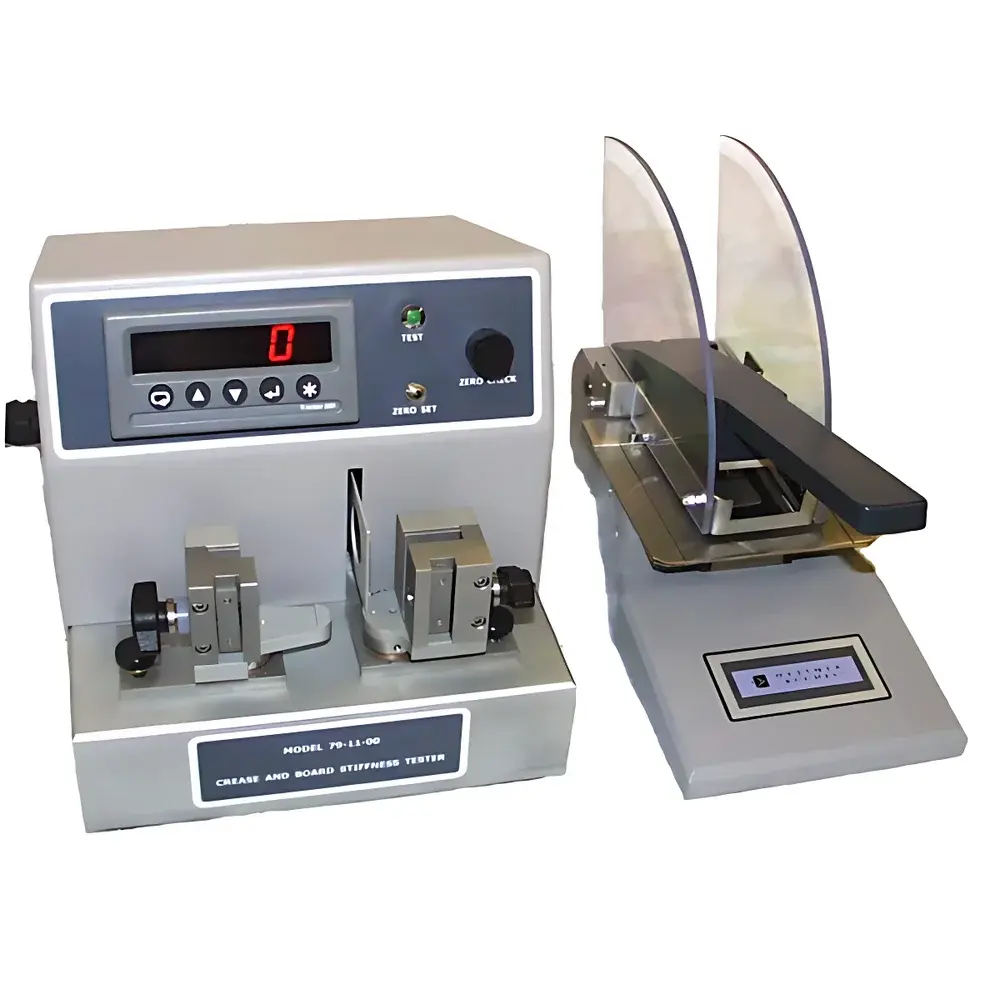
TMI Model 79-11-00 Crease Stiffness and Bending Resistance Tester
| Brand | TMI |
|---|---|
| Origin | USA |
| Model | 79-11-00 |
| Force Range | 0–399 gf |
| Display | 3-digit LCD |
| Crease Angle | 90° |
| Bend Angle (Stiffness) | 15° |
| Readout Time | 15 s |
| Resolution & Accuracy | ±1.0 gf |
| Power Supply | 240 V, 50 Hz |
| Fuse | 500 mA |
| Dimensions (Instrument) | 235 mm (H) × 180 mm (L) × 320 mm (W) |
| Dimensions (Packed) | 670 mm (H) × 550 mm (L) × 520 mm (W) |
| Weight (Instrument) | 11 kg |
| Weight (Packed) | 14 kg |
| Includes | Precision cutting blade and certified calibration weights |
Overview
The TMI Model 79-11-00 Crease Stiffness and Bending Resistance Tester is a precision mechanical instrument engineered for quantitative evaluation of two interdependent physical properties critical to folding carton performance: bending stiffness (also referred to as board挺度 in packaging engineering contexts) and crease resistance. It operates on the principle of controlled angular deflection under static load—applying a defined moment to a standardized specimen clamped at fixed geometry, then measuring the resulting force required to achieve prescribed bend (15°) or crease (90°) angles. This dual-mode measurement directly supports correlation with high-speed packaging line behavior, where mismatched stiffness-to-crease-force ratios are a primary root cause of misfolding, spring-back, edge curling, and adhesive bond failure. The instrument delivers traceable, repeatable force values in gram-force (gf), enabling calculation of the critical Stiffness-to-Crease Ratio (SCR)—a key process parameter specified in industry guidelines for carton design validation and press setup optimization.
Key Features
- Dual-function mechanical test platform calibrated for both bending stiffness (15° deflection) and crease resistance (90° fold) measurements on single- or multi-ply paperboard substrates
- High-repeatability analog loading mechanism with precision-machined fulcrum and lever arm geometry, ensuring consistent moment application per ASTM D6415 and TAPPI T 813 standards
- 3-digit LCD display with ±1.0 gf resolution and accuracy, providing immediate readout after 15-second stabilization period—aligned with typical dwell time in commercial creasing operations
- Integrated precision cutting blade for specimen preparation to exact dimensions (per ISO 5628 and TAPPI T 820), minimizing operator-induced variability
- Supplied with NIST-traceable calibration weights and documented verification procedure supporting GLP-compliant operation and internal audit readiness
- Compact benchtop footprint (235 × 180 × 320 mm) designed for integration into QC laboratories, R&D facilities, or pre-press evaluation stations without requiring environmental enclosures
Sample Compatibility & Compliance
The Model 79-11-00 accommodates standard test specimens cut from corrugated board, solid bleached sulfate (SBS), coated recycled board (CRB), and laminated carton stocks up to 3 mm thickness. Specimen width is fixed at 15 mm (per TAPPI T 813); length is adjustable to accommodate MD (machine direction) and CD (cross direction) testing. All measurements are conducted under controlled ambient conditions—typically 23 ± 1°C and 50 ± 2% RH—as mandated by ISO 187 and TAPPI T 402 for hygroscopic cellulose-based materials. Data generated satisfies input requirements for packaging line setup protocols compliant with ISO 2234 (folding box performance) and serves as objective evidence during FDA-regulated pharmaceutical packaging validation (21 CFR Part 211, Subpart F).
Software & Data Management
This is a standalone electromechanical tester with no embedded microprocessor or digital connectivity. All data acquisition is manual: operators record gf values directly from the LCD display into laboratory notebooks or LIMS-compatible spreadsheets. While no proprietary software is included, the instrument’s deterministic analog output and clearly defined test endpoints (15°/90° angular stops) ensure full compatibility with validated electronic data capture systems. Test records—including specimen ID, direction (MD/CD), measured force, calculated SCR, environmental log, and operator signature—meet ALCOA+ principles for data integrity when documented per SOPs aligned with ISO/IEC 17025 and 21 CFR Part 11 Annex 11 requirements for non-automated systems.
Applications
- Quantifying optimal crease depth vs. board basis weight relationships during pre-press die design
- Validating supplier board specifications against internal SCR targets (MD: 1.5–3.0; CD: 3.0–7.0)
- Troubleshooting recurring folding defects—e.g., “dog-earing,” “wing lift,” or glue-starved flaps—in pharmaceutical blister packaging lines
- Supporting root-cause analysis for carton collapse during palletized transport (ASTM D4169)
- Generating comparative datasets for board substitution studies involving recycled fiber blends or bio-based coatings
- Training packaging engineers on the mechanical basis of fold geometry tolerance limits
FAQ
Is the Model 79-11-00 compliant with international packaging testing standards?
Yes—it conforms to the geometric and procedural requirements of TAPPI T 813 (Crease Resistance), ASTM D6415 (Bending Resistance of Paperboard), and ISO 5628 (Determination of Bending Stiffness).
Can this instrument measure both machine direction (MD) and cross direction (CD) properties?
Yes—specimens are cut and oriented explicitly for uniaxial testing in either MD or CD; results are reported separately to compute directional SCR values.
What environmental controls are required during testing?
Testing must be performed in a conditioned room meeting ISO 187:2022 specifications (23 ± 1°C, 50 ± 2% RH) with acclimation of specimens for ≥24 hours prior to measurement.
Does the unit include calibration documentation?
Yes—a certificate of conformance and step-by-step verification protocol using supplied NIST-traceable weights are provided with each shipment.
Is operator training available from TMI or authorized distributors?
TMI offers optional on-site or virtual technical training covering specimen preparation, angle alignment verification, force interpretation, and SCR-based process adjustment logic.
Related Products






