
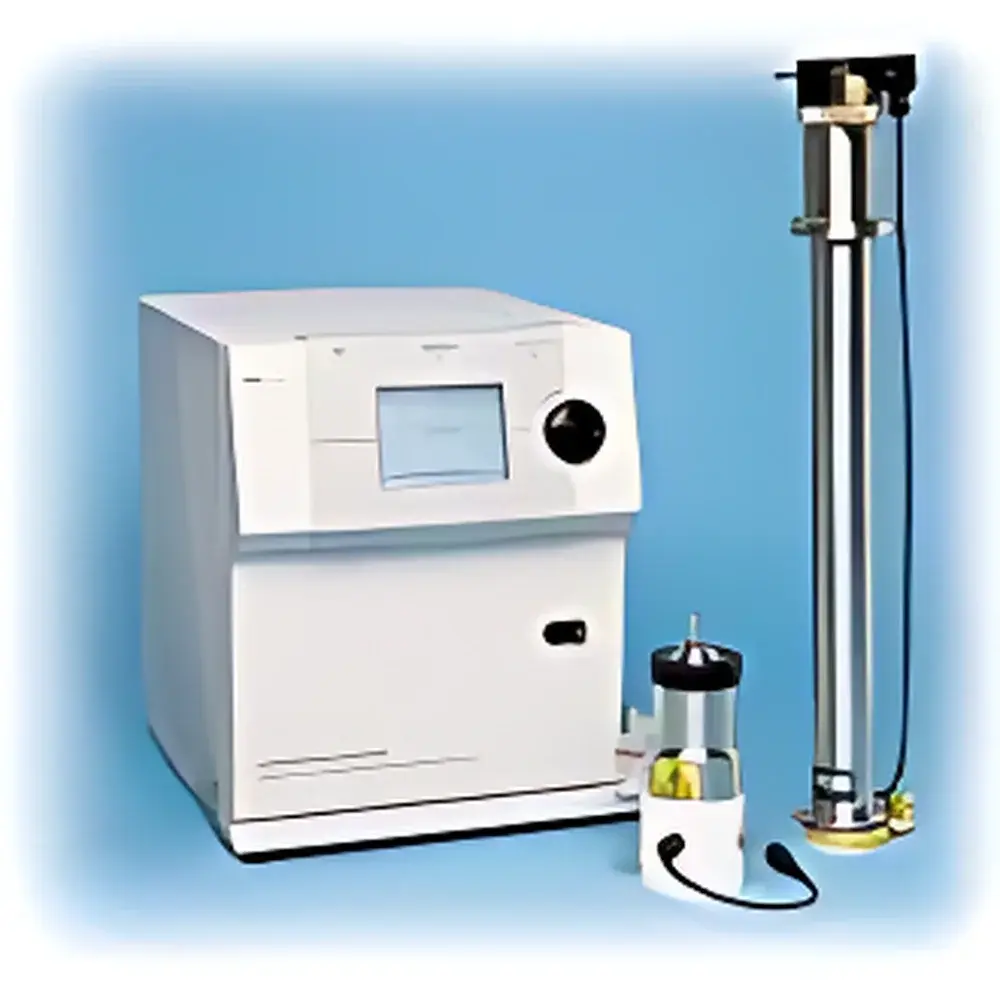
TSI Model 3080 Electrostatic Aerosol Classifier
| Origin | USA |
|---|---|
| Manufacturer Type | Authorized Distributor |
| Origin Category | Imported |
| Model | 3080 |
| Pricing | Available Upon Request |
| Particle Type | Solid or Non-Volatile Liquid |
| Size Range (3080L) | 10–1000 nm |
| Size Range (3080N) | 2–150 nm |
| Max Concentration | 1 × 10⁸ #/cm³ |
| Aerosol Flow Rate | 0.2–3 L/min (model-dependent) |
| Sheath Gas Flow Rate | 2–20 L/min (model-dependent) |
| Operating Temperature | 7–43 °C |
| Operating Pressure | 1 ± 0.2 atm |
Overview
The TSI Model 3080 Electrostatic Aerosol Classifier is a precision differential mobility analyzer (DMA) engineered for the generation and selection of monodisperse aerosol particles in the sub-1000 nm size range. Based on the principle of differential electrical mobility, the 3080 applies a controlled electric field across a laminar sheath gas flow to separate charged particles by their electrical mobility diameter—directly traceable to fundamental physical constants. This enables highly reproducible, NIST-traceable particle sizing with resolution sufficient for metrological-grade calibration of nanoparticle sizers (e.g., SMPS, CPCs), reference material generation, and fundamental studies of nanoparticle behavior. Unlike optical or inertial classification methods, electrostatic classification provides absolute size assignment independent of particle composition, refractive index, or density—making it the gold standard for primary aerosol metrology.
Key Features
- Modular dual-classifier platform supporting interchangeable 3080L (10–1000 nm) and 3080N (2–150 nm) classifier columns—enabling seamless transition between broad-range and ultrafine-resolution operation
- Stable, continuous monodisperse aerosol output with size distribution half-widths <10% at 100 nm and <15% at 10 nm, validated per ISO 27891 and ASTM D8196 guidelines
- Integrated high-voltage power supply with active feedback control, ensuring drift <±0.1% over 8-hour operation
- Temperature- and pressure-compensated flow control system maintaining laminar, fully developed sheath flow profiles across full operating ranges (7–43 °C, 1 ± 0.2 atm)
- Robust stainless-steel and electropolished aluminum construction compliant with ISO 14644-1 Class 5 cleanroom handling requirements
- Compatible with upstream chargers (e.g., TSI 3085, 3077) and downstream detectors including CPCs (3776, 3772), APS (3321), and SMPS+ systems
Sample Compatibility & Compliance
The Model 3080 accepts solid particles (e.g., PSL, silver, silica, carbon black) and non-volatile liquid aerosols (e.g., dioctyl sebacate, squalane) generated via atomization, evaporation–condensation, or electrospray. It does not support volatile or semi-volatile organics prone to evaporation under low-pressure or elevated-temperature conditions. The instrument meets essential requirements for GLP-compliant aerosol metrology workflows: all operational parameters—including voltage, flow rates, temperature, and pressure—are logged with timestamped audit trails. When integrated into an SMPS configuration, the complete system supports 21 CFR Part 11–compliant electronic records when paired with TSI’s Aerosol Instrument Manager (AIM) v10.2 or later. Calibration protocols align with NIST SP 800-142 and ISO/IEC 17025:2017 for testing and calibration laboratories.
Software & Data Management
The 3080 operates natively within TSI’s Aerosol Instrument Manager (AIM) software suite, which provides real-time voltage–mobility mapping, automated ramping sequences, and batch-mode classification protocols. AIM exports fully annotated data in HDF5 and CSV formats, including raw voltage settings, measured flows, environmental conditions, and calculated mobility diameters with propagated uncertainty estimates (per GUM Supplement 1). All configuration files are digitally signed and version-controlled. Remote monitoring and parameter adjustment are supported via secure TLS 1.2–encrypted Ethernet or USB-C interfaces. Data integrity is enforced through cyclic redundancy checks (CRC-32) on all saved sessions, and system logs retain ≥90 days of operational history without manual intervention.
Applications
- Primary calibration of condensation particle counters (CPCs), scanning mobility particle sizers (SMPS), and optical particle sizers (OPS) using NIST-traceable monodisperse standards
- Fundamental investigation of nanoparticle charging efficiency, coagulation kinetics, and surface charge dynamics in the 2–1000 nm regime
- Generation of challenge aerosols for filter efficiency testing (e.g., EN 1822, ISO 29463) and respirator certification (NIOSH 42 CFR Part 84)
- Controlled synthesis of nanostructured powders via classified electrospray deposition, enabling reproducible thin-film fabrication
- Validation of computational fluid dynamics (CFD) models for electrostatic precipitation and aerosol transport in microfluidic channels
- Reference aerosol generation for inter-laboratory comparison studies under ISO/REMCO frameworks
FAQ
What particle size ranges does the Model 3080 support?
The 3080L configuration covers 10–1000 nm; the 3080N extends down to 2 nm, with optimal resolution below 50 nm.
Can the 3080 classify volatile organic compounds (VOCs)?
No—it is designed exclusively for solid particles and non-volatile liquids. Volatile species will evaporate during classification, compromising size fidelity.
Is NIST traceability built into the instrument?
Yes—electrical mobility calibration is traceable to SI units via NIST-certified high-voltage dividers and mass flow meters calibrated to NIST SRM 2800 and SRM 2802.
How is sheath-to-aerosol flow ratio maintained across varying operating conditions?
Through independent thermal mass flow controllers with closed-loop PID regulation and real-time cross-sensitivity compensation for temperature and pressure deviations.
Does the 3080 require periodic recalibration?
Annual verification against NIST-traceable reference standards is recommended; TSI provides documented procedures and uncertainty budgets per ISO/IEC 17025.
Related Products







