
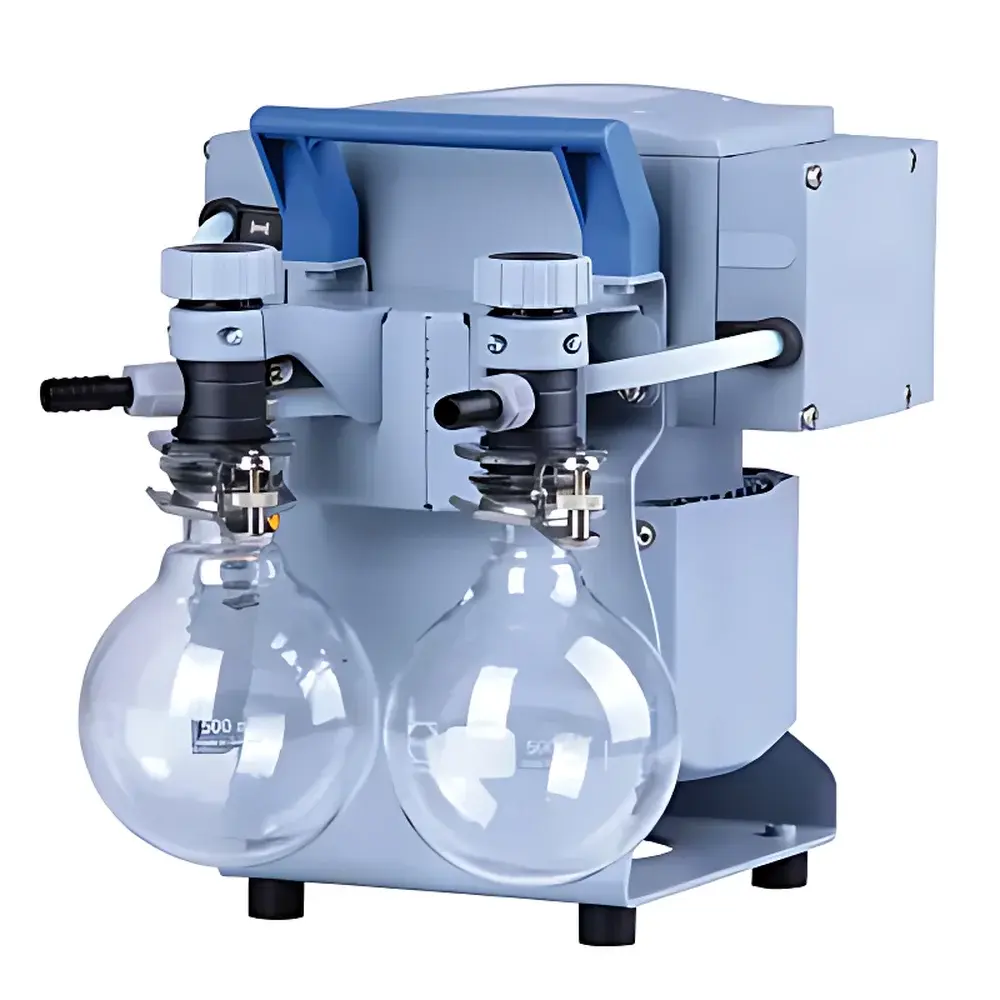
VACUUBRAND® ME 4C NT+2AK Chemical Vacuum System
| Brand | VACUUBRAND® |
|---|---|
| Origin | Germany |
| Model | ME 4C NT+2AK |
| Pump Stages | 2 / 1 |
| Max. Pumping Speed (50/60 Hz) | 3.9 / 4.3 m³/h |
| Max. Pumping Speed (50/60 Hz) | 2.3 / 2.5 cfm |
| Ultimate Vacuum (abs.) | 70 mbar / 52 torr |
| Operating Ambient Temp. | 10–40 °C |
| Storage Temp. | −10–60 °C |
| Max. Exhaust Pressure (abs.) | 1.1 bar |
| Inlet/Outlet Port | DN 10 mm hose nozzle |
| Rated Motor Power | 0.18 kW |
| Rated Speed (50/60 Hz) | 1500 / 1800 min⁻¹ |
| IP Rating | IP 40 |
| Dimensions (L×W×H) | 316 × 242 × 291 mm |
| Weight | 13.6 kg |
| Sound Pressure Level (50 Hz, typical) | 45 dBA |
| Certifications | NRTL (US/Canada), ATEX II 3G IIC T3 X (230 V only), Internal Atmosphere Only |
| Voltage/Frequency Options | 200–230 V~ 50–60 Hz |
| Connector | IEC 60320 C14 |
Overview
The VACUUBRAND® ME 4C NT+2AK Chemical Vacuum System is a two-stage, oil-free diaphragm vacuum pump engineered for robust performance in demanding laboratory environments where chemical compatibility, vapor tolerance, and long-term reliability are critical. Unlike rotary vane or scroll pumps, the ME 4C NT employs a chemically inert PTFE-coated diaphragm and elastomer-free valve system—ensuring exceptional resistance to aggressive solvents, acidic vapors, and condensable organic steam. Its ultimate vacuum of 70 mbar (52 torr) enables efficient operation across a wide range of low-to-medium vacuum applications, including solvent evaporation, vacuum drying, filtration, and concentration of heat-sensitive compounds. The integrated dual-capture design—featuring an inlet AK separator bottle (borosilicate glass with protective polymer sleeve) and an exhaust-side condensate trap—prevents liquid ingress, protects internal components from corrosion and mechanical damage, and significantly reduces operational noise and vibration. Designed and manufactured in Germany to DIN EN ISO 9001 standards, this system meets stringent requirements for GLP-compliant laboratories and supports audit-ready documentation workflows.
Key Features
- Chemically resistant PTFE-coated diaphragm and FKM-free valve assembly for extended service life under exposure to halogenated, polar, and protic solvents
- Two-stage diaphragm architecture delivering stable pumping speed up to 4.3 m³/h (60 Hz) with minimal pulsation and high reproducibility
- Dual-phase separation: inlet AK bottle captures aerosols and droplets before they reach the pump head; exhaust-side condensate trap prevents backflow and dampens acoustic emissions
- Compact footprint (316 × 242 × 291 mm) and low mass (13.6 kg) enable flexible benchtop integration without structural reinforcement
- Ultra-quiet operation at 45 dBA (50 Hz, measured at 1 m) and near-zero vibration—critical for sensitive instrumentation such as balances, microscopes, or analytical balances in shared lab spaces
- IP 40-rated motor housing provides protection against solid ingress while maintaining thermal stability across ambient temperatures from 10–40 °C
Sample Compatibility & Compliance
The ME 4C NT+2AK is validated for continuous duty with vapors generated during rotary evaporation of acetone, ethyl acetate, dichloromethane, methanol, and other low-boiling solvents (bp < 100 °C). It is not intended for use with highly oxidizing agents (e.g., concentrated nitric acid fumes), unsaturated hydrocarbons above 200 °C, or vacuum distillation requiring ultimate pressures below 10 mbar. The system complies with NRTL safety certification for both U.S. and Canadian markets and carries ATEX certification (II 3G IIC T3 X) for non-hazardous internal atmospheres when operated at 230 V. All electrical components conform to IEC 61000-6-3 (EMC emission) and IEC 61000-6-2 (immunity) standards. As a Class B laboratory device, it supports adherence to ISO/IEC 17025 quality management systems and facilitates traceability under FDA 21 CFR Part 11–aligned data integrity protocols when paired with compatible digital controllers.
Software & Data Management
While the ME 4C NT+2AK operates as a standalone analog unit, its standardized IEC 60320 C14 inlet enables seamless integration with third-party vacuum controllers (e.g., VACUUBRAND’s VARIO® series or LabVIEW-compatible PID modules) for real-time pressure monitoring, ramped evacuation profiles, and automated endpoint detection. Optional analog output (0–10 V) and digital RS-485 interface support logging of runtime, motor temperature, and vacuum level into LIMS or ELN platforms. All firmware updates and calibration records are maintained per ISO/IEC 17025 Annex A.3 requirements, and audit trails for maintenance events—including separator bottle replacement intervals and diaphragm service cycles—are retained for GLP/GMP compliance.
Applications
- Vacuum drying of hygroscopic or thermolabile samples in ovens and desiccators
- Single- or multi-position Büchner and Hirsch filtration setups with aqueous or organic filtrates
- Routine concentration of reaction mixtures and natural product extracts via rotary evaporation
- Preparation of air- and moisture-sensitive samples prior to XRD, SEM, or TGA analysis
- Support vacuum for cold traps, Schlenk lines, and glovebox antechambers where oil contamination must be avoided
FAQ
Can the ME 4C NT+2AK be used for high-vacuum applications such as freeze-drying?
No. With an ultimate vacuum of 70 mbar, it is optimized for rough vacuum processes—not primary pumps for lyophilization, which typically require ≤0.1 mbar.
Is the AK separator bottle autoclavable?
The borosilicate glass AK bottle is autoclavable at 121 °C; however, the protective polymer sleeve must be removed prior to sterilization.
What maintenance intervals are recommended for continuous operation?
Diaphragm replacement is advised every 6,000 operating hours or annually, whichever occurs first; inlet and exhaust separators should be inspected and cleaned after each solvent-intensive run.
Does the system include vacuum gauge capability?
No—vacuum measurement requires an external analog or digital gauge (e.g., VACUUBRAND’s VACUU·SELECT or DIGIVAC series), connected via standard DN 10 port.
Can the pump be mounted vertically or inverted?
Mounting orientation must remain horizontal per manufacturer specifications to ensure proper diaphragm actuation and condensate drainage; vertical installation voids warranty and compromises performance.



