
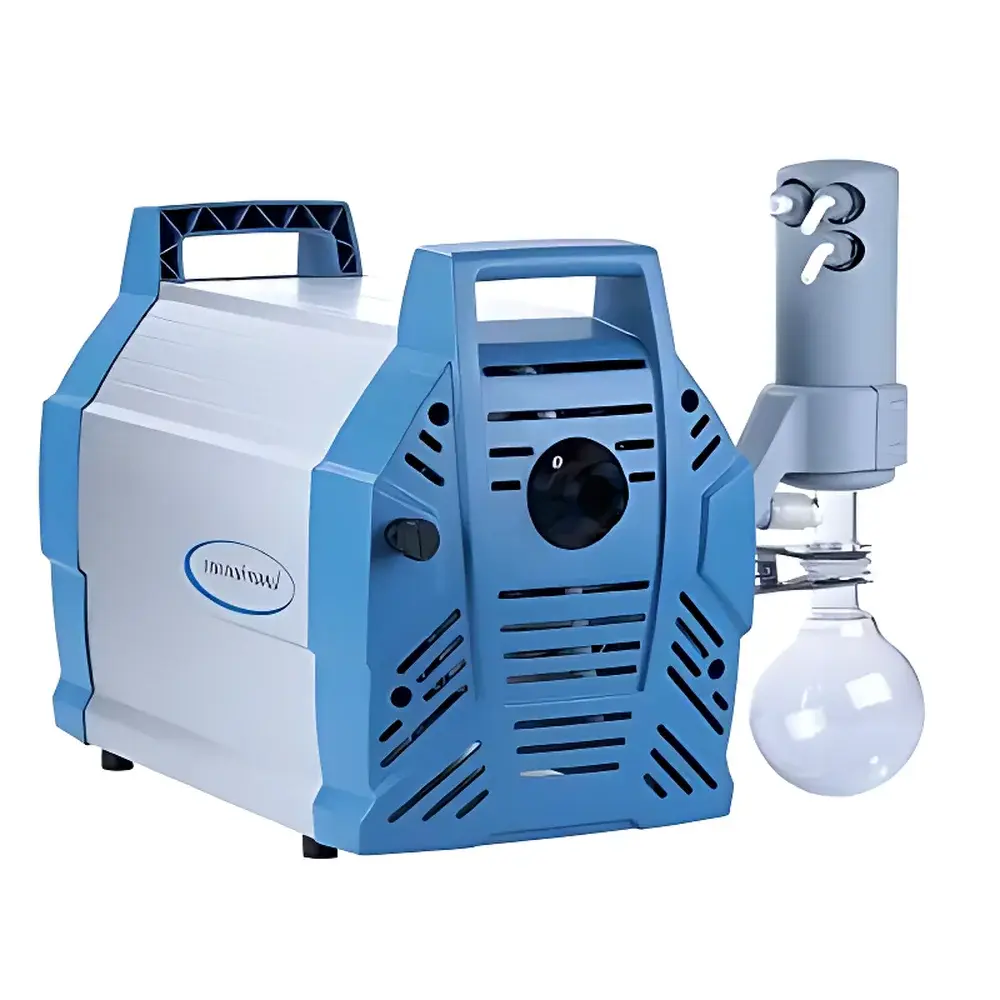
VACUUBRAND MV 10C NT+EK Chemical-Resistant Four-Stage Diaphragm Vacuum Pump
| Brand | VACUUBRAND® |
|---|---|
| Origin | Germany |
| Model | MV 10C NT+EK |
| Pump Stages | 4 |
| Pump Heads | 8 |
| Max. Pumping Speed (50/60 Hz) | 9.5 / 10.7 m³/h |
| Ultimate Pressure (abs.) | 0.9 mbar |
| Ultimate Pressure with Gas Ballast | 1.5 mbar |
| Motor Power | 0.44 kW |
| Motor Speed (50/60 Hz) | 1500 / 1800 min⁻¹ |
| Inlet Port | KF DN 25 |
| Exhaust Port | DN 10 mm hose nozzle |
| Cooling Water Connections | 2 × DN 6–8 mm |
| Operating Temp. Range | 10–40 °C |
| Noise Level (50 Hz, typical) | 52 dBA |
| IP Rating | IP 40 |
| Dimensions (L×W×H) | 528 × 387 × 395 mm |
| Weight | 29.1 kg |
| ATEX Certification (230 V only) | II 3G IIC T3 X, Internal Atmosphere Only |
Overview
The VACUUBRAND MV 10C NT+EK is a four-stage, oil-free diaphragm vacuum pump engineered specifically for demanding chemical laboratory applications involving aggressive vapors, corrosive gases, and solvent-laden exhaust streams. Its design follows the fundamental principle of positive displacement via elastomeric diaphragm oscillation—each stage progressively compresses and evacuates gas through sequential chambers, achieving high ultimate vacuum while maintaining chemical inertness across all wetted surfaces. Unlike rotary vane or scroll pumps, this system eliminates lubricant contamination risk and avoids hydrocarbon backstreaming—critical for solvent recovery, distillation, freeze-drying, and vacuum filtration where sample purity and operator safety are paramount. The MV 10C NT+EK integrates an integrated exhaust condenser (EK) to capture volatile organic compounds prior to atmospheric release, significantly reducing emissions and supporting compliance with ISO 14001 environmental management frameworks and local VOC emission regulations.
Key Features
- Four-stage architecture with eight diaphragm heads delivering high volumetric throughput (up to 10.7 m³/h at 60 Hz) without sacrificing ultimate vacuum performance (0.9 mbar absolute)
- Chemically resistant wetted materials: All fluid-contact components—including diaphragms, valves, and chamber housings—are constructed from fluoropolymers (PTFE, FEP, PTFE-reinforced composites), ensuring long-term stability against halogenated solvents, acids, bases, and peroxides
- PTFE “sandwich” diaphragm design enhances fatigue resistance and extends service life under continuous operation with condensable vapors
- Integrated EK exhaust condenser enables efficient solvent recovery (>90% typical capture efficiency for acetone, ethanol, ethyl acetate), reducing disposal costs and environmental footprint
- Gas ballast valve allows controlled admission of dry air during pump-down to purge condensates—maintaining stable ultimate pressure even during wet operation
- Low-noise (52 dBA at 50 Hz) and low-vibration operation suitable for shared lab environments and sensitive instrumentation setups
- IP 40-rated enclosure provides protection against solid ingress; optional cooling water connections support extended duty cycles in elevated ambient temperatures
Sample Compatibility & Compliance
The MV 10C NT+EK is validated for use with a broad spectrum of chemically aggressive media, including but not limited to HCl(g), Cl₂, SO₂, NOₓ, chlorinated hydrocarbons, esters, ketones, and alcohols. Its fluoropolymer construction meets ASTM D543 requirements for resistance to chemical attack. The pump complies with EU Machinery Directive 2006/42/EC and Electromagnetic Compatibility Directive 2014/30/EU. For installations in potentially explosive atmospheres, the 230 V variant carries ATEX certification (II 3G IIC T3 X) for internal atmosphere use only—requiring external zone classification verification per EN 60079-10-1. It supports GLP-compliant workflows when paired with traceable calibration records and maintenance logs.
Software & Data Management
While the MV 10C NT+EK operates as a standalone analog device, it is fully compatible with third-party vacuum monitoring systems via its standard 0–10 V analog output (optional accessory). When integrated into automated platforms (e.g., LabVIEW, DeltaV, or Siemens Desigo), real-time pressure feedback, motor current draw, and runtime hours can be logged for preventive maintenance scheduling and audit readiness. The included user manual documents full traceability of component lot numbers, material certifications (e.g., FDA-compliant PTFE per 21 CFR 177.1550), and factory test reports—enabling alignment with FDA 21 CFR Part 11 data integrity expectations where electronic records are employed.
Applications
- Vacuum distillation and fractional evaporation of acid-sensitive or oxidation-prone compounds
- Solvent removal in API synthesis and fine chemical purification under inert atmosphere control
- Freeze-drying of biologics and pharmaceutical intermediates requiring hydrocarbon-free vacuum
- Rotary evaporation with high-boiling-point solvents (e.g., DMF, DMSO) where condensate load exceeds standard pump capacity
- Gas scavenging in Schlenk line manifolds and glovebox antechambers handling pyrophoric reagents
- Environmental testing chambers requiring stable sub-1 mbar vacuum with minimal outgassing contribution
FAQ
What types of solvents can the EK condenser effectively recover?
The EK unit achieves >90% condensation efficiency for common laboratory solvents with boiling points above 30 °C (e.g., methanol, ethanol, acetone, ethyl acetate, toluene) when operated with cooling water at ≤15 °C.
Is the pump suitable for continuous 24/7 operation?
Yes—when ambient temperature remains within 10–40 °C and cooling water flow is maintained (if installed), the MV 10C NT+EK is rated for indefinite duty cycle per DIN EN 60034-1.
Can it be used with reactive gases like chlorine or hydrogen sulfide?
Yes—the fluoropolymer wetted path provides documented compatibility with Cl₂, H₂S, NH₃, and HBr per VACUUBRAND’s Material Compatibility Guide v.4.2 (2023).
Does the pump require periodic oil changes or lubrication?
No—this is a completely oil-free, maintenance-free diaphragm pump. Only diaphragm and valve replacement is required per manufacturer’s service schedule (typically every 12–18 months under normal lab use).
How is vacuum level monitored and controlled in automated systems?
Via optional analog output (0–10 V proportional to vacuum level) or integration with digital pressure transducers (e.g., VACUUBRAND VD 100 series) using RS485 Modbus RTU protocol.
Related Products



