
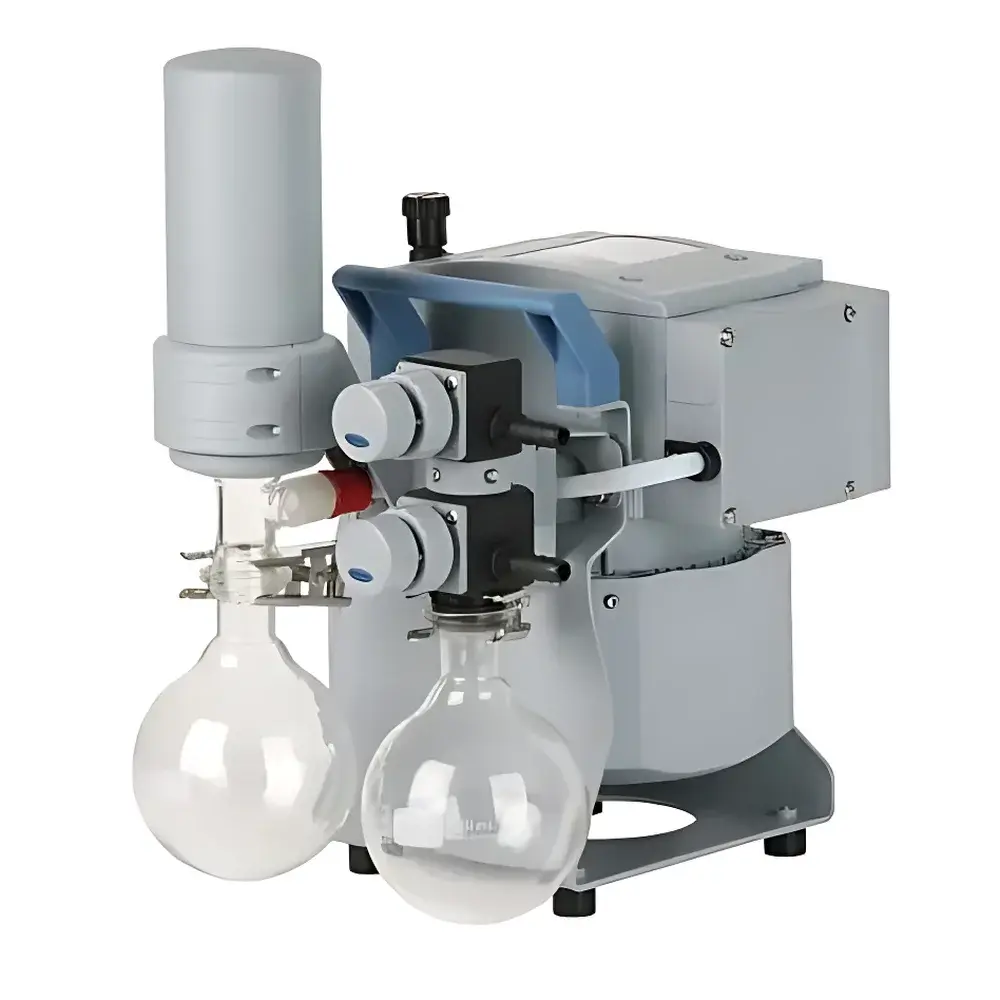
VACUUBRAND MZ 2C NT + AK SYNCHRO + EK Chemical Vacuum System
| Brand | VACUUBRAND® |
|---|---|
| Origin | Germany |
| Pump Type | Dual-Stage Diaphragm Vacuum Pump |
| Motor Power | 0.18 kW |
| Max. Pumping Speed (50/60 Hz) | 2.0 / 2.3 m³/h |
| Ultimate Vacuum (Absolute) | 7 / 5 mbar (torr) |
| Ultimate Vacuum with Gas Ballast | 12 / 9 mbar (torr) |
| Inlet Ports | 2 × DN 10 mm hose nozzles |
| Exhaust Port | DN 10 mm hose nozzle |
| Cooling Water Connections | 2 × DN 6–8 mm |
| Noise Level (50 Hz, typical) | 45 dBA |
| Dimensions (L×W×H) | 326 × 248 × 402 mm |
| Weight | 14.5 kg |
| Ambient Operating Temperature | 10–40 °C |
| IP Rating | IP 40 |
| Certifications | NRTL (US/Canada), ATEX II 3G IIC T3 X (230 V only) |
Overview
The VACUUBRAND MZ 2C NT + AK SYNCHRO + EK is a fully integrated, oil-free chemical vacuum system engineered for high-reliability operation in demanding laboratory environments. Based on dual-stage diaphragm pump architecture, it delivers robust vacuum performance without lubricating oils—eliminating risk of contamination, hydrocarbon backstreaming, or maintenance downtime associated with rotary vane pumps. Its core design adheres to the fundamental principles of positive displacement vacuum generation: two synchronized diaphragm stages compress and expel gas molecules sequentially, achieving deep ultimate vacuum while maintaining chemical resistance across aggressive vapors and condensable solvents. The system is purpose-built for parallel vacuum applications—including simultaneous operation of rotary evaporators, vacuum concentrators, and desiccators—without cross-interference between channels. Integrated gas ballast functionality enables stable operation under high solvent load conditions, preserving ultimate vacuum integrity even during prolonged solvent removal cycles.
Key Features
- Dual independent inlet ports (DN 10 mm), each equipped with manually adjustable flow control valves for precise regulation of effective pumping speed per application
- Integrated glass inlet separator (AK) with protective polymer coating—designed to capture particulates and aerosolized liquid droplets before they reach the pump head, extending service life and ensuring consistent performance
- High-efficiency exhaust condenser (EK) with compact, multi-pass internal geometry—achieves >95% solvent recovery under standard operating conditions, minimizing volatile organic compound (VOC) emissions and supporting solvent reuse protocols
- Synchronized dual-stage diaphragm drive mechanism ensures low vibration, reduced mechanical wear, and long-term repeatability of vacuum setpoints
- Gas ballast valve allows continuous operation in the presence of condensable vapors while maintaining stable base pressure—critical for evaporation of acetone, ethyl acetate, dichloromethane, and other common organic solvents
- IP 40-rated enclosure provides protection against solid objects ≥1 mm; optimized for ambient lab environments (10–40 °C operational range)
Sample Compatibility & Compliance
The MZ 2C NT + AK SYNCHRO + EK is constructed using chemically inert materials—including PTFE-coated diaphragms, EPDM elastomers, and borosilicate glass components—to ensure compatibility with acidic, basic, and halogenated vapors. It complies with NRTL safety certification standards for both U.S. and Canadian markets and meets ATEX Directive 2014/34/EU classification II 3G IIC T3 X for use in potentially explosive atmospheres (230 V version only). While not intrinsically rated for Zone 0/1, its sealed architecture and absence of ignition sources make it suitable for general laboratory use under GLP-compliant workflows. The system supports audit-ready documentation practices when integrated into regulated environments governed by FDA 21 CFR Part 11 or ISO/IEC 17025 requirements—particularly where solvent recovery metrics, vacuum stability logs, and preventive maintenance records are required.
Software & Data Management
This model operates as a standalone hardware system with no embedded digital controller or data logging interface. However, its analog operational parameters—including stable vacuum levels, consistent noise signature (<45 dBA at 50 Hz), and predictable thermal profile—enable seamless integration with third-party process monitoring systems via external pressure transducers and programmable logic controllers (PLCs). When deployed alongside VACUUBRAND’s optional VARIO control modules or compatible LabVIEW-based acquisition platforms, users can log vacuum profiles, track cumulative runtime, and correlate solvent recovery efficiency with batch-specific process parameters—supporting continuous improvement initiatives aligned with Lean Lab and ISO 55001 asset management frameworks.
Applications
- Simultaneous vacuum support for rotary evaporation (e.g., Büchi R-300, IKA RV 10) and vacuum drying (e.g., Binder VD series, Memmert VO series)
- Solvent removal in preparative HPLC fraction collection and lyophilization pre-concentration steps
- Controlled degassing of polymer solutions, adhesives, and resin formulations prior to casting or curing
- Vacuum-assisted filtration in analytical sample preparation workflows compliant with EPA Method 3510C or ASTM D5907
- Environmental chemistry labs requiring VOC containment and solvent recycling per ISO 14001 environmental management system criteria
FAQ
Can this system operate continuously for extended periods (e.g., overnight solvent evaporation)?
Yes—the MZ 2C NT is rated for continuous duty under specified ambient conditions (10–40 °C) and exhibits thermal stability verified through IEC 61000-3-2 harmonic emission testing.
Is the AK separator interchangeable with other VACUUBRAND models?
The AK unit is mechanically and dimensionally compatible with all MZ 2C-series vacuum systems utilizing DN 10 mm inlet configurations.
Does the EK condenser require periodic cleaning or maintenance?
Routine inspection every 200 operating hours is recommended; condensate collection vessels should be emptied before reaching 80% capacity to maintain optimal heat exchange efficiency.
What is the expected service interval for diaphragm replacement?
Under typical laboratory usage (≤8 h/day, moderate solvent load), diaphragm assemblies retain functional integrity for ≥12,000 hours—validated per DIN EN ISO 9001 calibration traceability protocols.
Can the system be used with corrosive gases such as HCl or Cl₂?
While chemically resistant, prolonged exposure to highly reactive halogen gases exceeds the validated material compatibility envelope; consult VACUUBRAND’s Chemical Resistance Guide (CRG-2023) for specific concentration and temperature limits.



