
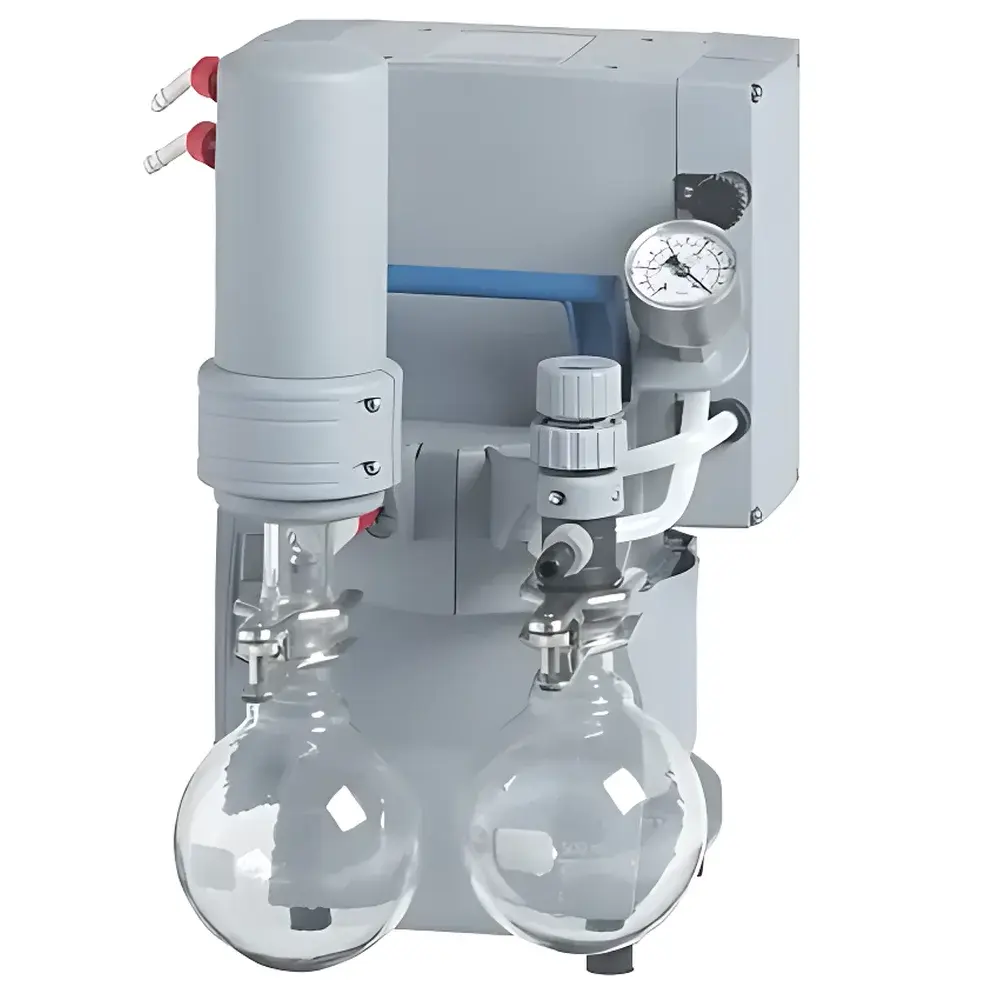
VACUUBRAND PC 201 NT Chemical Vacuum System
| Brand | VACUUBRAND® |
|---|---|
| Country of Origin | Germany |
| Model | PC 201 NT |
| Pump Stages | 4-stage / 3-stage |
| Max. Pumping Speed (50/60 Hz) | 3.4 / 3.8 m³/h |
| Ultimate Vacuum (absolute, without gas ballast) | 1.5 / 1.1 mbar |
| Ultimate Vacuum (absolute, with gas ballast) | 3 / 2.2 mbar |
| Motor Power Rating | 0.25 kW |
| Rated Speed (50/60 Hz) | 1500 / 1800 rpm |
| Inlet/Outlet Port | DN 10 mm hose nozzle |
| Cooling Water Connections | 2 × DN 6–8 mm |
| Operating Temperature Range | 10–40 °C |
| Storage Temperature Range | −10–60 °C |
| Noise Level (50 Hz, typical) | 45 dBA |
| IP Rating | IP 40 |
| Dimensions (L×W×H) | 326 × 243 × 402 mm |
| Weight | 17.5 kg |
| Certifications | NRTL (US/Canada), ATEX II 3G IIC T3 X (230 V only), Internal Atmosphere Only |
Overview
The VACUUBRAND PC 201 NT Chemical Vacuum System is a purpose-engineered, oil-sealed rotary vane vacuum pump designed for demanding chemical laboratory applications requiring high chemical resistance, reliable solvent vapor handling, and stable vacuum performance across extended operation cycles. Built on a robust 4-stage / 3-stage compression architecture, the PC 201 NT delivers consistent ultimate vacuum levels down to 1.5 mbar (absolute) without gas ballast—and maintains functional stability even under continuous exposure to aggressive vapors from high-boiling-point solvents such as DMSO, DMF, ethylene glycol, or chlorinated hydrocarbons. Its sealed oil circulation system, combined with integrated gas ballast functionality, enables operation in chemically aggressive environments while preserving long-term pump integrity and minimizing oil degradation. The system is optimized for integration with rotary evaporators, vacuum concentrators, freeze dryers, and vacuum drying ovens—particularly where solvent recovery efficiency, operator safety, and regulatory compliance are critical.
Key Features
- Chemically resistant construction: All wetted parts—including pump housing, vanes, and internal seals—are engineered from materials compatible with common organic solvents, acids, and bases.
- Integrated gas ballast valve: Allows controlled admission of ambient air into the compression chamber to reduce condensable vapor load, enabling stable operation at higher ultimate pressures (3 mbar absolute) when handling saturated solvent vapors.
- Dual-stage solvent recovery: Equipped with a borosilicate glass separator bottle (with protective outer sleeve) at the inlet to trap entrained droplets and particulates, plus an external coolant-cooled condenser at the exhaust that achieves up to 98–100% solvent capture efficiency under optimal cooling conditions.
- Manual vacuum regulation: Precision needle valve allows fine-tuned control of effective suction speed at the vacuum port, facilitating reproducible process conditions during distillation or concentration steps.
- Analog vacuum monitoring: Front-mounted mechanical pressure gauge provides real-time, drift-free indication of absolute vacuum level without reliance on electronic calibration or battery power.
- Low-noise, low-vibration design: Optimized motor-pump coupling and vibration-damping feet ensure stable mounting on lab benches and compatibility with sensitive instrumentation.
Sample Compatibility & Compliance
The PC 201 NT is validated for use with non-explosive, non-toxic, and non-radioactive chemical vapors encountered in standard synthetic, analytical, and pharmaceutical R&D workflows. It complies with NRTL requirements for electrical safety in both U.S. and Canadian markets (UL/cUL listed). For installations in potentially explosive atmospheres, the 230 V variant carries ATEX certification (II 3G IIC T3 X), indicating suitability for Zone 2/22 environments—though it is explicitly rated for internal atmosphere use only and must not be installed in hazardous zones without additional engineering controls. The unit meets IP40 ingress protection standards and operates reliably within GLP-compliant laboratories where traceability, maintenance logs, and documented operational parameters are required. While not inherently 21 CFR Part 11 compliant (as it lacks digital audit trail functionality), its analog interface supports manual record-keeping aligned with FDA-regulated QC/QA documentation practices.
Software & Data Management
The PC 201 NT is a standalone, analog-operated vacuum system with no embedded firmware, digital display, or data output interfaces. This design prioritizes operational simplicity, electromagnetic immunity, and long-term reliability in environments where electronic interference or software obsolescence pose risks. All vacuum parameters—including inlet pressure, flow rate adjustments, and cooling water status—are monitored and regulated manually via calibrated mechanical gauges and valves. Users maintain full traceability through handwritten or LIMS-integrated log entries referencing time-stamped vacuum readings, solvent collection volumes, and maintenance intervals (e.g., oil change every 500 operating hours or per VACUUBRAND’s recommended schedule). Optional accessories—including DN 10 mm reinforced vacuum tubing (Order No. 686002)—are supplied with material certifications suitable for ISO 17025-accredited labs.
Applications
- Routine solvent removal from reaction mixtures using rotary evaporation under controlled vacuum gradients.
- Vacuum concentration of aqueous and organic extracts in natural product isolation and metabolomics workflows.
- Deaeration of viscous polymer solutions or silicone oils prior to casting or molding.
- Stabilization of moisture-sensitive compounds during vacuum drying in desiccators or vacuum ovens.
- Gas-phase purging and inert atmosphere preparation for Schlenk-line setups and glovebox antechambers.
- Supporting vacuum filtration of corrosive filtrates where membrane integrity must be preserved against chemical attack.
FAQ
What types of solvents can the PC 201 NT safely handle?
The pump is compatible with most common organic solvents—including acetone, methanol, ethanol, ethyl acetate, toluene, chloroform, and dichloromethane—as well as moderately aggressive media like THF and acetonitrile. For highly polar or strongly acidic/basic vapors (e.g., concentrated HCl or NaOH fumes), extended exposure is not recommended without upstream scrubbing or cold trapping.
Is the PC 201 NT suitable for continuous 24/7 operation?
Yes, provided ambient temperature remains within 10–40 °C, cooling water flow is maintained (if condenser is active), and scheduled oil changes and inspections are performed per VACUUBRAND’s maintenance protocol. Continuous duty requires adequate ventilation and periodic verification of vacuum stability.
Can the system be integrated with automated vacuum controllers?
No—the PC 201 NT features manual flow control and analog pressure indication only. For programmable vacuum ramping or feedback-controlled processes, users must pair it with an external electronic vacuum controller and compatible solenoid valve assembly.
What is the expected service life of the pump oil under typical lab usage?
Under normal chemical load and ambient conditions, VACUUBRAND recommends oil replacement every 500 operating hours or at least once every six months—whichever occurs first. Oil analysis kits are available for quantitative assessment of acid number and contaminant load.
Does the unit include vacuum tubing and connectors?
The base configuration ships fully assembled and ready for connection; however, vacuum hoses, clamps, and cooling water lines are not included and must be ordered separately (e.g., DN 10 mm vacuum tubing, Order No. 686002).



