
XRSIM (v3) X-ray Radiographic Simulation Software by Iowa State University NDE Center
| Origin | USA |
|---|---|
| Manufacturer Type | Authorized Distributor |
| Origin Category | Imported |
| Model | XRSIM (v3) |
| Pricing | Available Upon Request |
Overview
XRSIM (v3) is a physics-based X-ray radiographic simulation platform developed over 23 years by the Nondestructive Evaluation (NDE) Center at Iowa State University. Engineered for high-fidelity digital radiography modeling, it implements first-principles radiation transport physics—including photon attenuation (Beer–Lambert law), Compton scattering, photoelectric absorption, and pair production—to simulate realistic X-ray image formation under user-defined experimental conditions. Unlike empirical or simplified rendering tools, XRSIM computes detector signal generation from fundamental interaction cross-sections and energy deposition models, making it suitable for quantitative process validation, inspection protocol development, and regulatory-compliant virtual qualification in aerospace, nuclear, defense, and advanced manufacturing sectors.
Key Features
- Full Monte Carlo–accelerated ray-tracing engine with deterministic secondary particle tracking for accurate dose deposition and scatter estimation
- Configurable X-ray source definition: adjustable anode material, target angle, focal spot size (0.1–5 mm), window filtration (Be, Al, Cu), and continuous/bremsstrahlung spectrum generation up to 450 kV
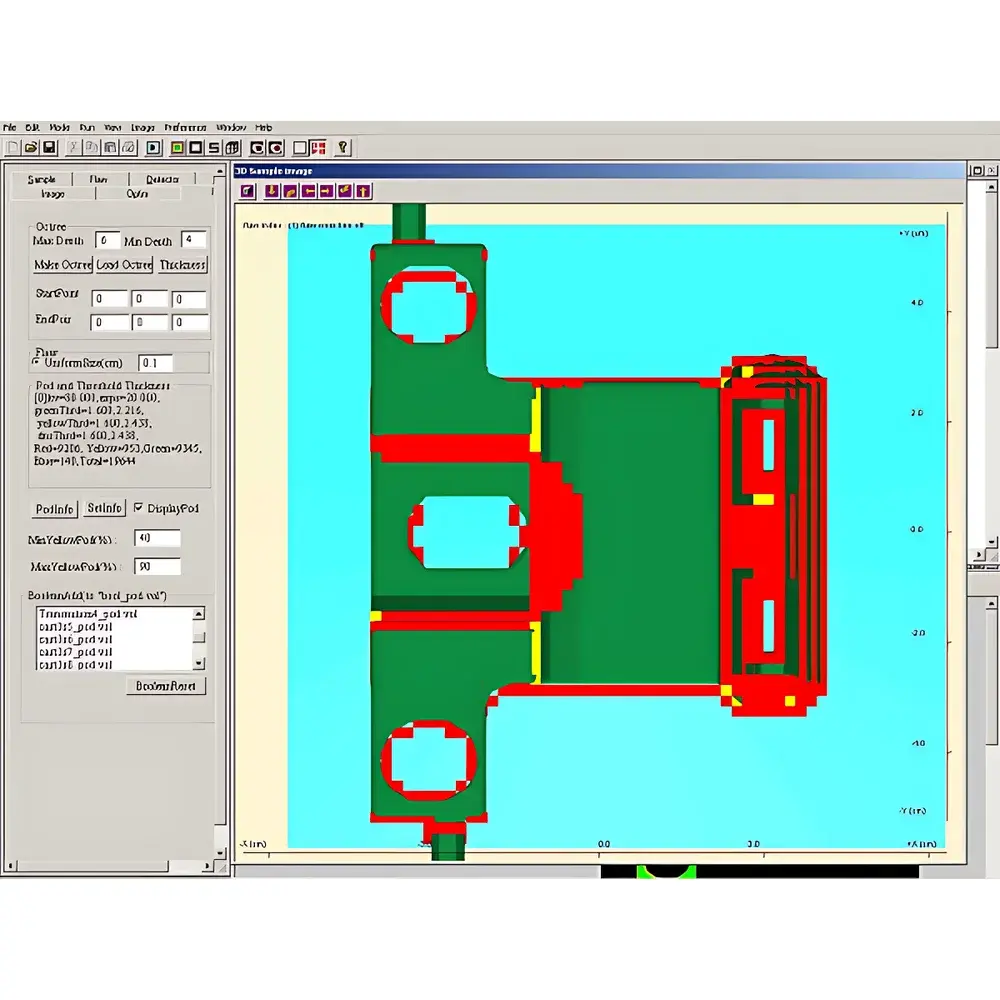
- STL-based 3D geometry import supporting assemblies of up to 20 distinct parts; each part may contain up to four embedded volumetric defects (e.g., voids, inclusions, cracks) defined by shape, position, and material composition
- Multi-modal detector modeling: film response curves (ISO 11699-1 compliant), amorphous silicon flat-panel detectors (with pixel pitch, fill factor, and DQE specification), image intensifiers, and phosphor-based systems
- Low hardware footprint: optimized for standard workstations (Intel i7 / AMD Ryzen 7, 16 GB RAM, OpenGL 4.5-compatible GPU); no HPC cluster required for typical single-view simulations
- Open API architecture enabling integration with MATLAB, Python (via ctypes bindings), and third-party CAD/CAE environments for parametric workflow automation
Sample Compatibility & Compliance
XRSIM accepts industrial-grade STL meshes exported from SolidWorks, CATIA, Siemens NX, and Fusion 360—retaining geometric fidelity without tessellation artifacts. Defect geometries are defined via Boolean operations on solid primitives, ensuring metrologically traceable representation. The software supports ASTM E2737 (Standard Practice for Digital Radiographic Testing), ISO 17636-2 (Radiographic testing of welds), and EN 1435 (Radiographic examination of welded joints). Simulation outputs—including raw detector images, line profiles, contrast-to-noise ratio (CNR) maps, and effective penetration depth calculations—are structured for audit-ready documentation under GLP and GMP frameworks. While not FDA-cleared as a medical device, its methodology aligns with IEC 62598 (radiation safety in industrial imaging) and ASME BPVC Section V, Article 2 requirements for simulated technique qualification.
Software & Data Management
XRSIM (v3) employs a project-centric file structure (.xrsimproj) containing fully versioned simulation configurations, geometry metadata, source/detector parameter sets, and output image stacks (16-bit TIFF or DICOM-compliant format). All simulation parameters—including kVp, mAs, source-to-object distance (SOD), object-to-detector distance (ODD), and filtration—are logged with timestamps and user identifiers, satisfying 21 CFR Part 11 audit trail requirements when deployed on validated Windows Server environments. Batch processing mode enables parameter sweeps (e.g., angular step scans for coverage analysis) with CSV-exportable performance metrics. Integration with LabVIEW and Python allows automated report generation compliant with ASNT SNT-TC-1A training records and ISO/IEC 17025 calibration documentation standards.
Applications
- Optimization of radiographic technique parameters (kV, mA, exposure time, geometry) prior to physical trials—reducing film usage by >60% and accelerating NDT method qualification cycles
- Quantitative assessment of detection limits for sub-surface discontinuities in castings, additive-manufactured components, and composite laminates
- Virtual validation of inspection coverage for complex geometries (e.g., turbine blades, fuselage frames, nuclear fuel cladding) using angular projection mapping and overlap analysis
- Training curriculum development for Level II/III NDT personnel per ISO 9712, including synthetic image libraries annotated with ground-truth defect dimensions and orientations
- Supporting design-for-inspectability (DFI) initiatives by identifying blind zones early in product development, minimizing late-stage rework in aerospace and power generation programs
- Enabling digital twin integration for predictive maintenance workflows where simulated baseline radiographs serve as reference states for AI-driven anomaly detection
FAQ
Does XRSIM support multi-energy (dual-kV) simulation for material discrimination?
Yes—XRSIM v3 implements spectral decomposition and dual-energy subtraction algorithms for qualitative material separation, though quantitative basis material decomposition requires external calibration data.
Can STL files include internal porosity or graded material properties?
STL geometry is inherently surface-only; however, XRSIM allows assignment of heterogeneous material properties (density, atomic number, mass attenuation coefficients) to individual mesh regions via user-defined volume segmentation masks.
Is GPU acceleration mandatory for real-time rendering?
No—GPU use is optional and limited to visualization; core radiation transport remains CPU-bound and thread-optimized for reproducibility across hardware platforms.
How does XRSIM handle scattered radiation in thick-section simulation?
It models coherent and incoherent scatter contributions using form factor approximations and Klein–Nishina cross-sections, with scatter rejection implemented via virtual collimation and detector acceptance angle constraints.
Are simulation results accepted by regulatory bodies for technique approval?
XRSIM-generated data has been cited in ASME Code Case N-807 submissions and supports ASTM E2698 equivalency arguments; formal acceptance depends on site-specific validation per client QA procedures.



