
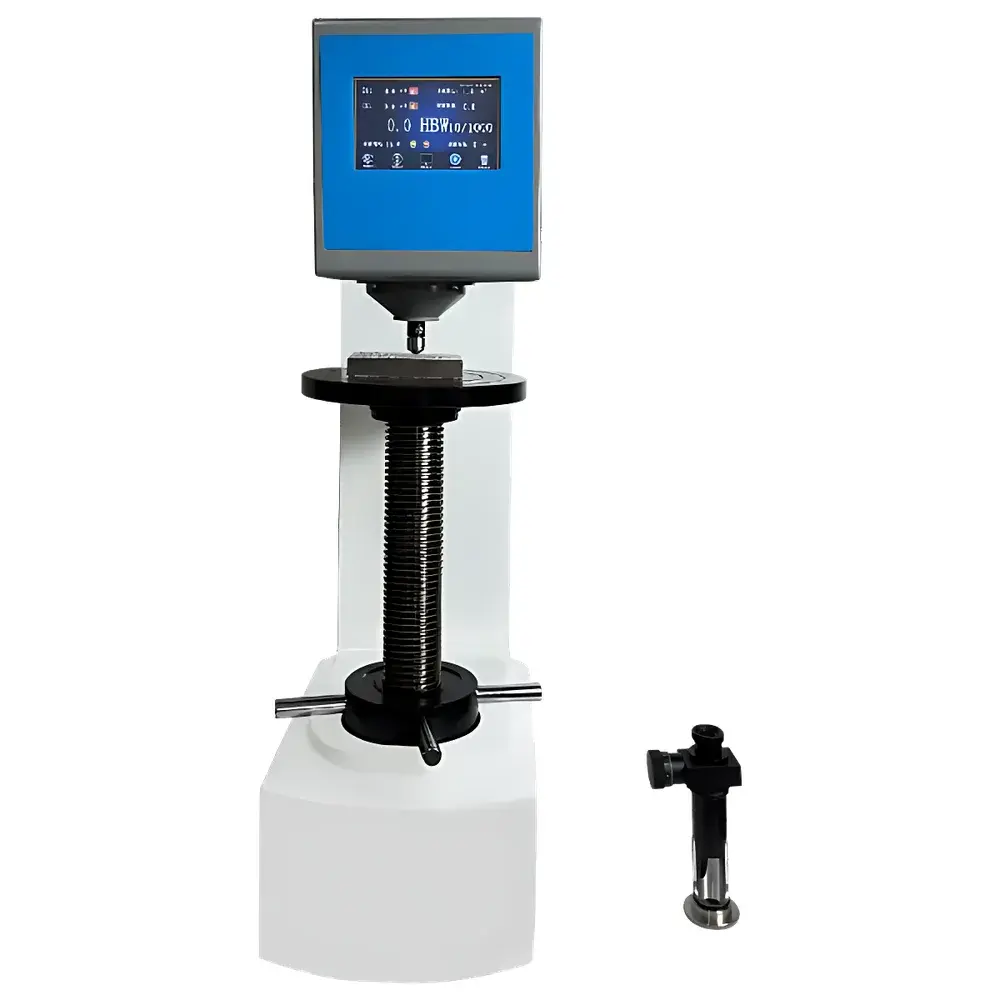
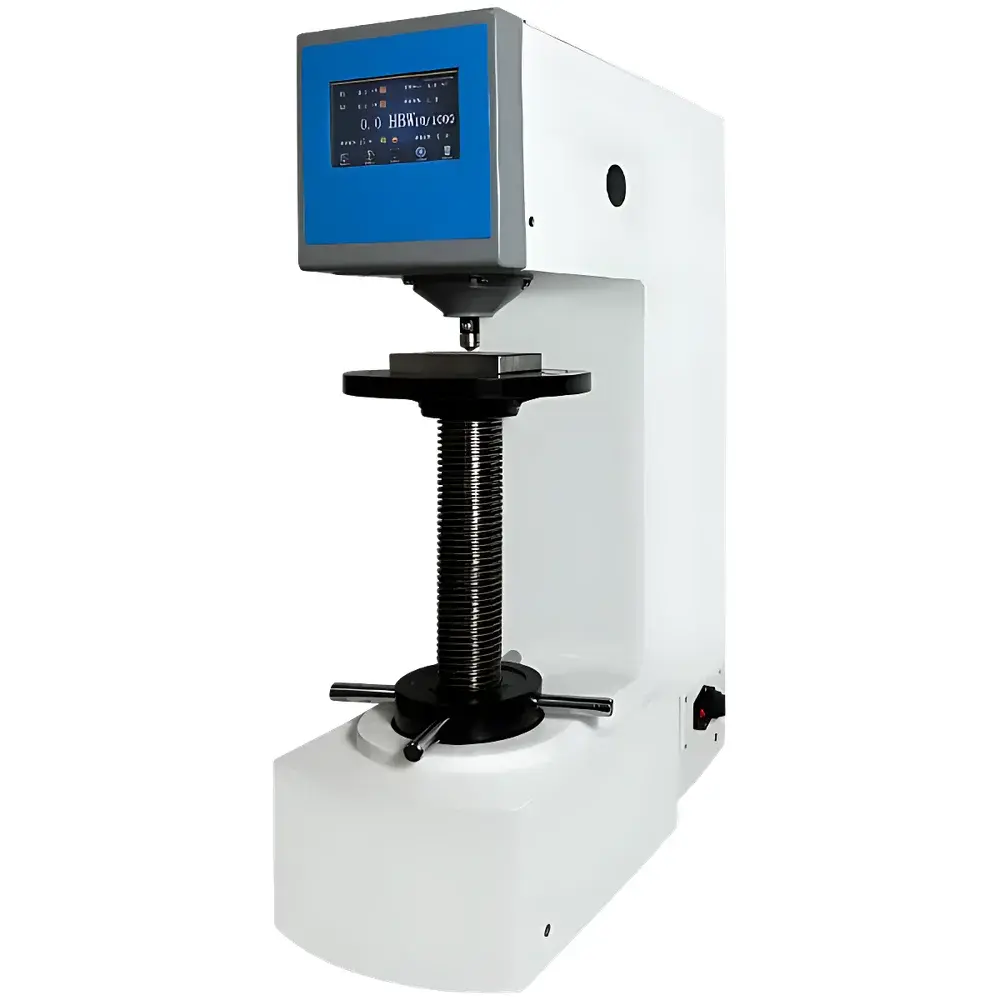
YANRUN HBS-D3000M4.3 Electronic Brinell Hardness Tester
| Brand | YANRUN |
|---|---|
| Origin | Shanghai, China |
| Manufacturer Type | Direct Manufacturer |
| Country of Origin | China |
| Model | HBS-D3000M4.3 |
| Instrument Type | Brinell Hardness Tester |
| Measuring Range | 8–650 HBW |
| Test Force Levels | 62.5–3000 kgf (612.5–29,400 N) |
| Indentation Scales | HBW2.5/62.5 to HBW10/3000 |
| Dwell Time | 0–60 s (1 s increments) |
| Max Specimen Height | 250 mm |
| Distance from Indenter Center to Front Column | 155 mm |
| Field of View Diameter | 6 mm |
| Eyepiece Magnification | 20× |
| Eyepiece Graduation | 0.01 mm |
| Test Record Capacity | Up to 30 sets |
| Standard Compliance | GB/T 231.1, GB/T 231.2, JJG 150 |
| Hardness Scale Conversion | HRC, HV, HK, HBW, HRA, HRD, HR15N/30N/45N, HR15T/30T/45T, HRB, HRF |
| Display | Touchscreen interface with direct hardness readout |
| Power Supply | AC 220 V / 50 Hz |
| Dimensions (L×W×H) | 520 × 230 × 755 mm |
| Net Weight | 114.0 kg |
| Gross Weight | 139.5 kg |
Overview
The YANRUN HBS-D3000M4.3 Electronic Brinell Hardness Tester is a precision-engineered instrument designed for reliable and repeatable macro-hardness evaluation of metallic materials in quality control, metallurgical research, and industrial manufacturing environments. It operates on the classical Brinell principle—applying a predetermined test force via a hardened tungsten carbide ball indenter (diameters: 2.5 mm, 5 mm, or 10 mm) onto the surface of a specimen, followed by optical measurement of the resulting permanent indentation diameter. The measured diameter is used to calculate the Brinell hardness number (HBW) according to ISO 6506-1 and ASTM E10 standards. This model supports full automation of loading, dwell, and unloading sequences across 12 standardized Brinell test scales—including HBW10/3000 (the most common high-load configuration for cast iron and steel forgings) and low-force variants such as HBW2.5/62.5 for thin or softer materials—ensuring broad applicability without manual intervention.
Key Features
- Full automatic test cycle control: programmable force application, dwell time (0–60 s in 1 s increments), and controlled unloading—minimizing operator variability and enhancing inter-laboratory reproducibility.
- Dual-readout capability: integrated 20× calibrated eyepiece with 0.01 mm resolution for manual verification, plus touchscreen-driven automatic digital measurement of indentation diameter within a 6 mm field of view.
- Comprehensive hardness scale conversion: real-time calculation and display of equivalent values across 14 standardized scales (HRC, HV, HK, HRA, HRB, HRD, HR15N/30N/45N, HR15T/30T/45T, HRF), traceable to NIST-correlated reference tables.
- Modular specimen stage system: includes large flat platform (Ø197 mm), medium platform (Ø75 mm), and V-block fixture (Ø75 mm), accommodating cylindrical, irregular, and plate-shaped samples up to 250 mm in height and 155 mm clearance from column wall.
- Rugged cast-iron frame with vibration-damped base and precision-ground guideways ensures long-term mechanical stability and resistance to environmental drift during extended testing sessions.
- Onboard data storage for up to 30 test records—including load, dwell time, indentation diameter, calculated HBW, conversion values, and timestamp—enabling offline review without external software dependency.
Sample Compatibility & Compliance
The HBS-D3000M4.3 is validated for use with ferrous and non-ferrous metals including carbon steels, alloy steels, aluminum alloys, copper, brass, and cast materials. Surface preparation must conform to ISO 6506-1 requirements: flat, smooth, and free of scale, oxide layers, or machining artifacts that could distort indentation geometry. The instrument meets national metrological verification requirements per JJG 150 and complies fully with GB/T 231.1 (equivalent to ISO 6506-1) for test method validation and GB/T 231.2 (equivalent to ISO 6506-2) for verification of hardness reference blocks. While not pre-certified for FDA 21 CFR Part 11, its deterministic test logic, immutable timestamped records, and absence of editable raw data fields support alignment with GLP/GMP documentation practices when deployed in regulated production QC labs.
Software & Data Management
The embedded firmware provides intuitive touchscreen navigation with multilingual UI (English default). All hardness calculations are performed using fixed arithmetic algorithms derived directly from ISO 6506 Annex A equations—no user-adjustable coefficients or curve-fitting parameters. Test results are stored in non-volatile memory with read-only access; export functionality is limited to USB-stick-based CSV dump (optional accessory). For integration into enterprise LIMS or MES systems, ASCII serial output (RS-232) is available with configurable baud rate and protocol framing—supporting automated transfer of HBW, load, dwell, and conversion values without proprietary drivers. Audit trail features include power-on counter, total test count, and last calibration date—accessible via service menu with password protection.
Applications
This tester is routinely deployed in foundries for incoming raw material verification of billets and ingots; in heat treatment facilities to validate tempering, annealing, and case-hardening processes; and in automotive/aerospace component suppliers for final inspection of crankshafts, gears, and landing gear forgings. Its extended low-force range (down to HBW2.5/62.5) permits evaluation of soft aluminum extrusions and sintered powder metallurgy parts where Rockwell or Vickers methods risk indentation cracking or pile-up. In academic metallurgy labs, it serves as a primary tool for correlating microstructure (e.g., pearlite/ferrite ratios) with bulk mechanical response under quasi-static loading conditions.
FAQ
What Brinell test forces does the HBS-D3000M4.3 support?
It delivers 10 discrete test forces from 62.5 kgf (612.5 N) to 3000 kgf (29,400 N), covering all standard Brinell scales defined in ISO 6506-1.
Is calibration certification included with shipment?
A factory-issued calibration report traceable to Chinese National Metrology Institute (NIM) standards is provided; third-party ISO/IEC 17025 calibration is available upon request.
Can the instrument perform hardness testing on curved surfaces?
Yes—when used with the supplied V-block fixture and appropriate spherical correction factors applied manually per GB/T 231.1 Annex C.
Does the system meet international standards for laboratory accreditation?
It satisfies technical requirements of ISO/IEC 17025:2017 clause 6.4.7 (equipment verification) when operated within specified environmental conditions (20 ± 2 °C, <65% RH) and maintained per manufacturer’s schedule.
What maintenance intervals are recommended?
Annual verification of force accuracy and indenter geometry is advised; daily cleaning of optical path and periodic lubrication of loading mechanism per Section 7.2 of the operation manual.



