
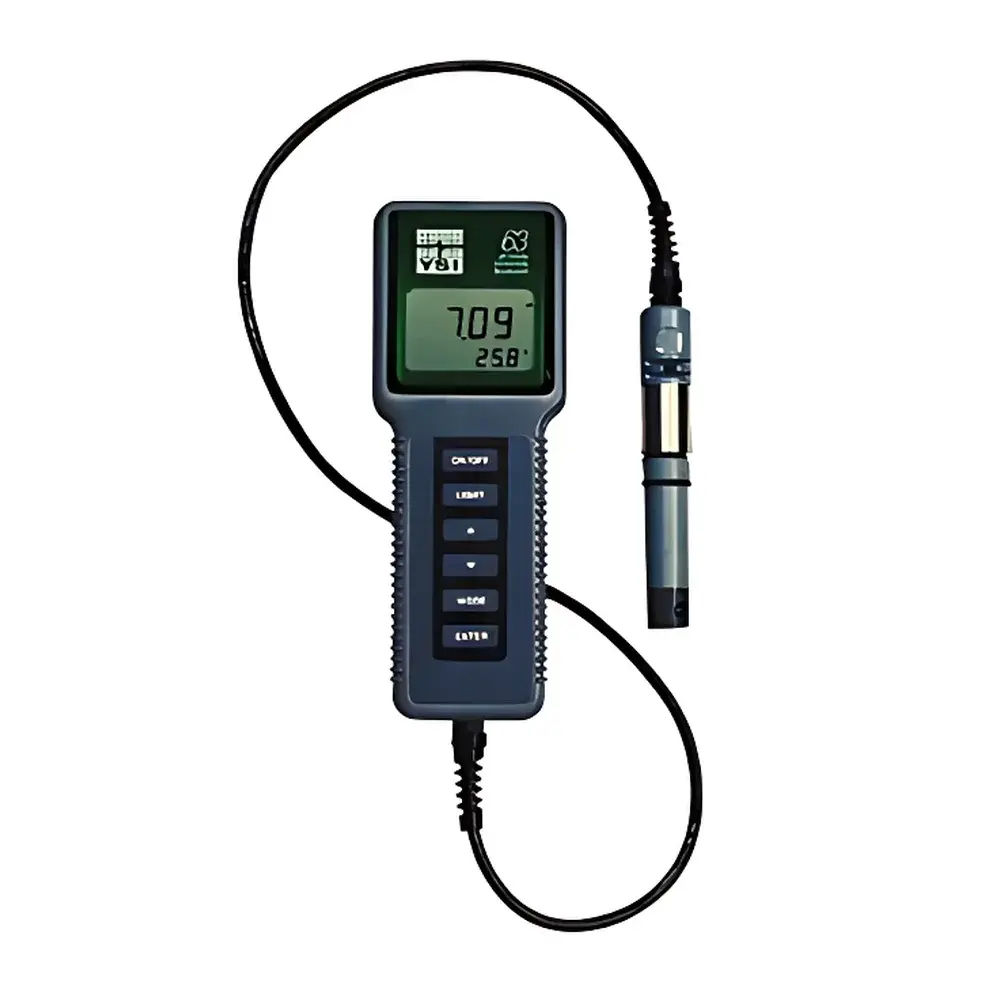
YSI Model 63 Portable Multiparameter Water Quality Analyzer
| Key | Origin: USA |
|---|---|
| Manufacturer Type | Authorized Distributor |
| Origin Category | Imported |
| Model | YSI Model 63 |
| Pricing | Available Upon Request |
Overview
The YSI Model 63 Portable Multiparameter Water Quality Analyzer is a field-deployable, battery-powered instrument engineered for simultaneous, real-time measurement of pH (acidity), conductivity, salinity, and temperature in freshwater, estuarine, and coastal marine environments. Based on potentiometric (pH), four-electrode conductometric (conductivity), and thermistor-based (temperature) sensing principles, the Model 63 delivers traceable, field-validated data under dynamic environmental conditions. Its integrated probe architecture—combining a composite glass pH electrode, quad-nickel conductivity cell, and precision NTC thermistor—ensures coordinated sensor alignment and minimizes spatial sampling error. Designed explicitly for compliance with standard field protocols (e.g., ASTM D1293 for pH, ASTM D5391 for conductivity, ISO 7888 for salinity estimation), the analyzer supports regulatory-grade water quality monitoring in EPA-certified programs, watershed assessments, and long-term ecological research.
Key Features
- Integrated multi-sensor probe: Single-body design housing pH, conductivity, and temperature sensors with fixed geometric relationship—eliminates inter-probe calibration drift and ensures synchronized depth profiling.
- Field-rugged construction: Stainless-steel probe body with polymer protective sleeve; IP67-rated electronics enclosure (exceeding IP65); stress-relieved cable terminations with molded strain relief boots.
- Extended deployment capability: Standard cable lengths of 3 m, 7.5 m, 15 m, and 30 m; shielded coaxial cable minimizes electromagnetic interference in high-noise field settings (e.g., near generators or radio transmitters).
- Intelligent sensor management: Automatic buffer recognition during pH calibration (pH 4.01, 7.00, 10.01); selectable 1-, 2-, or 3-point calibration; user-adjustable conductivity reference temperature (15–25 °C) and temperature compensation coefficient (0–4 %/°C).
- Robust power system: Six AA alkaline batteries providing ~100 hours of continuous operation; low-battery indicator with graceful shutdown protocol to preserve unsaved data.
- Onboard data handling: Non-volatile flash memory stores up to 50 measurement sets; all values timestamped and retained through power loss; no external memory cards or proprietary drivers required.
Sample Compatibility & Compliance
The Model 63 is validated for use across natural and engineered aqueous matrices—including rivers, lakes, wetlands, aquifers, wastewater effluents, and brackish tidal zones—with no sample pre-filtration required for routine field screening. Its pH electrode operates reliably in turbid, particulate-laden, or low-ionic-strength waters where conventional electrodes exhibit sluggish response or junction clogging. Conductivity measurements adhere to the four-electrode principle, minimizing polarization effects and enabling stable readings from ultrapure water (0.1 µS/cm) to saturated brines (400 mS/cm). Salinity is derived algorithmically from conductivity, temperature, and pressure-independent coefficients per PSS-78 (Practical Salinity Scale), with traceability to NIST-traceable KCl standards. The instrument meets GLP documentation requirements for field data integrity and supports audit-ready workflows compliant with US EPA Method 150.1 (pH), Method 120.1 (conductivity), and ISO/IEC 17025–accredited laboratories.
Software & Data Management
Data acquisition is fully self-contained: no PC interface or proprietary software is required for basic operation. All measurements are displayed on a high-contrast, backlit LCD with 12.7 mm digit height—optimized for readability under direct sunlight or low-light nocturnal surveys. While the Model 63 does not feature Bluetooth or USB connectivity, its internal memory enables manual transcription into LIMS or spreadsheet platforms. Calibration history, date/time stamps, and operator ID fields (via manual entry) support chain-of-custody documentation. For laboratories requiring electronic records under FDA 21 CFR Part 11, the device may be operated within a validated procedural framework where handwritten logs or camera-captured screen images serve as attributable, legible, and contemporaneous records.
Applications
- Regulatory surface water monitoring (e.g., TMDL implementation, NPDES permit compliance)
- Groundwater plume characterization and wellhead protection studies
- Wetland restoration project baseline and post-intervention assessment
- Educational field labs and undergraduate environmental science coursework
- Coastal zone management—estuarine mixing zone delineation and salinity intrusion tracking
- Drinking water source surveillance and distribution system integrity checks
FAQ
What is the maximum operational depth for the probe?
The probe is rated for continuous submersion up to 30 meters, contingent upon selected cable length and proper handling of the sealed BNC connector.
Can the pH electrode be replaced in the field without tools?
Yes—the composite glass electrode features a threaded, O-ring-sealed housing and is designed for tool-free replacement using only hand-tightening.
Does the instrument comply with ISO/IEC 17025 requirements?
While the Model 63 itself is not accredited, its measurement functions and calibration traceability align with ISO/IEC 17025 Clause 6.4 (Equipment) and Clause 6.6 (Measurement Traceability) when used within an accredited laboratory’s documented procedures.
Is temperature compensation applied automatically during conductivity measurement?
Yes—temperature compensation is continuous and configurable; the default setting uses linear compensation referenced to 25 °C, but users may select 15 °C, 20 °C, or 25 °C and adjust the β coefficient between 0 and 4 %/°C.
How is salinity calculated, and what standard does it follow?
Salinity is computed using the UNESCO 1983 algorithm based on measured conductivity, temperature, and atmospheric pressure assumptions; results are reported in practical salinity units (PSU or ppt) per PSS-78.







