
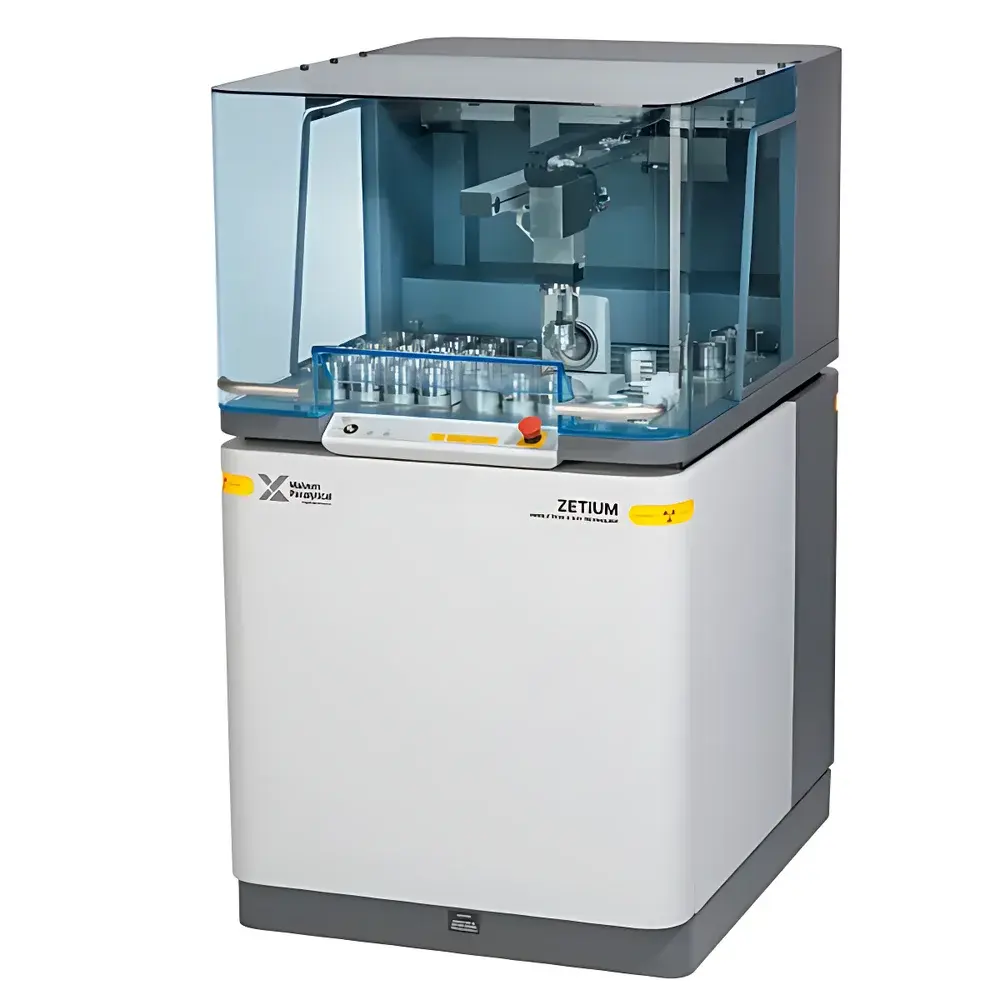
Malvern Panalytical Zetium Wavelength Dispersive X-Ray Fluorescence Spectrometer
| Brand | Malvern Panalytical |
|---|---|
| Origin | Netherlands |
| Instrument Type | Floor-standing |
| Excitation Source | High-power X-ray tube (2.4–4 kW) |
| Analytical Range | Be (4) to Am (95) |
| Configuration | Scanning-type WDXRF with integrated EDXRF core (SumXcore technology) |
| Software Platform | SuperQ with Virtual Analyst |
| Compliance | Designed for ISO/IEC 17025, ASTM E1621, ASTM E2488, USP <233>, and GLP/GMP environments requiring audit trail and electronic signature support (21 CFR Part 11 ready) |
Overview
The Malvern Panalytical Zetium Wavelength Dispersive X-Ray Fluorescence (WDXRF) Spectrometer is an engineered platform for high-precision, multi-element quantitative and qualitative elemental analysis across solid, liquid, and loose powder samples. Operating on the fundamental principle of wavelength-dispersive spectroscopy—where characteristic X-ray fluorescence photons are diffracted by analyzing crystals and resolved via Bragg’s law—the Zetium delivers exceptional spectral resolution, peak-to-background ratios, and long-term stability. Its architecture integrates a scanning WDXRF optical path with an embedded energy-dispersive core (SumXcore), enabling hybrid acquisition strategies that combine the high resolution and low detection limits of WDXRF with the speed and flexibility of EDXRF. This dual-core design supports rapid screening, high-throughput routine analysis, and rigorous trace-level quantification in regulated and R&D-intensive environments—including metallurgy, cement production, geochemistry, petrochemicals, polymers, and advanced materials development.
Key Features
- Modular high-power X-ray tube system offering selectable output levels (1 kW, 2.4 kW, 3 kW, or 4 kW) to optimize sensitivity, detection limits, and analysis time per application.
- Multiple anode material options (Rh, Cr, Mo, Au) for tailored excitation efficiency across light, mid-, and heavy-element ranges.
- HiPer scintillation detector with linear response up to 3.5 Mcps, extending dynamic range for high-concentration heavy elements (e.g., Nb, Mo in steel matrices).
- Composite detector configuration supporting simultaneous light-element (Be–F) and transition-metal analysis with enhanced counting statistics.
- SumXcore technology: synergistic use of EDXRF core for fast pre-scan and element identification, followed by targeted WDXRF measurement—reducing total analysis time by up to 50% without compromising accuracy.
- Programmable collimator masks accommodating sample diameters from 6 mm to 37 mm; supports micro-area analysis with spatially resolved mapping capabilities.
- High-capacity autosampler (up to 209 positions) with optional barcode reader for unambiguous sample tracking and LIMS integration.
- CHI-BLUE X-ray tube window coating for improved thermal management, corrosion resistance, and extended tube lifetime under continuous high-power operation.
- Air-lock vacuum chamber with compact design minimizes helium consumption during liquid analysis and accelerates sample cycling into vacuum (<15 s typical).
Sample Compatibility & Compliance
The Zetium accommodates a broad spectrum of sample forms—including pressed pellets, fused beads, metals, thin films, slurries, oils, and filter media—without requiring fundamental changes to hardware configuration. Sample presentation modules support both direct loading and interfaced sample preparation (e.g., automated fusion units or milling systems). The platform meets international analytical standards including ASTM E1621 (standard test method for elemental analysis of waste materials), ASTM E2488 (standard guide for XRF analysis of cement and concrete), ISO 29581-2 (cement analysis), and USP (elemental impurities in pharmaceuticals). System software supports full 21 CFR Part 11 compliance with electronic signatures, audit trails, role-based access control, and data integrity validation—making it suitable for GLP and GMP-regulated laboratories.
Software & Data Management
SuperQ software serves as the unified control and evaluation environment, featuring Virtual Analyst—a guided workflow interface enabling non-specialist users to configure methods, calibrate, and interpret results without deep spectroscopic expertise. Application-specific software modules include: QuantExpress (empirical calibration), Omnian (fundamental parameters-based semi-quantitative analysis), GeoTrace (geological trace element modeling), LubriScan (lubricant additive and wear metal analysis), and ThinFilm (multi-layer thickness and composition). All modules operate within a common database framework supporting raw spectrum storage, metadata tagging, version-controlled method libraries, and export to CSV, XML, or LIMS-compatible formats. Data security protocols align with ISO/IEC 27001-aligned laboratory IT policies.
Applications
The Zetium is deployed across industries where regulatory compliance, reproducibility, and elemental coverage are critical. In cement and building materials labs, it performs rapid major- and minor-oxide analysis (SiO₂, Al₂O₃, Fe₂O₃, CaO, MgO, SO₃, Na₂O, K₂O) with sub-0.01 wt% precision. In metallurgical QA/QC, it quantifies alloying elements (Cr, Ni, Mo, V, Nb) and tramp elements (P, S, Sn, As) in stainless steels and superalloys. Petrochemical applications include sulfur and additive element monitoring in fuels and lubricants. Geological laboratories leverage its trace-element capability (ppm-level detection for REEs, U, Th, Zr) in exploration and resource assessment. Polymer and electronics manufacturers rely on its ability to screen for restricted substances (Br, Cl, Cd, Pb, Hg, Cr⁶⁺) per RoHS and IEC 62321 requirements.
FAQ
What is the difference between WDXRF and EDXRF in the Zetium platform?
The Zetium uses WDXRF as its primary high-resolution analytical mode, while integrating an EDXRF core (SumXcore) for rapid elemental survey and intelligent measurement planning—enabling adaptive, application-optimized workflows.
Can the Zetium analyze light elements such as beryllium and boron?
Yes—using vacuum or helium purge environments, optimized crystals (e.g., LiF, PET, TAP), and specialized detectors, the Zetium achieves reliable quantification from Be (Z=4) through Am (Z=95).
Is the system compatible with automated sample preparation systems?
Yes—Malvern Panalytical offers certified interfaces to fusion robots, pellet presses, and milling stations, enabling end-to-end automation from sample prep to reporting.
How does the Zetium ensure long-term calibration stability?
Through hardware-based drift correction (reference channel monitoring), periodic internal standard checks, and software algorithms that track crystal aging and detector gain shifts over time.
What service and support options are available globally?
Malvern Panalytical provides factory-certified installation, preventive maintenance contracts, remote diagnostics, application support centers, and accredited training programs aligned with ISO/IEC 17025 competency requirements.




