
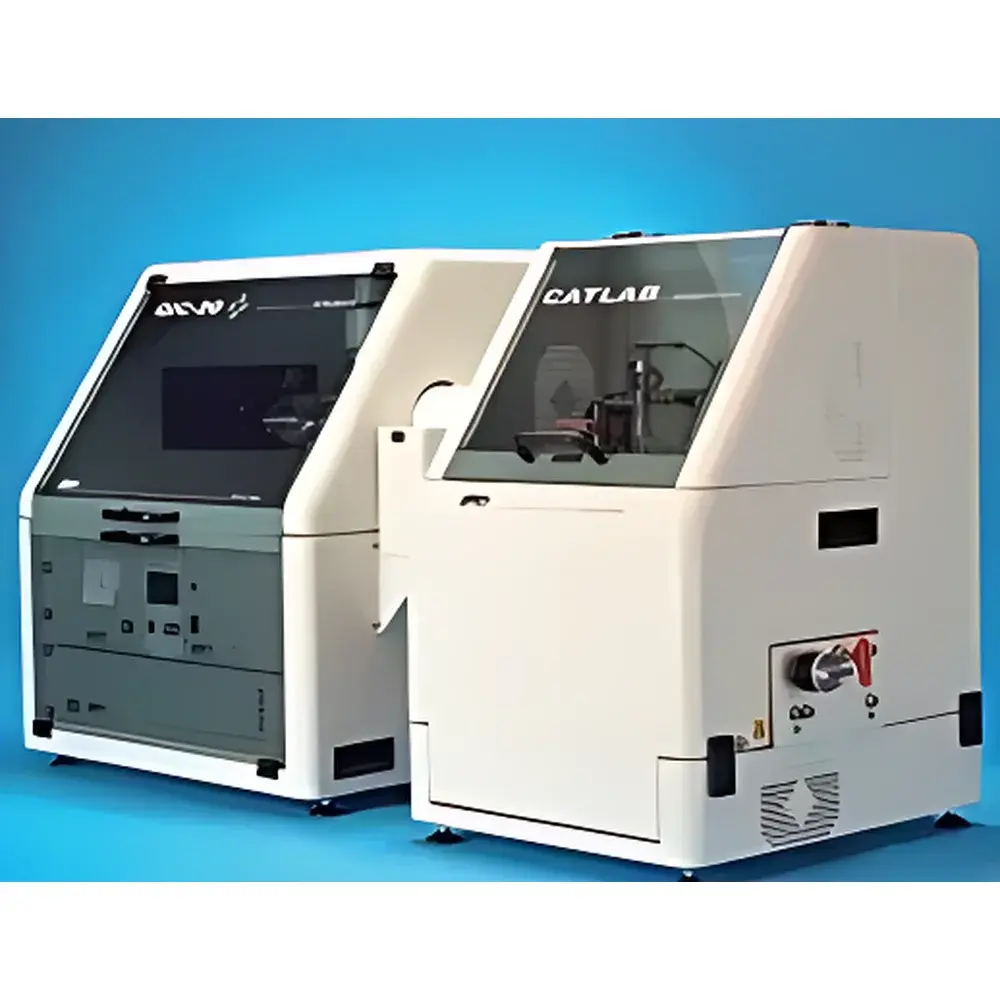
Hiden CATLAB Catalytic Microreactor–Mass Spectrometer System
| Brand | Hiden |
|---|---|
| Origin | United Kingdom |
| Model | CATLAB |
| Instrument Type | Chemisorption Analyzer / Catalytic Characterization System |
| Temperature Range | −196 °C to 1000 °C (selectable furnace options) |
| Heating Rate | 1–20 °C/min |
| Pressure Range | Ambient (atmospheric) |
| Gas Flow Range | 3–100 mL/min (up to 500 mL/min optional) |
| Mass Range | 1–200 amu (300 amu optional) |
| Response Time | <500 ms |
| Scan Speed | up to 100 amu/s |
| Detection Units | %, ppm, ppb |
| Gas Inlet Channels | 4 standard (8 optional) |
| Catalyst Cartridge System | Interchangeable, thermocouple-integrated |
| Reactor–MS Interface | Dead-volume-free, heated transfer line |
Overview
The Hiden CATLAB Catalytic Microreactor–Mass Spectrometer System is a fully integrated, high-fidelity platform engineered for in-depth catalytic surface science and reaction kinetics characterization. Combining a precision-controlled microreactor with a quadrupole mass spectrometer (QIC20), the system enables real-time, quantitative analysis of gaseous species evolving during temperature-programmed experiments (TPD, TPO, TPR, TPRx), adsorption/desorption equilibria, and transient kinetic studies. Its core measurement principle relies on controlled thermal perturbation of catalyst surfaces under well-defined gas atmospheres, coupled with sub-second mass spectral detection of evolved or consumed species. This architecture supports rigorous mechanistic interpretation—linking surface stoichiometry, active site distribution, and elementary step energetics—making it indispensable for R&D laboratories engaged in heterogeneous catalysis, emission control material development, and sustainable chemical process design.
Key Features
- Modular, interchangeable catalyst cartridges with integrated base-mounted thermocouples for direct, spatially representative temperature measurement at the catalyst bed—eliminating thermal lag and gradient artifacts.
- Low-thermal-mass reactor furnace with rapid heating/cooling rates (1–20 °C/min) and extended operating range (−196 °C to 1000 °C), supporting cryogenic adsorption, ambient desorption, and high-temperature redox cycling.
- Dead-volume-free, heated capillary interface between reactor outlet and mass spectrometer inlet—critical for preserving transient species integrity and enabling accurate time-resolved quantification of short-lived intermediates.
- Four independently controlled mass flow controllers (MFCs) as standard (expandable to eight), allowing precise multi-gas mixing, pulse injection, and dynamic atmosphere switching without manual valve intervention.
- Corrosion-resistant gas path options (e.g., electropolished stainless steel, Hastelloy® components) for compatibility with aggressive feedstocks including H₂S, Cl₂, NH₃, and halogenated hydrocarbons.
- Real-time synchronization of reactor parameters (temperature, flow, pressure) with full-spectrum mass data acquisition via Hiden’s proprietary CATLAB software—enabling automated experiment sequencing and on-the-fly spectral deconvolution.
Sample Compatibility & Compliance
The CATLAB system accommodates powdered, pelletized, or monolithic catalyst samples (typically 10–100 mg) mounted in standardized quartz or metal cartridges. It supports both supported (e.g., Pt/Al₂O₃, Ni/SiO₂) and unsupported (e.g., Pd black, Ru nanoparticles) catalysts, as well as model single-crystal surfaces when used with appropriate holders. All hardware and software modules are designed to meet essential requirements for GLP-compliant environments: audit-trail-enabled method storage, electronic signature support, and full data provenance tracking. While not pre-certified for FDA 21 CFR Part 11, the system architecture permits validation-ready configuration—including user access controls, change logs, and raw data immutability—facilitating compliance with ISO/IEC 17025, ASTM D3907 (catalyst activity testing), and ISO 11540 (TPD methodology) frameworks.
Software & Data Management
CATLAB Control Software provides a unified interface for instrument orchestration, data acquisition, and post-processing. Experiments are defined via intuitive protocol templates—covering ramp-hold-cool cycles, isothermal pulses, and multi-step gas-switch sequences—with parameter constraints enforced to prevent out-of-spec operation. Mass spectral data are acquired at user-defined dwell times and scanned across selectable m/z windows, with real-time background subtraction and isotopic correction applied. Quantitative calibration is performed using certified gas standards traceable to NIST, supporting linear dynamic ranges from ppb to percent-level concentrations. All raw datasets (time-stamped .raw files), processed reports (.pdf/.xlsx), and method definitions are stored in a hierarchical project structure with SHA-256 checksum verification. Export formats include ASCII, CSV, and vendor-neutral HDF5—ensuring long-term archival integrity and third-party analysis interoperability.
Applications
- Quantitative determination of active metal surface area via CO or H₂ chemisorption, with simultaneous detection of competitive adsorbates.
- Temperature-programmed desorption (TPD) profiling of acid/base site strength distributions using NH₃ or CO₂ probes.
- In situ monitoring of surface oxidation states during TPR/TPO, correlating O₂ consumption profiles with lattice oxygen mobility.
- Transient kinetic analysis of catalytic reactions (e.g., CO oxidation, NOx reduction), resolving rate-determining steps through isotopic labeling (¹⁸O₂, ¹³CO).
- Adsorption thermodynamics (isosteric heat, entropy) derived from multi-temperature uptake isotherms coupled with mass-resolved desorption signatures.
- Rapid catalyst screening across compositional libraries using automated batch protocols and multivariate statistical analysis of spectral fingerprints.
FAQ
What types of catalysts can be analyzed with the CATLAB system?
Powdered, extruded, or monolithic heterogeneous catalysts—including supported metals, metal oxides, zeolites, and carbides—are routinely characterized. Sample mass typically ranges from 10–100 mg; custom holders accommodate single crystals or thin films.
Is vacuum compatibility required for operation?
No—the system operates at ambient pressure. The mass spectrometer employs differential pumping to maintain its high-vacuum ion source while sampling atmospheric-pressure reactor effluent via the heated capillary interface.
Can the CATLAB software export data for third-party kinetic modeling tools?
Yes. Time-resolved concentration vs. temperature/time datasets export in CSV and HDF5 formats, with metadata headers compatible with MATLAB, Python (SciPy), and commercial tools such as Aspen Adsorption and CHEMKIN.
How is temperature accuracy ensured across the full operating range?
Each furnace option is calibrated against NIST-traceable reference standards. The embedded base thermocouple provides direct catalyst-bed feedback, and software applies real-time cold-junction compensation and nonlinearity correction per ASTM E230.
What maintenance intervals are recommended for the mass spectrometer?
Annual ion source cleaning and filament replacement are typical under standard usage. The QIC20’s sealed detector and robust quadrupole design minimize downtime; preventative maintenance kits and remote diagnostics are available via Hiden’s global service network.



