
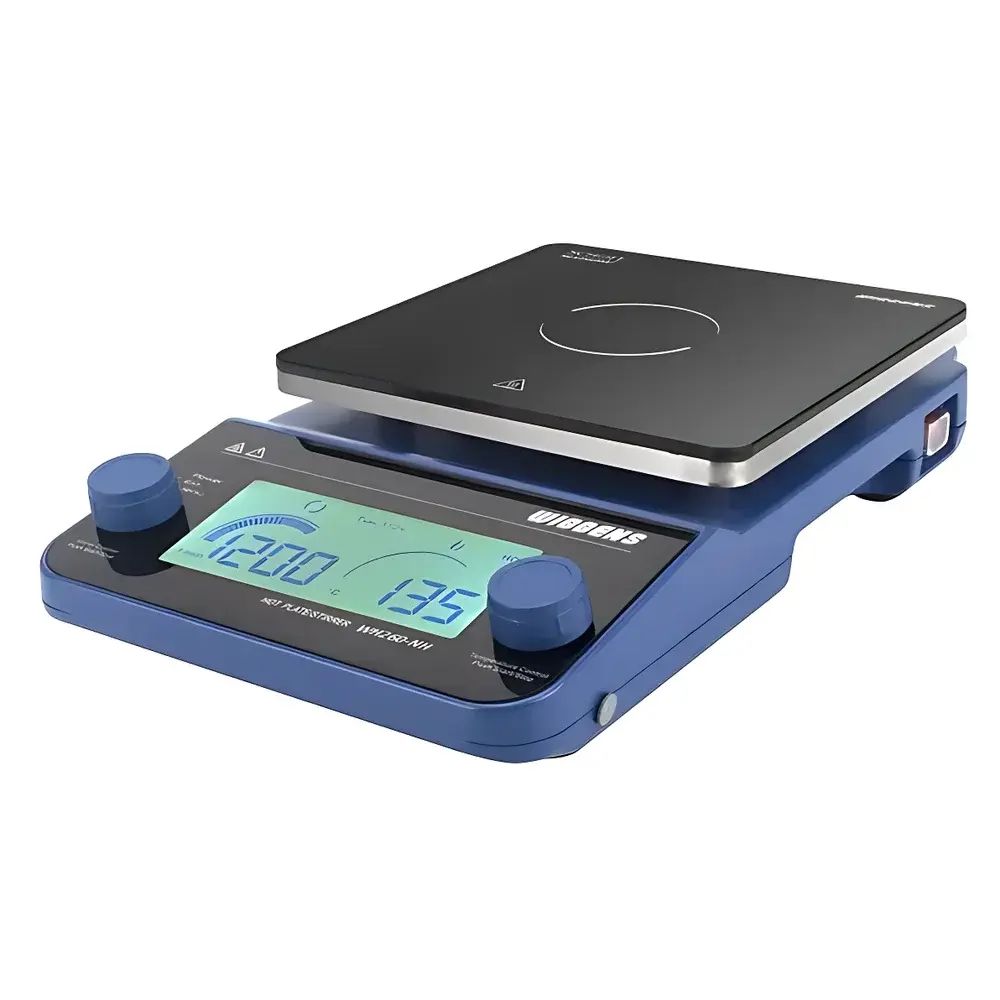
WIGGENS WH260-NH Heating Magnetic Stirrer
| Brand | WIGGENS |
|---|---|
| Origin | Germany |
| Model | WH260-NH |
| Maximum Stirring Volume | 20 L |
| Speed Range | 100–1500 rpm |
| Temperature Control Range | 0–450 °C |
| Heating Plate Max Temp | ≤450 °C |
| Sample Temp Control (with Pt100) | ≤300 °C |
| Safety Cut-off Temp Range | 50–500 °C (adjustable) |
| Over-Temp ΔT Protection | 10–50 °C (adjustable) |
| Temperature Stability (with Pt100) | ±1 °C |
| Heating Power | 1000 W |
| Display | LCD |
| Control Interface | Rotary Knob + Keypad |
| Timer | 1–1999 min or Continuous |
| Plate Material | Enamel-Coated Glass |
| Plate Dimensions | 180 × 180 mm |
| USB-A Port | Yes |
| Dimensions (W×D×H) | 187 × 315 × 84 mm |
| Weight | 3.0 kg |
| Power Supply | 220 V / 50 Hz |
Overview
The WIGGENS WH260-NH is a high-performance, microprocessor-controlled heating magnetic stirrer engineered for precision thermal and mechanical sample manipulation in research, quality control, and routine laboratory environments. It integrates a robust ceramic-glass heated plate with a high-torque magnetic drive system, enabling simultaneous temperature regulation and homogeneous mixing across volumes up to 20 L of aqueous media. Its core operating principle relies on electromagnetic induction to rotate a PTFE- or glass-coated stir bar within the sample vessel while delivering rapid, uniform conductive heating via an infrared-enhanced heating element. The unit supports closed-loop temperature feedback using an external Pt100 sensor immersed directly in the sample—ensuring accurate, real-time thermal control independent of surface plate temperature. Designed for long-term reliability under continuous operation, the WH260-NH conforms to IEC 61010-1 safety standards for laboratory electrical equipment and features full electrical isolation of critical components within a sealed housing.
Key Features
- Triple-PID temperature algorithm selection (PID1–PID3) optimized for diverse thermal mass scenarios: PID1 for low-heat-capacity or small-volume samples; PID3 for rapid ramp-up of large-volume loads.
- Adjustable over-temperature protection (ΔT = 10–50 °C above setpoint), activated by internal safety thermostat and independent Pt100 monitoring.
- Corrosion-resistant spill containment channel integrated into the control panel front edge—prevents liquid ingress into electronics during accidental splashes.
- Nano-reinforced enamel-coated glass heating plate (180 × 180 mm) offering exceptional thermal uniformity, chemical resistance, and mechanical durability at elevated temperatures.
- High-resolution backlit LCD display showing real-time setpoints and actual values for speed (rpm), plate temperature (°C), sample temperature (°C), timer status, and error codes.
- Auto-recall function retains last-used parameters (speed, temperature, timer) upon power cycle—critical for SOP-driven workflows and GLP-compliant documentation.
- USB-A interface enables firmware updates and future integration with lab automation systems (e.g., via RS232/USB-serial bridge).
Sample Compatibility & Compliance
The WH260-NH accommodates standard borosilicate glass vessels (beakers, flasks, reaction vials) from 10 mL to 20 L capacity, provided appropriate stir bar geometry and size are selected for Reynolds number optimization. It is compatible with aqueous, organic, and mildly corrosive solvents when used with chemically inert stir bars (e.g., PTFE-sheathed or glass-coated). The unit meets CE marking requirements under Directive 2014/30/EU (EMC) and 2014/35/EU (LVD), and complies with ISO/IEC 17025 calibration traceability guidelines when operated with NIST-traceable Pt100 probes. For regulated environments, its deterministic control logic, non-volatile parameter storage, and configurable alarm thresholds support audit readiness per FDA 21 CFR Part 11 Annex 11 expectations where electronic records are maintained.
Software & Data Management
While the WH260-NH operates as a standalone instrument without embedded data logging, its USB-A port provides physical layer connectivity for optional external data acquisition modules. When paired with third-party software (e.g., LabVIEW™ drivers or Python-based serial polling scripts), users can capture timestamped sequences of speed, plate temperature, sample temperature, and operational state. All configuration changes—including PID selection, ΔT offset, and timer activation—are stored in non-volatile memory and persist through power interruption. The device does not generate audit trails internally but supports manual logbook entries aligned with GLP/GMP documentation practices through its consistent parameter recall behavior.
Applications
- Kinetic studies requiring precise thermal ramping and sustained agitation (e.g., hydrolysis, polymerization, enzyme assays).
- Preparation of homogeneous calibration standards and reference materials across pharmaceutical, environmental, and food testing labs.
- Dissolution testing per USP , where controlled heating and stirring simulate gastrointestinal conditions.
- Synthesis workflows involving reflux, solvent removal, or crystallization nucleation under reproducible thermal-mechanical conditions.
- QC/QA validation of viscosity modifiers, surfactants, or suspensions where temperature-dependent rheological behavior must be assessed.
FAQ
Does the WH260-NH support external temperature feedback control?
Yes—it accepts input from a standard 2-wire or 4-wire Pt100 sensor placed directly in the sample, enabling true sample-centric temperature regulation rather than plate-surface approximation.
Can the unit maintain ±1 °C stability during extended runs?
When operated with a calibrated Pt100 probe and appropriate thermal insulation of the vessel, the WH260-NH achieves ±1 °C stability over time under steady-state conditions, as verified per ISO 17025-accredited test protocols.
Is the heating plate resistant to strong acids or alkalis?
The enamel-coated glass surface resists common laboratory reagents including 1 M HCl, 1 M NaOH, and 30% H₂O₂; however, prolonged exposure to HF, hot concentrated phosphoric acid, or molten alkali metals is not recommended.
What safety certifications does this model hold?
It carries CE marking compliant with IEC 61010-1:2010, RoHS 2011/65/EU, and EMC Directive 2014/30/EU. No UL or CSA listing is included for North American markets.
How is the 1000 W heating power distributed across the plate surface?
Power delivery is spatially uniform across the active zone, with thermal gradient measurements showing ≤3 °C deviation across the 180 × 180 mm area at 400 °C setpoint, per manufacturer’s thermal mapping report WIG-TP-260NH-2023-08.
Related Products



