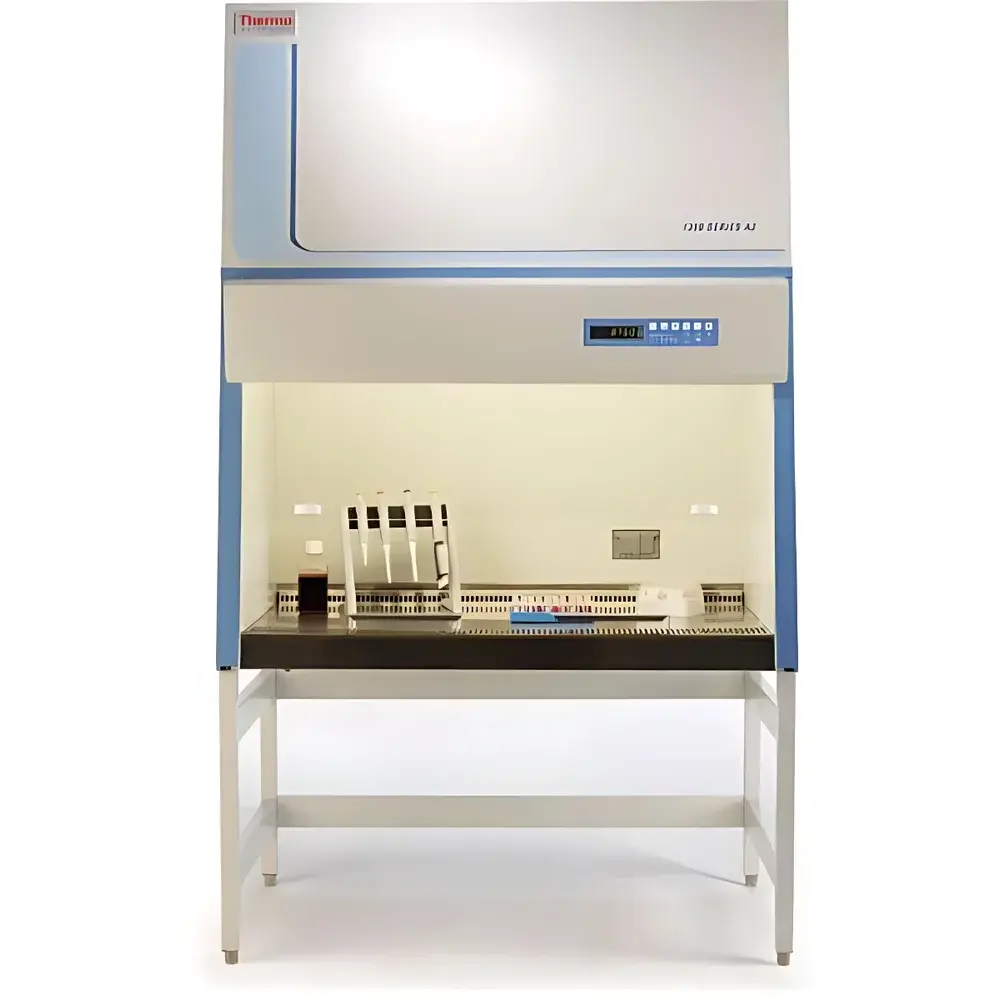
Thermo Fisher Scientific 1300 A2 Class II Biological Safety Cabinet
| Brand | Thermo Fisher |
|---|---|
| Origin | USA |
| Manufacturer Type | Original Equipment Manufacturer (OEM) |
| Product Category | Imported |
| Model | 1300 A2 |
| Instrument Class | Class II, Type A2 |
| External Dimensions (L×W×H) | 1300 × 1580 × 870 mm |
| Internal Dimensions (L×W×H) | 1200 × 780 × 630 mm |
| Filter Efficiency | >99.999% for 0.3 µm particles |
| Airflow Pattern | 30% exhaust / 70% recirculation |
| Work Area Dimensions (W×D×H) | 1200 × 495 × 780 mm or 1800 × 495 × 780 mm |
| Exhaust Flow Rate | 330 or 490 CFM |
| Work Surface Area | 0.56 or 0.84 m² |
| Sash Opening Height | 250 mm |
| Fluorescent Illumination | >65 foot-candles (fc) |
| Sound Pressure Level | 63 or 65 dB(A) |
| Heat Output at 25°C | 150 or 260 W |
| Voltage Range | 90–250 V AC |
| Power Consumption | 200 or 400 W |
Overview
The Thermo Fisher Scientific 1300 A2 Class II Biological Safety Cabinet is an engineered solution for personnel, product, and environmental protection in laboratories handling Risk Group 1–3 biological agents, low-to-moderate concentrations of volatile toxic chemicals, and trace quantities of unsealed radioactive materials. Designed in strict accordance with ISO 14644-1 (cleanroom classification), EN 12469:2000 (performance requirements for biological safety cabinets), and IEC 61010-1 (safety requirements for electrical equipment), this cabinet operates on the fundamental principle of laminar airflow—using inward-facing front intake velocity (≥0.5 m/s), downward vertical recirculated air (70%), and filtered exhaust (30%) to maintain a sterile work environment. Its dual-fan architecture ensures independent control of inflow and downflow velocities, enabling stable containment even during sash movement or filter loading—critical for GLP-compliant cell culture, vaccine production, and diagnostic assay development.
Key Features
- Dual DC brushless motors (EBM-Papst) — eliminate carbon dust accumulation, reduce maintenance intervals, and deliver precise, energy-efficient airflow control with >20,000-hour service life.
- Active airflow monitoring system — continuously measures inflow and downflow velocities using pressure-based anemometry; triggers real-time visual/audible alarms upon deviation from ANSI/NSF/EN-set thresholds (e.g., <0.4 m/s inflow).
- Ergonomic angled sash design — optimized at 15° tilt to minimize operator fatigue and reduce heat load by up to 60% compared to vertical-sash equivalents, supporting prolonged use in high-throughput labs.
- UV lamp with programmable timer — enables scheduled decontamination cycles without manual intervention, supporting routine maintenance workflows compliant with USP and laboratory SOPs.
- Integrated LED status indicators — provide immediate feedback on airflow integrity, UV operation, and alarm conditions, facilitating rapid operational verification prior to each use.
- Robust stainless steel interior (304 grade) and seamless welded construction — resist corrosion from ethanol, hydrogen peroxide vapor, and common disinfectants used in BSL-2/3 environments.
Sample Compatibility & Compliance
The 1300 A2 accommodates standard biosafety workflows involving open vessels, pipetting, centrifugation, and microinjection. It supports simultaneous handling of biological samples (e.g., human primary cells, recombinant proteins, viral vectors) and limited volumes (<2% v/v) of low-volatility hazardous chemicals such as formaldehyde, phenol, or ethidium bromide—provided vapors are captured within the exhaust ducting system. Certification includes CE marking under the EU Medical Device Regulation (MDR) Annex I essential requirements, full compliance with EN 12469:2000 (including containment testing via potassium iodide and microbial challenge protocols), and IEC 61010-1:2010 for electrical safety. The unit meets NSF/ANSI 49-2022 structural and performance criteria for Type A2 cabinets and supports audit readiness for FDA 21 CFR Part 11 (via optional data logging modules) and ISO/IEC 17025 accreditation.
Software & Data Management
While the base configuration operates via embedded microcontroller logic without external software dependency, optional digital interfaces support integration into centralized lab infrastructure. An RS-485 port enables connection to building management systems (BMS) for remote airflow logging and alarm relay. With the Thermo Fisher Connect™ Lab Dashboard add-on (sold separately), users gain access to time-stamped event logs—including sash position history, UV cycle records, and airflow excursions—with export capability in CSV format for internal QA review. All logged data retains immutable timestamps and user authentication trails, satisfying ALCOA+ principles (Attributable, Legible, Contemporaneous, Original, Accurate) required under GxP-regulated environments.
Applications
- Cell culture expansion and transfection in academic and biotech R&D labs.
- Preparation of sterile parenterals and compounded IV admixtures in hospital pharmacy cleanrooms (USP compliant when installed with appropriate HVAC and gowning protocols).
- Microbiological analysis of clinical specimens under CLIA-certified workflows.
- Handling of genetically modified organisms (GMOs) classified under OECD Guidance Document No. 161.
- Supporting biosafety level 2+ (BSL-2+) operations where chemical-biological hybrid hazards require dual protection mechanisms.
FAQ
What biosafety levels is the 1300 A2 certified for?
It is validated for use with Risk Group 1, 2, and 3 agents under BSL-2 and BSL-3 containment conditions, provided supplemental engineering controls (e.g., dedicated exhaust ducting, negative pressure rooms) are implemented per CDC/NIH Biosafety in Microbiological and Biomedical Laboratories (BMBL) 6th edition.
Can it be used with volatile organic solvents?
Yes—within defined limits: only low-volatility compounds at ≤2% v/v concentration and total mass flow rates compatible with the activated carbon filter capacity (when equipped); full solvent compatibility requires third-party validation per ASTM D5467.
Is annual certification required?
Per EN 12469 and NSF/ANSI 49, performance verification—including inflow velocity, downflow uniformity, smoke pattern analysis, and containment testing—must be conducted annually by an accredited third-party technician or qualified in-house engineer following ISO/IEC 17025 procedures.
Does it meet FDA 21 CFR Part 11 requirements?
The base unit does not include electronic signature functionality; however, when integrated with Thermo Fisher Connect™ Lab Dashboard and configured with role-based access control, audit trail generation, and electronic record retention, it supports Part 11 compliance for regulated pharmaceutical and clinical trial applications.