
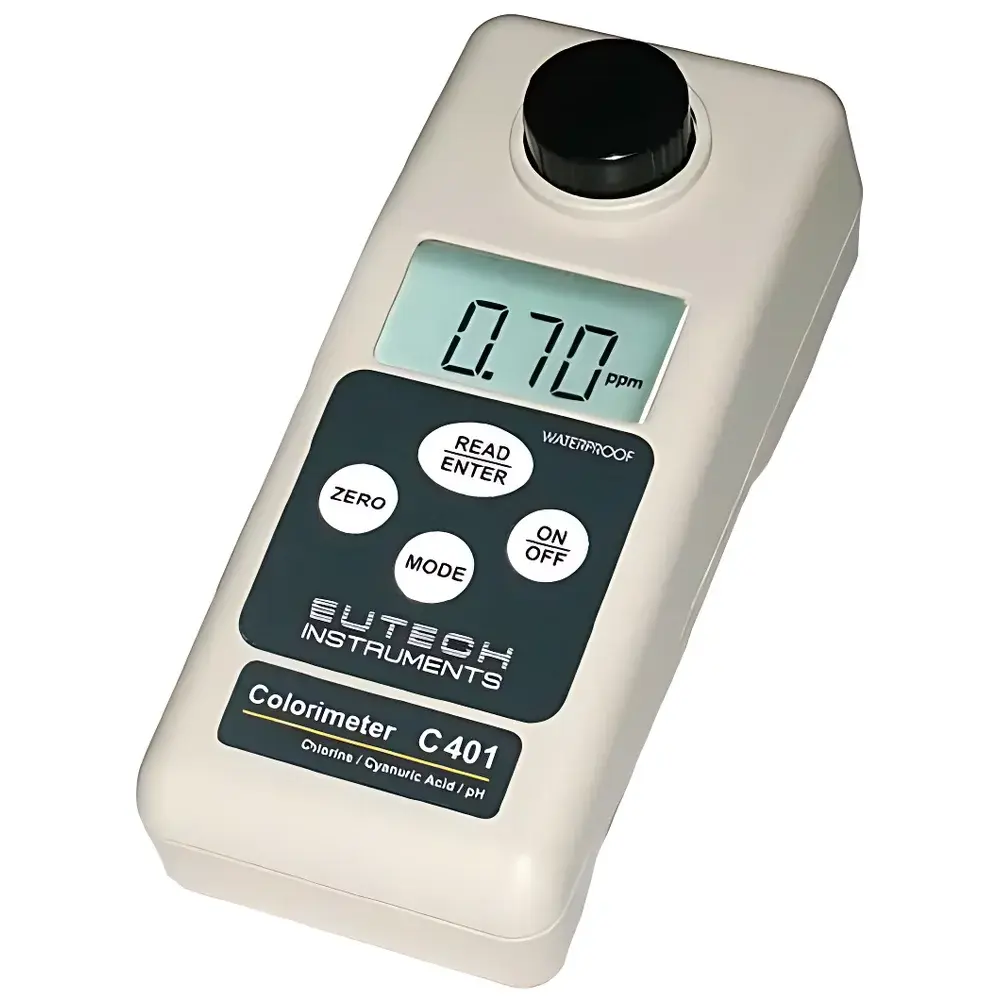
Thermo Fisher Eutech C401 Portable Residual and Total Chlorine, Cyanuric Acid & pH Colorimeter
| Brand | Thermo Fisher |
|---|---|
| Origin | Singapore |
| Manufacturer | Thermo Fisher Scientific |
| Product Type | Imported Instrument |
| Model | C401 |
| Price | Upon Request |
| Chlorine Range | 0–1.99 ppm / 2.0–6.0 ppm |
| Chlorine Resolution | 0.01 ppm / 0.1 ppm |
| Chlorine Accuracy | ±0.02 ppm / ±0.2 ppm |
| pH Range | 5.9–8.2 |
| pH Resolution | 0.1 |
| pH Accuracy | ±0.1 |
| Cyanuric Acid Range | 5–90 ppm |
| Cyanuric Acid Resolution | 1 ppm |
| Cyanuric Acid Accuracy | ±4 ppm |
| Light Source | LED (525 nm) |
| Calibration | Single-point user-selectable per test |
| Operating Temperature | 0–50 °C |
| Power Supply | 4 × 1.5 V AAA batteries |
| Battery Life | >3000 measurements |
| IP Rating | IP67 |
| Dimensions (Instrument) | 15.5 × 6.8 × 4.6 cm |
| Weight (Instrument) | 200 g |
| Packaging Dimensions | 35.5 × 16.5 × 10.5 cm |
| Package Weight | 1170 g |
Overview
The Thermo Fisher Eutech C401 is a rugged, handheld colorimetric analyzer engineered for field-deployable measurement of free residual chlorine, total chlorine, cyanuric acid, and pH in aqueous samples. It operates on the principle of absorbance photometry using a stable, temperature-compensated LED light source at 525 nm—optimized for DPD (N,N-diethyl-p-phenylenediamine) reaction chemistry. Unlike electrochemical or amperometric sensors, the C401 eliminates drift, electrode fouling, and calibration dependency by relying on standardized colorimetric reagent kits and optical detection. Its microprocessor-controlled optical path ensures consistent pathlength and photometric linearity across its dual-range chlorine measurement capability (0–1.99 ppm and 2.0–6.0 ppm), making it suitable for routine compliance monitoring where trace-level accuracy and operational simplicity are critical—particularly in recreational water management, municipal drinking water verification, and public health laboratory support.
Key Features
- IP67-rated enclosure for full dust ingress protection and submersion resistance up to 1 meter for 30 minutes—validated under IEC 60529 standards.
- Auto-ranging optical detection system with dual-resolution display: 0.01 ppm (low range) and 0.1 ppm (high range) for chlorine species, eliminating manual range selection errors.
- Integrated self-diagnostic firmware that validates LED output intensity, battery voltage stability, and sensor baseline prior to each measurement cycle.
- Pre-programmed method libraries for EPA-compliant DPD-based chlorine assays (Method 334.0) and cyanuric acid turbidimetry (Standard Methods 4500-Cl G), with embedded lot-specific reagent correction factors.
- High-efficiency optical architecture delivering <1.5% inter-instrument repeatability (n=12 units, same reagent lot, 1.0 ppm Cl₂ standard) under controlled ambient conditions (25 ± 2 °C).
- Low-power design enabling >3000 measurements per set of AAA alkaline batteries—verified per IEC 60086-2 specifications at 25 °C and 50% duty cycle.
Sample Compatibility & Compliance
The C401 accepts standard 10 mL glass or polypropylene sample vials (included) and is compatible with commercially available DPD No. 1 (free chlorine), DPD No. 3 (total chlorine), and melamine-based cyanuric acid reagents. Sample turbidity up to 5 NTU does not significantly interfere with absorbance readings due to fixed-wavelength detection and internal blank subtraction. The instrument meets ISO/IEC 17025 requirements for field instrumentation used in accredited testing laboratories when operated within defined environmental limits (0–50 °C, non-condensing humidity ≤85%). It supports documentation traceability aligned with GLP principles—including timestamped result storage and batch-coded reagent tracking—and is routinely deployed in facilities subject to CDC Model Aquatic Health Code (MAHC) and WHO Guidelines for Safe Recreational Water Environments.
Software & Data Management
While the C401 operates as a standalone instrument with no onboard data logging, its measurement protocol is fully compatible with Thermo Fisher’s optional Eutech Connect mobile application (iOS/Android) via Bluetooth 4.2 LE. This enables secure wireless transfer of time-stamped results—including operator ID, location metadata (GPS-tagged), reagent lot number, and instrument serial—for integration into LIMS or electronic lab notebooks. All transmitted data adhere to ALCOA+ principles (Attributable, Legible, Contemporaneous, Original, Accurate, Complete, Consistent, Enduring, Available) and support audit-ready export in CSV or PDF formats compliant with FDA 21 CFR Part 11 when paired with validated enterprise authentication workflows.
Applications
- Swimming pool and spa water quality verification per NSF/ANSI 50 and EN 15288-1.
- Drinking water distribution system spot-checking in accordance with US EPA Stage 2 Disinfectants and Disinfection Byproducts Rule (DBPR).
- Field validation of point-of-use (POU) chlorination systems in humanitarian response settings.
- Cyanuric acid stabilization monitoring in outdoor chlorinated pools to prevent UV degradation of free chlorine.
- Regulatory inspections conducted by state health departments, environmental agencies, and third-party certification bodies (e.g., AQUA, PWTAG).
FAQ
Does the C401 require daily calibration?
No. The instrument uses factory-calibrated optical components and single-point user verification per test—eliminating routine calibration drift common in electrochemical sensors.
Can the C401 measure combined chlorine independently?
No. Combined chlorine is calculated as the difference between total chlorine and free chlorine values, both measured sequentially using DPD No. 1 and DPD No. 3 reagents.
Is the device compliant with ASTM D1253 for residual chlorine determination?
Yes—the C401 implements the core photometric methodology specified in ASTM D1253-22, including DPD reagent chemistry, 525 nm detection, and 10 mm pathlength geometry.
What reagent formats are supported?
Powder pillows (DPD No. 1, No. 3, cyanuric acid), liquid reagents, and tablet forms—all conforming to APHA Standard Methods 4500-Cl G and 4500-CN G.
How is temperature compensation applied during pH measurement?
The integrated NTC thermistor automatically adjusts the pH electrode’s mV-to-pH conversion in real time across the full 0–50 °C operating range, per NIST SRM 186 buffer traceability.
Related Products







