
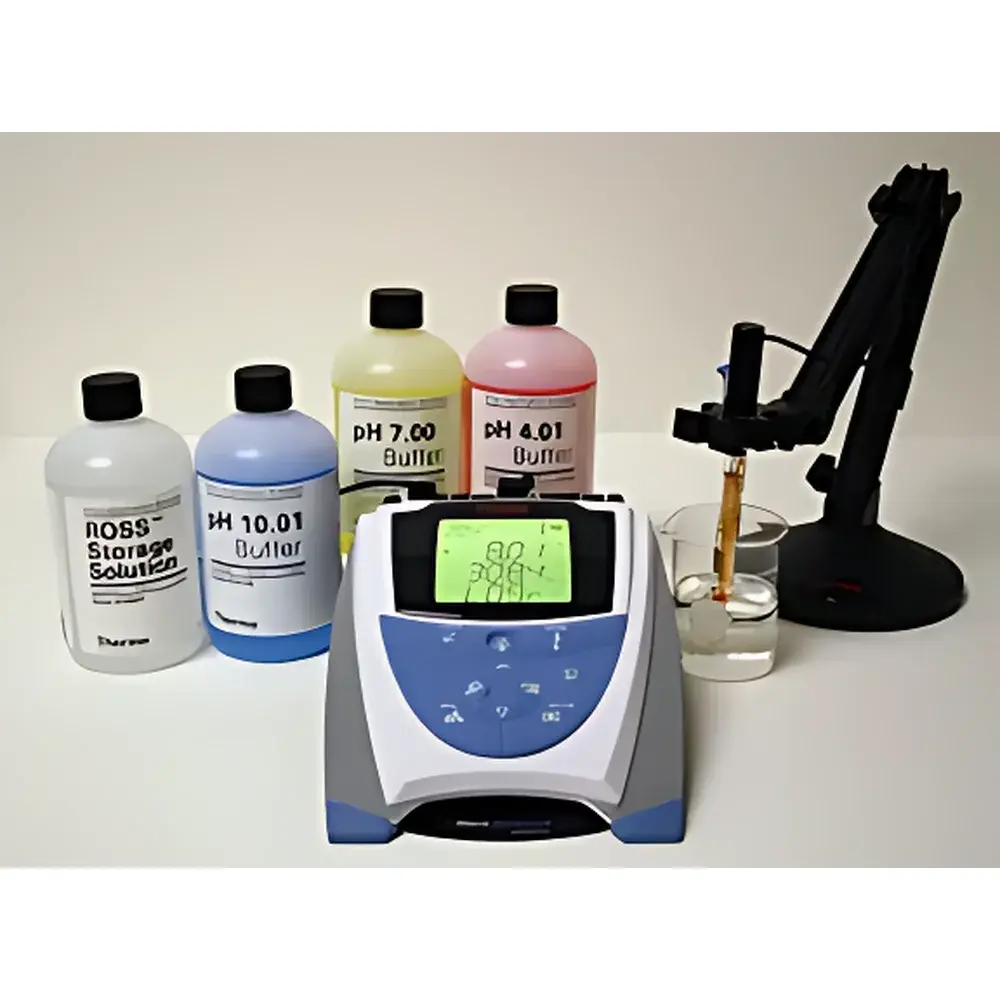
Thermo Scientific Orion Star LogR pH Meter
| Brand | Thermo Fisher |
|---|---|
| Origin | USA |
| Manufacturer | Thermo Fisher Scientific |
| Product Line | Orion Star LogR Series |
| Model | LogR |
| Measurement Principle | Potentiometric pH with integrated LogR temperature sensing via pH electrode membrane resistance |
| pH Range | –2.000 to 19.999 |
| Resolution | 0.001 pH (selectable) |
| Accuracy | ±0.002 pH |
| Calibration Points | 1–5-point, auto-buffer recognition (USA/NIST, EURO/DIN) |
| mV Range | ±1999.9 mV |
| mV Accuracy | ±0.2 mV or ±0.05% of reading, whichever is greater |
| Temperature Range | 0–100 °C (manual or LogR-compensated) |
| LogR Temp Accuracy | ±0.1 °C (10–100 °C) |
| Resistance Range | 0–6000 MΩ |
| Resistance Resolution | 0.1 MΩ (<2000 MΩ), 1 MΩ (≥2000 MΩ) |
| Data Storage | 1000 readings with timestamp |
| Interface | RS232 |
| Compliance | Designed for GLP/GMP environments |
Overview
The Thermo Scientific Orion Star LogR pH Meter is a precision potentiometric measurement system engineered for laboratories requiring high-accuracy, traceable pH and temperature determination without auxiliary temperature probes. Unlike conventional pH meters that rely on separate ATC (Automatic Temperature Compensation) sensors, the Star LogR series implements proprietary LogR technology—measuring the electrical resistance across the pH-sensitive glass membrane of compatible Orion ROSS™ electrodes to derive sample temperature in real time. This eliminates thermal lag, sensor mismatch, and calibration drift associated with dual-sensor systems. The instrument simultaneously acquires pH, mV, ORP, and membrane resistance values, enabling continuous electrode health monitoring. Its architecture supports rigorous regulatory compliance, including method validation workflows aligned with ASTM E70, ISO 3696, USP , and ICH Q2(R2) guidelines for analytical instrument qualification.
Key Features
- LogR temperature sensing: Direct, non-invasive temperature derivation from pH electrode membrane resistance—no external temperature probe required
- Real-time membrane resistance display (0–6000 MΩ): Enables proactive electrode diagnostics and failure prediction before measurement drift occurs
- SMART STABILITY™ and SMART AVERAGING™ algorithms: Dynamically adjust response thresholds and averaging windows to optimize precision under variable sample conditions
- 5-point pH calibration with buffer auto-recognition: Supports USA/NIST and EURO/DIN standard buffers; includes calibration alarm and slope validation reporting
- GLP-compliant data management: Stores up to 1000 timestamped readings with operator ID, method name, and calibration history
- Secure method storage: Up to 10 user-defined, password-protected methods—including custom calibration curves, units, and display preferences
- RS232 interface: Enables bidirectional communication with LIMS, ELN, or Thermo Fisher’s Orion Desktop Software for automated report generation and electronic signature support
- Backlit graphical LCD: High-contrast display with intuitive icon-based navigation and simultaneous multi-parameter readout (e.g., pH + temp + resistance)
Sample Compatibility & Compliance
The Orion Star LogR pH Meter is validated for use with Thermo Fisher’s full line of ROSS™ pH electrodes—including the included 8220BNWP micro-combination electrode—designed for low-ionic-strength, high-resistivity, and viscous samples. It meets the electrical safety requirements of IEC 61010-1 and electromagnetic compatibility standards per EN 61326-1. When operated with calibrated buffers traceable to NIST SRMs and paired with documented procedures, the system satisfies analytical instrument qualification (AIQ) criteria for installation qualification (IQ), operational qualification (OQ), and performance qualification (PQ) under GxP frameworks. Its resistance measurement capability supports routine verification of electrode integrity per ASTM D1129 and ISO 17025 clause 5.5.2.
Software & Data Management
Data export via RS232 enables seamless integration into regulated laboratory environments. When connected to Thermo Fisher’s Orion Desktop Software (v4.0+), users can generate 21 CFR Part 11–compliant reports with electronic signatures, audit trails, and version-controlled method archiving. The software supports raw data review, trend analysis of electrode resistance over time, and automated calibration certificate generation. All stored measurements include embedded metadata: date/time stamp, operator ID, electrode serial number, calibration status, and environmental temperature (LogR-derived). Internal memory retains full traceability even during power loss, and data can be exported in CSV or PDF formats for regulatory submission.
Applications
- Pharmaceutical QC labs performing pH testing of injectables, ophthalmic solutions, and buffer preparations per USP
- Biotechnology process development where rapid electrode health assessment reduces downtime during cell culture media preparation
- Environmental testing of surface waters and wastewater effluents with variable conductivity and temperature gradients
- Academic research requiring high-resolution pH profiling in electrochemical reaction monitoring
- Food & beverage quality control for acidified products, dairy fermentation, and shelf-life stability studies
- Chemical manufacturing QA workflows involving aggressive solvents or high-pH caustic solutions where conventional ATC probes degrade rapidly
FAQ
How does LogR technology improve pH measurement accuracy compared to traditional ATC?
LogR eliminates thermal inertia and spatial mismatch by deriving temperature directly from the pH electrode’s glass membrane—ensuring the temperature reference point coincides exactly with the pH-sensing interface.
Can the LogR function be disabled to use an external temperature probe?
No—the LogR system is hardware-integrated and requires compatible ROSS electrodes; it does not support external RTD or thermistor inputs.
Is the 8220BNWP electrode included in the 350S001 kit suitable for low-conductivity samples?
Yes—the ROSS micro-electrode features a low-resistance glass formulation and optimized junction design for stable response in deionized water and organic-aqueous mixtures down to 1 µS/cm.
Does the meter support ISO/IEC 17025-compliant uncertainty estimation?
When used with certified reference materials, documented calibration procedures, and recorded environmental parameters, the system provides the foundational data necessary for uncertainty budgeting per GUM (JCGM 100:2008).
What happens if membrane resistance exceeds 6000 MΩ during measurement?
The display shows “OVER” and triggers a visual alert; this indicates severe electrode dehydration or coating, prompting immediate cleaning or rehydration per Orion Technical Bulletin TB-1002.





