
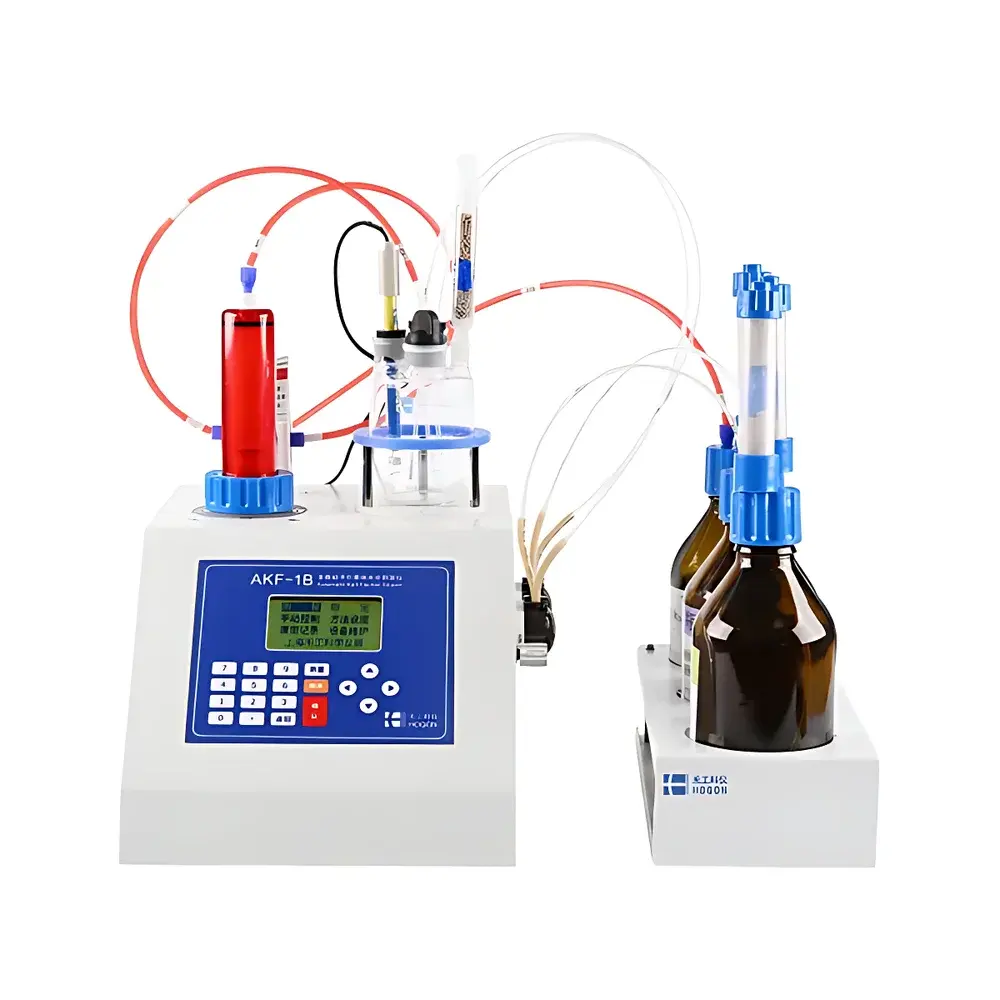
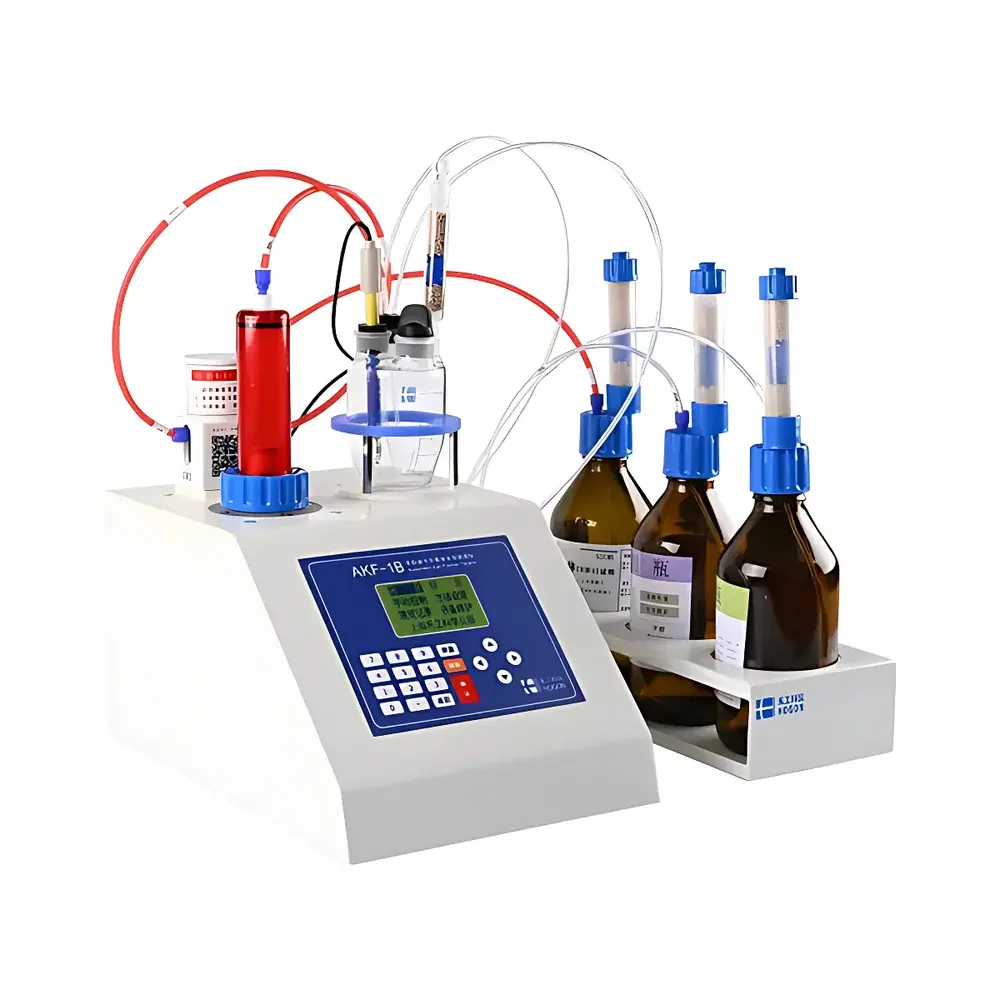
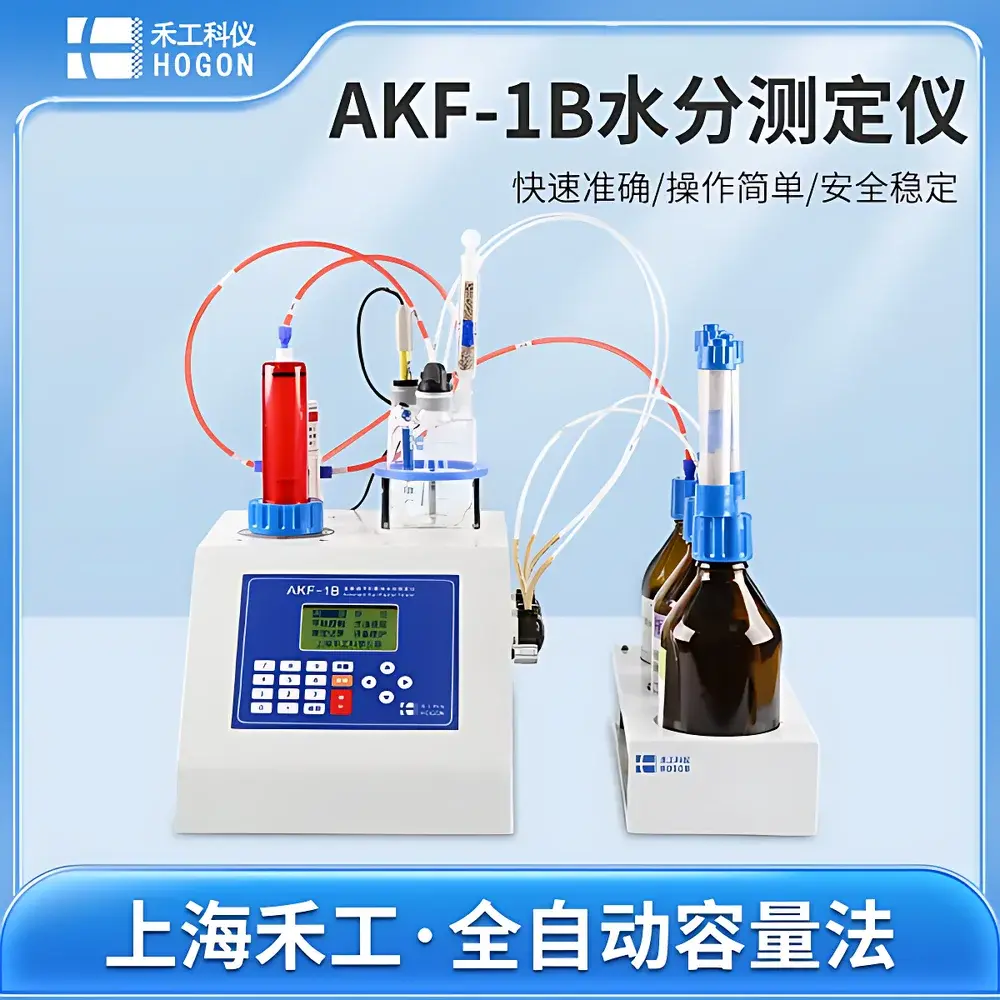
HOGON AKF-1B Automated Volumetric Karl Fischer Moisture Titrator
| Brand | HOGON |
|---|---|
| Origin | Shanghai, China |
| Manufacturer Type | Direct Manufacturer |
| Instrument Type | Volumetric Karl Fischer Titrator |
| Titration Mode | Fully Automated |
| Measurement Resolution | 1.0 µL |
| Moisture Range | 0.001–100% w/w |
| Accuracy (RSD) | ≤1.0% |
| Minimum Dispensing Volume | 5 µL (20 mL High-Precision Burette) |
| Repeatability | ±3.0% RSD |
| Linearity (r²) | ≥0.99 |
| Polarization Voltage Adjustment Range | 0–120 mV |
| Burette Capacity | 20 mL |
| Titration Control Precision | ±5.0 µL |
| Power Supply | 110–240 V AC, 50–63 Hz |
| Data Storage | Internal Memory with Auto-Save Function |
Overview
The HOGON AKF-1B is a fully automated volumetric Karl Fischer (KF) moisture titrator engineered for precision, reliability, and operational simplicity in regulated laboratory environments. It operates on the classical coulometric-free volumetric KF principle—where iodine generated *in situ* via stoichiometric reaction with water in a methanol-based electrolyte system is quantified by precise burette dispensing of standardized KF reagent. The instrument employs dual-platinum electrode polarization detection with adjustable voltage (0–120 mV), enabling robust endpoint discrimination across diverse sample matrices—including viscous oils, hygroscopic powders, and thermally labile pharmaceutical intermediates. Its sealed titration cell design minimizes atmospheric moisture intrusion, while integrated solvent exchange and waste evacuation subsystems eliminate manual handling of toxic pyridine-free or pyridine-containing KF reagents—ensuring operator safety and analytical integrity.
Key Features
- Fully enclosed titration cell compatible with all commercially available volumetric KF reagents (e.g., Hydranal®, Aquastar®, Riedel-de Haën®)
- Intelligent endpoint algorithm with adaptive PID-controlled titration rate modulation—optimizing speed without compromising endpoint sharpness
- Automated solvent fill, reagent aspiration, and waste discharge sequences—reducing procedural variability and cross-contamination risk
- Real-time drift compensation: continuous background moisture monitoring and automatic subtraction based on ambient humidity and temperature inputs
- 20 mL high-precision glass burette with ±5.0 µL delivery accuracy and 1.0 µL resolution; minimum dispensing volume of 5 µL ensures sensitivity for low-moisture samples
- Adjustable magnetic stirring (stepless speed control) and patented desiccant-integrated cell cap system to stabilize headspace conditions
- Integrated data logging: measurement parameters (moisture content %, absolute water mass µg, reagent consumption mL), dynamic titration curve, and timestamped results stored internally
Sample Compatibility & Compliance
The AKF-1B supports direct analysis of solid, liquid, and semi-solid samples across pharmaceutical APIs, excipients, polymers, petrochemical feedstocks, food-grade starches, agrochemical formulations, and battery-grade electrolytes. It conforms to core international standard methodologies including ASTM E203, ISO 760, USP , EP 2.5.12, and JP 2.05. In China, it meets GB/T 6283 (Chemical Products), GB 5009.3 (Food Safety), and GB/T 33818–2017 (CNT Conductive Slurries). The system architecture supports GLP-compliant workflows through audit-trail-capable result storage, user-access-level controls, and non-editable raw data retention—facilitating FDA 21 CFR Part 11 readiness when deployed with validated networked data export protocols.
Software & Data Management
The AKF-1B features an embedded real-time operating system with a 4.3-inch TFT LCD interface and full numeric keypad navigation—requiring no external PC for routine operation. All method parameters (endpoint threshold, drift correction window, stirring speed, solvent volume) are programmable and recallable per sample type. Measurement data—including moisture %, absolute water mass (µg), reagent consumed (mL), titration curve coordinates, and environmental drift values—are timestamped and retained in non-volatile memory (≥1,000 test records). USB export enables CSV-formatted data transfer to LIMS or statistical analysis platforms. Firmware supports user-defined report templates aligned with internal QA documentation requirements.
Applications
- Pharmaceutical QC: Residual moisture quantification in lyophilized products, tablet granules, and sterile active ingredients per ICH Q5C guidelines
- Materials Science: Water content verification in lithium-ion battery cathode slurries, silicone elastomers, and epoxy resin precursors
- Food & Agriculture: Compliance testing for flour, dairy powders, dried fruits, and animal feed per Codex Alimentarius moisture limits
- Petrochemical QA: Trace water determination in jet fuel (ASTM D6304), transformer oil (IEC 60814), and lubricants
- Research Laboratories: Method development for KF-compatible solvents, reagent stability studies, and kinetic endpoint profiling
FAQ
What KF reagent types are supported?
The AKF-1B accepts both single-component and two-component volumetric KF reagents—pyridine-free and pyridine-based—provided they meet standard iodine equivalence specifications (e.g., 5.0 mg H₂O/mL).
Does the instrument support external printer or LIMS integration?
Yes—via USB host port for direct printing and optional RS-232/USB-to-serial adapter for ASCII protocol-based LIMS connectivity.
How is moisture drift compensated during long-duration analyses?
The system continuously monitors baseline current drift over user-defined intervals (1–10 min), applies linear or exponential correction models, and subtracts calculated ambient contribution from final result.
Is calibration traceable to NIST or other national standards?
While the instrument itself does not include built-in certified reference materials, it supports external calibration using NIST-traceable water standards (e.g., sodium tartrate dihydrate, disodium tartrate sesquihydrate) per ASTM E203 Annex A1.
What maintenance intervals are recommended for routine operation?
Daily: Electrode cleaning with dry lint-free tissue; weekly: solvent line purge and cell drying; quarterly: burette piston lubrication and seal inspection per manufacturer’s technical bulletin TB-AKF-1B-MNT-2023.
Related Products





