
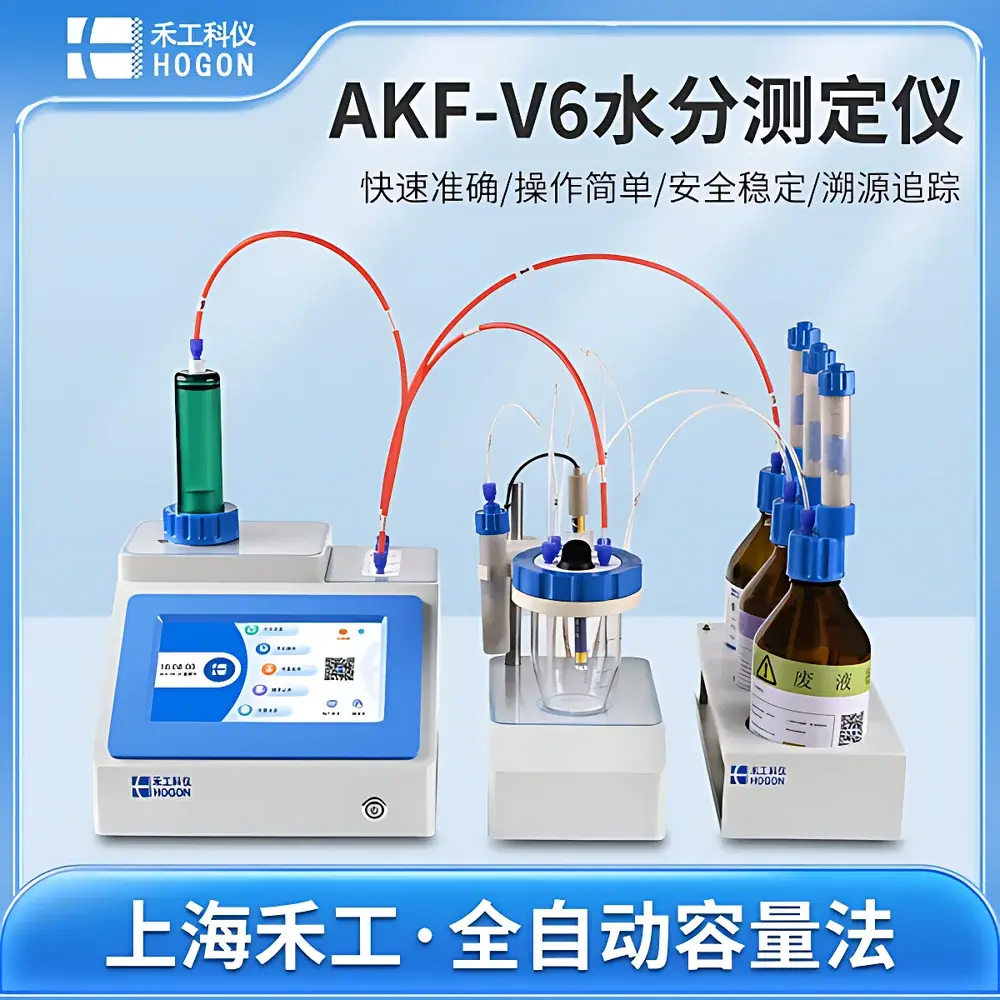
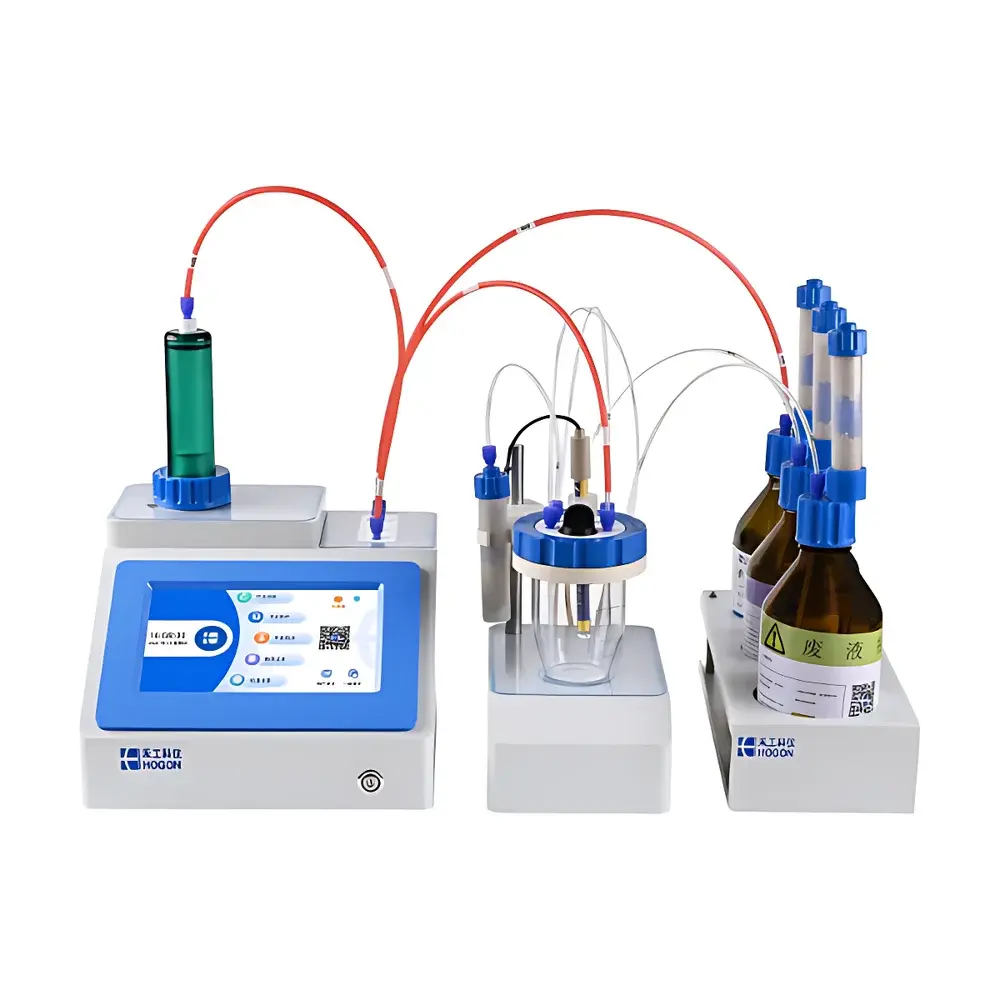
HOGON AKF-V6 Lactose-Specific Volumetric Karl Fischer Moisture Titrator
| Brand | HOGON |
|---|---|
| Origin | Shanghai, China |
| Manufacturer Type | Direct Manufacturer |
| Regional Classification | Domestic (China) |
| Model | AKF-V6 Lactose-Specific |
| Titration Method | Fully Automatic Volumetric Titration |
| Instrument Type | Volumetric Karl Fischer Moisture Analyzer |
| Moisture Range | 10 ppm – 100% H₂O (0.001–100 wt%) |
| Resolution | 0.1 ppm |
| Accuracy | RSD ≤ 0.3% (at 1500 µL reagent consumption) |
| Minimum Dispensing Volume | 0.5 µL (20 mL burette) |
| Burette Delivery Precision | ±0.5 µL (20 mL burette) |
Overview
The HOGON AKF-V6 Lactose-Specific Volumetric Karl Fischer Moisture Titrator is a purpose-engineered analytical instrument designed for high-precision water content determination in pharmaceutical excipients—particularly lactose—and other hygroscopic, low-solubility, or thermally sensitive biomaterials. It operates on the principle of volumetric coulometric-free Karl Fischer titration, where iodine generated in situ via stoichiometric reaction with water is quantified using a standardized iodine-containing titrant (e.g., I₂, SO₂, pyridine/methanol-based reagent). Unlike coulometric systems, the AKF-V6 employs a dual-plunger precision burette system to deliver titrant with sub-microliter repeatability, enabling robust quantification across trace (10 ppm) to bulk (100% w/w) moisture levels. Its architecture is optimized for compliance-critical environments—especially those governed by USP , EP 2.5.12, and JP 2.05—where reproducibility, auditability, and matrix-specific method robustness are non-negotiable.
Key Features
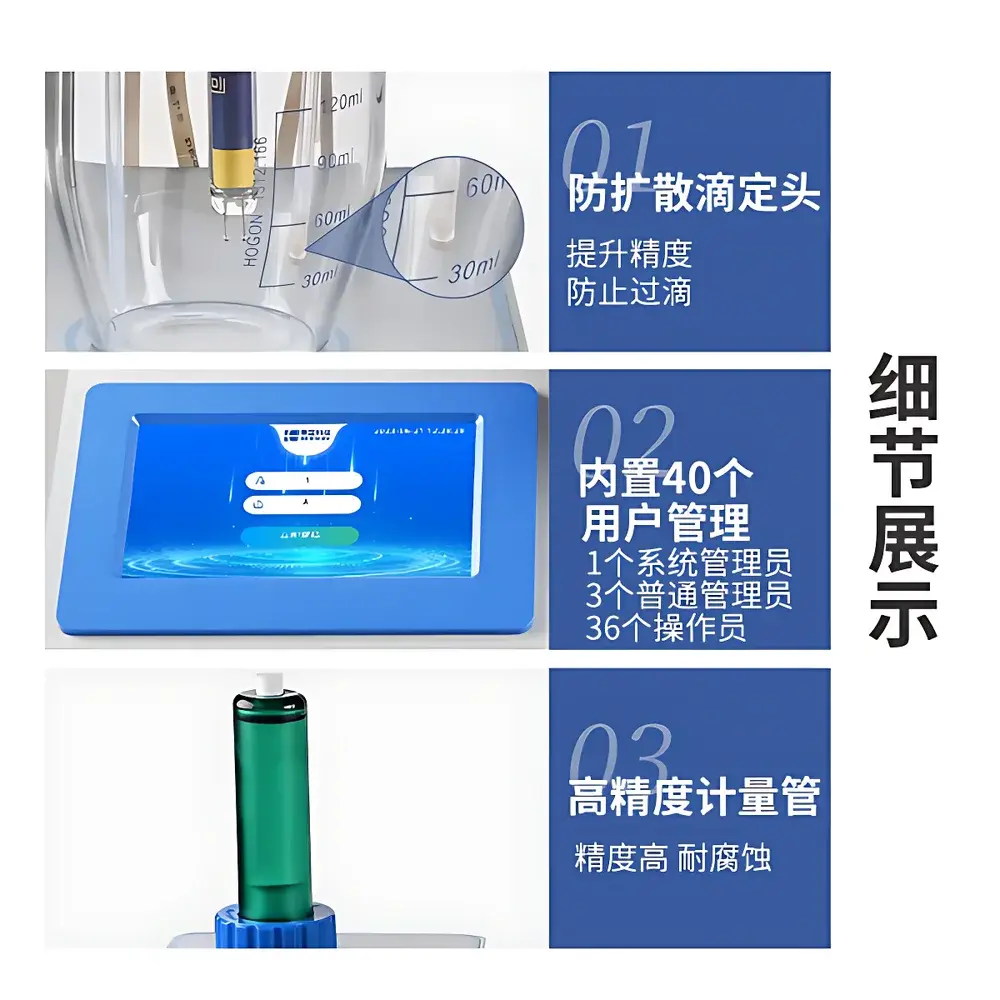
- 7-inch capacitive color touchscreen with intuitive bilingual (English/Chinese) UI, real-time titration curve visualization, and dynamic parameter display including drift compensation, endpoint slope, and reagent consumption
- Hermetically sealed titration cell assembly constructed from chemically resistant PTFE, borosilicate glass, and stainless-steel components—designed to prevent ambient moisture ingress and minimize reagent degradation
- HOGON proprietary high-fidelity burette drive mechanism delivering ±0.5 µL accuracy over 20 mL capacity, validated per ISO 8655-3 for piston burettes
- Fully automated liquid handling: auto-sampling (via optional syringe pump or external autosampler), reagent aspiration, cell rinsing, waste evacuation, electrode conditioning, and quantitative dispensing—all programmable per sample batch
- Multi-mode endpoint detection: dynamic slope thresholding, fixed drift stabilization, and adaptive algorithm-based equivalence point recognition—enabling reliable analysis of heterogeneous matrices such as freeze-dried proteins, polymeric carriers (PLA, PGA, PVA), and insoluble capsule shells
- Integrated GLP-compliant data management: time-stamped results, operator ID logging, electronic signature support, and full audit trail compliant with FDA 21 CFR Part 11 requirements
Sample Compatibility & Compliance
The AKF-V6 Lactose-Specific variant is pre-optimized for lactose monohydrate and anhydrous lactose—commonly used as fillers and binders in solid oral dosage forms. Its solvent compatibility extends to methanol, chloroform, acetonitrile, glacial acetic acid, and mixed systems (e.g., chloroform/methanol), supporting dissolution of challenging samples including hydrophobic polymers (e.g., PVP K30), lyophilized biologics (serum albumin, monoclonal antibody formulations), and low-volatility solvents (e.g., gadobutrol, etifoxine). The system conforms to pharmacopeial standards including USP “Water Determination”, EP 2.5.12 “Loss on Drying and Water Content”, and JP 2.05 “Determination of Water”. All firmware and software modules undergo periodic validation per IQ/OQ/PQ protocols aligned with ISO/IEC 17025 and GMP Annex 11.
Software & Data Management
The embedded HOGON TitraSoft™ v4.2 platform provides role-based access control (three-tier user hierarchy: Administrator, Supervisor, Operator), encrypted local database storage (≥1000 test records with full metadata), and export capability to CSV, PDF, or XML formats for LIMS integration. Each measurement includes raw current vs. time data, derivative plots, endpoint confirmation flags, and reagent lot traceability. Audit logs record all critical events—including method edits, calibration updates, user logins, and result deletions—with immutable timestamps and digital signatures. Optional network connectivity enables remote diagnostics and centralized fleet monitoring without compromising data sovereignty.
Applications
The AKF-V6 serves as a primary moisture verification tool across pharmaceutical development, QC release testing, and stability studies. Key use cases include: quantification of residual moisture in freeze-dried monoclonal antibody products; water content validation of excipient blends prior to tableting; moisture profiling of sterile ophthalmic solutions (e.g., sodium hyaluronate eye drops); batch consistency assessment of soft/hard gelatin capsules; and specification testing of API intermediates such as amoxicillin granules, ibuprofen capsules, and calcium carbonate tablets. It also supports regulatory submissions requiring documented method suitability per ICH Q2(R2), particularly for samples exhibiting slow dissolution kinetics or surface adsorption artifacts.
FAQ
Is the AKF-V6 compatible with non-aqueous solvents such as chloroform or acetonitrile?
Yes—the titration cell and fluidic pathway are chemically inert to common Karl Fischer solvents, including chloroform, acetonitrile, toluene, and glacial acetic acid.
Can the instrument be validated for GMP environments?
Yes—full IQ/OQ documentation packages are available, and the system supports 21 CFR Part 11 compliance through electronic signatures, audit trails, and user permission controls.
Does the AKF-V6 support heating accessories for difficult-to-dissolve samples?
Yes—optional heated headspace samplers and temperature-controlled stirring modules are available to enhance extraction efficiency for polymers and crystalline solids.
What is the minimum detectable water mass in a 10 mg sample?
At 10 ppm detection limit and 10 mg sample mass, the theoretical minimum detectable water mass is 0.1 ng—achievable under controlled ambient conditions and optimized titrant freshness.
How often does the burette require recalibration?
Burette linearity and delivery accuracy are verified during annual PQ; routine daily verification uses certified water standards traceable to NIST SRM 2890.




