
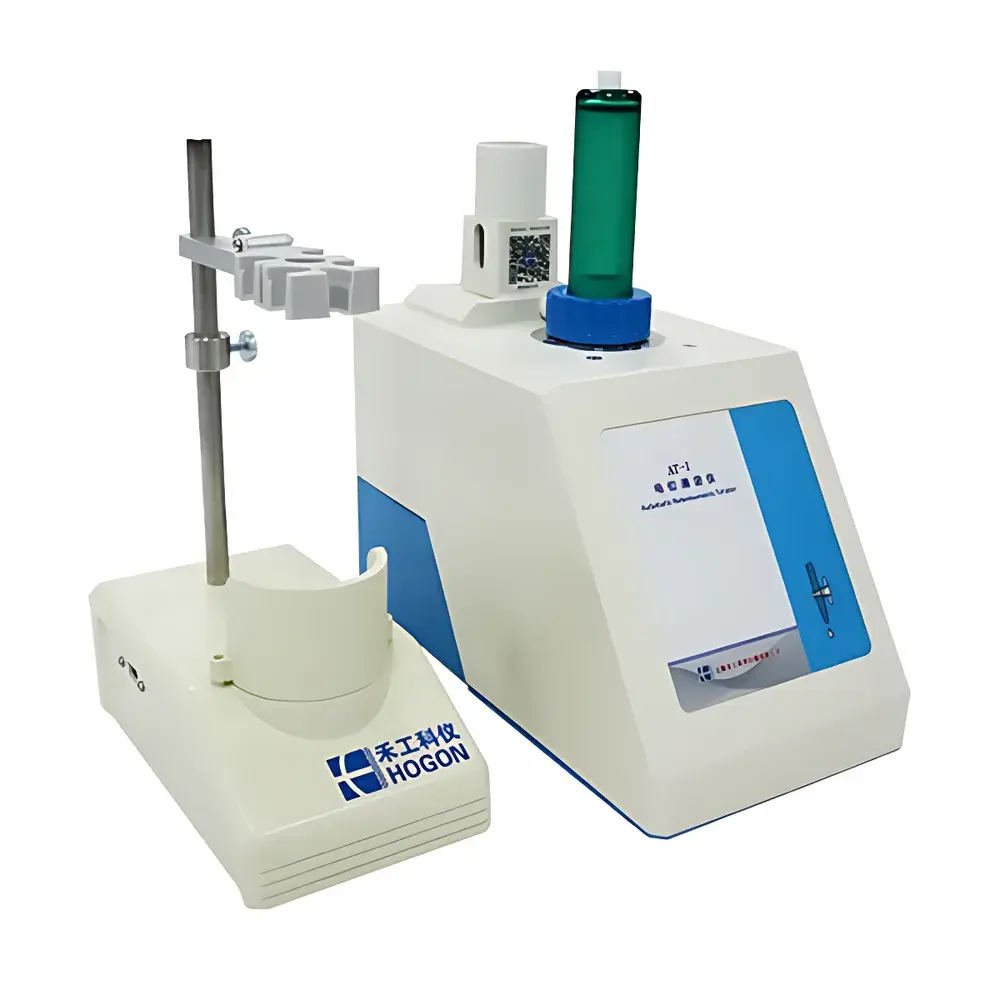
TCL-1B HOGON Cement-Specific Automatic Potentiometric Titrator
| Brand | HOGON |
|---|---|
| Origin | Shanghai, China |
| Manufacturer Type | Direct Manufacturer |
| Product Category | Domestic |
| Model | TCL-1B |
| Instrument Type | General-Purpose Potentiometric Titrator |
| Application Scope | Cement Chloride Ion Analysis Dedicated |
| Measurement Range | mV: −2000 to +2000 mV |
| pH | 0.000–14.000 |
| Temperature | −55.0 to +125.0 °C |
| Meter Accuracy | ±0.5% of full scale |
| Meter Resolution | 0.1 mV |
| Titration Precision | ≤0.8 mV/h |
Overview
The TCL-1B HOGON Cement-Specific Automatic Potentiometric Titrator is an application-optimized electrochemical analyzer engineered for the precise and standardized determination of chloride ion (Cl⁻) concentration in hydraulic cement and related construction materials. It operates on the principle of potentiometric endpoint detection using a silver/silver chloride (Ag/AgCl) indicator electrode paired with a double-junction saturated calomel reference electrode (SCE), enabling high-fidelity monitoring of the potential shift during argentometric titration with standardized silver nitrate (AgNO₃) solution. Designed in strict compliance with GB/T 176–2017 *Chemical Analysis Methods for Cement*, this instrument delivers trace-level chloride quantification (typically in the range of 0.005–0.5 wt%) required for quality control in cement manufacturing, precast concrete production, third-party testing laboratories, and building materials research institutions. Its architecture integrates closed-loop motorized burette control, real-time potential acquisition at 10 Hz sampling rate, and thermally compensated electrode signal processing — all calibrated against NIST-traceable reference standards.
Key Features
- GB/T 176–2017–compliant dual-mode operation: dedicated chloride ion assay and AgNO₃ standardization protocols, each with preloaded titration parameters (e.g., initial addition volume, dynamic step size, endpoint slope threshold)
- Triple-electrode configuration: factory-calibrated silver indicator electrode, chloride-selective membrane electrode, and double-junction saturated calomel reference electrode — optimized for low-noise signal stability in high-ionic-strength cement extracts
- USB 2.0 interface enabling full remote control via Windows-based HOGON TitraSoft™ software; supports synchronized data logging, method recall, and audit-ready electronic signatures
- Real-time dual-curve visualization: simultaneous display of E vs. V (potentiometric curve) and dE/dV vs. V (first derivative curve) with automatic inflection point detection and user-adjustable smoothing filters
- PDF report generation engine: exports fully annotated titration records—including raw data tables, curve overlays, calculation formulas, operator ID, timestamp, and environmental metadata—with unlimited storage capacity on local or network drives
- Role-based access control system: administrator-defined user accounts with granular permissions (e.g., method editing, calibration lockout, report export, audit log review) aligned with GLP/GMP documentation requirements
Sample Compatibility & Compliance
The TCL-1B is validated for use with aqueous extracts prepared from Portland cement, slag-blended cements, fly ash–containing binders, and mortar specimens per Clause 9.3 of GB/T 176–2017. Sample introduction utilizes standard 100 mL titration beakers with magnetic stirring (speed adjustable from 50–600 rpm). The system accommodates matrix effects from high alkalinity (pH >12.5) and suspended solids through adaptive baseline correction algorithms and optional filtration pre-treatment. All measurement procedures conform to ISO 9001–certified internal validation protocols. While not FDA 21 CFR Part 11–validated out-of-the-box, the software architecture supports electronic signature implementation and audit trail activation for regulated environments upon customer-specific configuration.
Software & Data Management
TitraSoft™ v4.2 provides a modular, ISO/IEC 17025–informed workflow environment. Core modules include Method Builder (for custom equivalence point algorithms), Calibration Manager (with multi-point electrode verification logs), and Report Designer (supporting configurable templates compliant with CNAS-CL01:2018 reporting clauses). Raw data files (.tdf) are stored in open ASCII format for third-party statistical analysis. Audit trails record every parameter change, calibration event, and result modification with operator ID, timestamp, and reason-for-change annotation. Data integrity is enforced via SHA-256 hashing of exported PDF reports and optional integration with enterprise LIMS via HL7 or CSV batch import.
Applications
- Chloride content verification in ASTM C114– and EN 196–2–compliant cement batches prior to dispatch
- Quality assurance testing of admixtures and supplementary cementitious materials (SCMs) for Cl⁻ contamination
- Research-scale investigation of chloride binding capacity in novel clinker formulations
- Validation of leaching protocols for chloride migration studies in hardened concrete
- Interlaboratory comparison exercises under CNAS proficiency testing schemes (e.g., PT-2023-CM-04)
FAQ
Does the TCL-1B support non-cement applications such as water or soil chloride analysis?
Yes — while optimized for cement matrices, its potentiometric platform can be reconfigured for chloride analysis in drinking water (per ISO 9297), wastewater (per EPA Method 325.3), and acid-leached soil extracts when paired with appropriate sample preparation protocols and electrode conditioning routines.
Is firmware upgradable in the field?
Yes — firmware updates are delivered via secure USB flash drive and installed through the TitraSoft™ Maintenance Console; version history and release notes are publicly archived on the HOGON technical portal.
What electrode maintenance procedures are recommended for long-term accuracy?
Silver indicator electrodes require weekly polishing with 0.3 µm alumina slurry and storage in 3 mol/L KNO₃ solution; double-junction reference electrodes must be refilled with saturated KCl every 30 days and cleaned ultrasonically for 5 minutes biweekly.
Can the instrument meet ISO/IEC 17025 traceability requirements?
Yes — HOGON provides factory calibration certificates traceable to NIM (National Institute of Metrology, China) standards, including uncertainty budgets for mV, pH, and temperature channels; on-site verification services are available upon request.
Is cloud-based data backup supported?
Not natively — however, TitraSoft™ supports scheduled automated backups to mapped network locations or NAS devices; integration with AWS S3 or Azure Blob Storage requires custom API middleware deployment by qualified IT personnel.





