
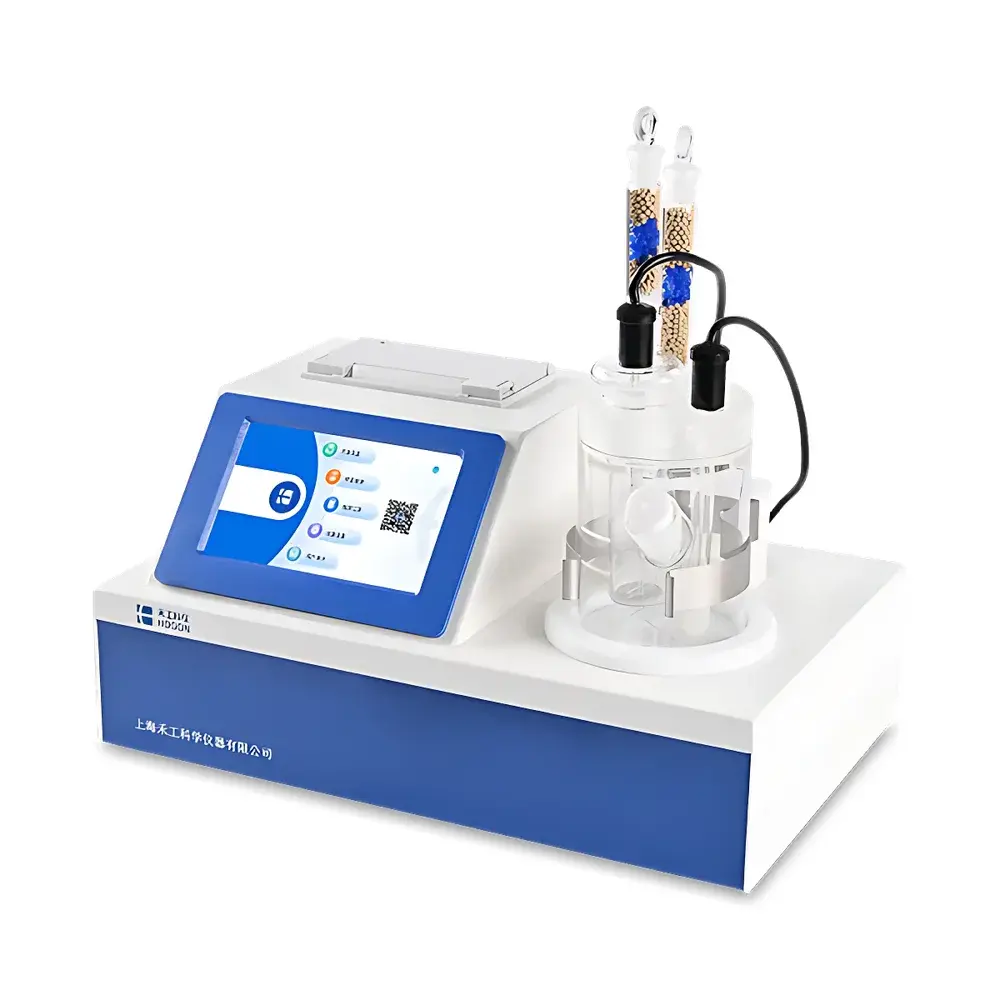
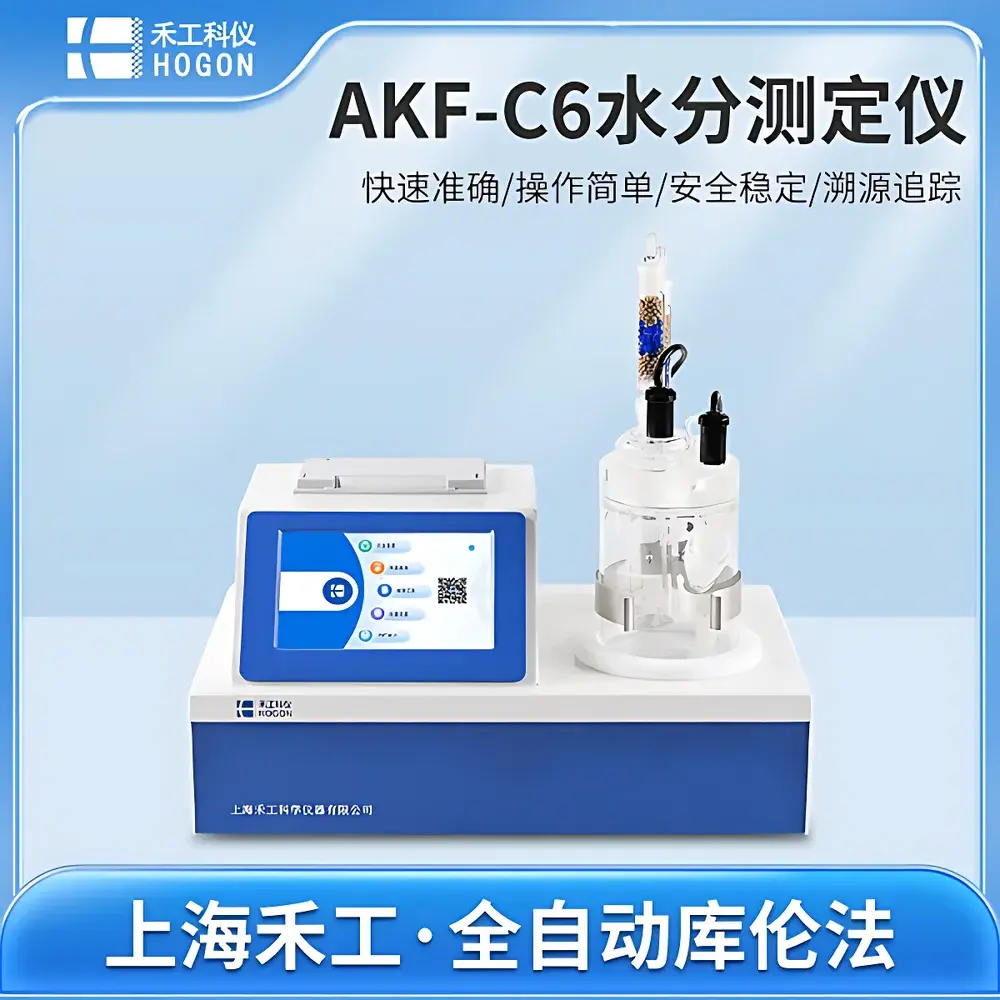
HOGON AKF-C6 Chloroform-Specific Coulometric Karl Fischer Moisture Analyzer
| Brand | HOGON |
|---|---|
| Origin | Shanghai, China |
| Manufacturer Type | Direct Manufacturer |
| Instrument Type | Coulometric Karl Fischer Titrator |
| Moisture Range | 0.001–100% w/w |
| Resolution | 0.01 µg |
| Accuracy | >99.7% (at 1000 µg water) |
| Minimum Dispense Volume | 1/2000 of burette capacity |
| Repeatability | 99.7% |
| Linearity (R²) | 0.999 |
| Electrode Type | Generator/Electrolysis Electrode |
| Current Control Precision | ±0.1 mA |
| Power Supply | 110–240 V AC, 50–61 Hz |
| Data Storage Capacity | 200 test records |
Overview
The HOGON AKF-C6 Chloroform-Specific Coulometric Karl Fischer Moisture Analyzer is a fully automated, microprocessor-controlled titration system engineered for high-precision coulometric water determination in low-water-content samples—particularly those dissolved or suspended in chloroform and other halogenated solvents commonly used in pharmaceutical synthesis, excipient processing, and biologics formulation. Unlike volumetric KF systems, the AKF-C6 employs electrochemical generation of iodine at the anode via Faraday-controlled electrolysis, enabling trace-level quantification (down to 0.01 µg absolute water mass) without manual reagent dispensing. Its design complies with the electrochemical equivalence principle defined in ASTM E203 and ISO 8533, ensuring stoichiometric accuracy across the full dynamic range (0.001–100% w/w). The instrument is explicitly optimized for chloroform-based matrices—addressing challenges such as solvent-induced electrode passivation, slow endpoint response, and background drift common in halogen-rich environments.
Key Features
- True coulometric operation with real-time current regulation (1–400 mA, ±0.1 mA precision), dynamically adapting to sample load and ambient humidity.
- Integrated multi-range electrolysis control architecture supporting rapid equilibrium stabilization—even under variable lab humidity (20–80% RH) and temperature fluctuations (15–30 °C).
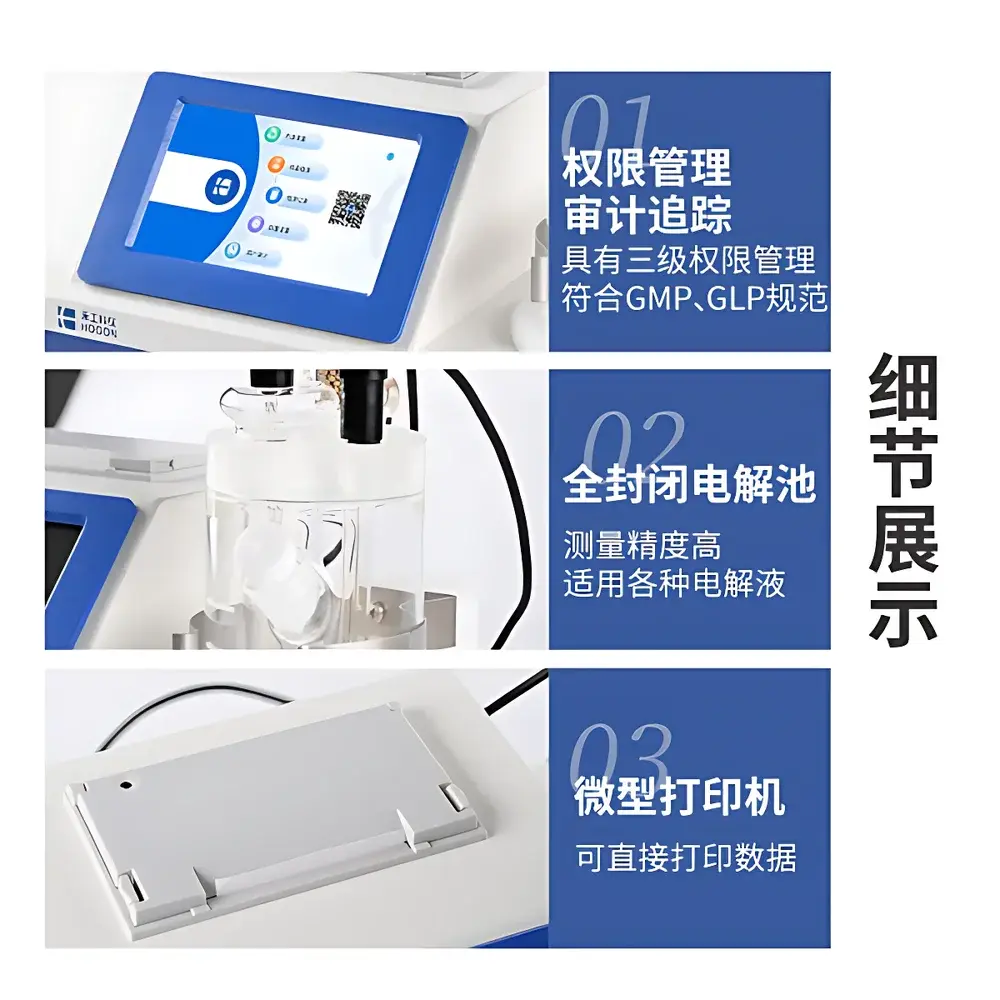
- Color capacitive touchscreen interface with alphanumeric keypad; method-driven workflow requiring no programming expertise.
- Onboard titration curve visualization: real-time current vs. time plot enables troubleshooting of endpoint anomalies, over-titration, or side reactions.
- Three-tier user permission system (Administrator / Supervisor / Analyst) with enforced password policies and session timeout.
- Built-in bromine index measurement capability—no hardware modification required—leveraging identical coulometric cell and current control logic.
- Intelligent drift compensation algorithms, including adaptive blank subtraction, multi-point drift calibration, and solvent-specific baseline correction.
- Hardware-level fault diagnostics: continuous monitoring of electrode impedance, cell voltage, electrolyte level, and power integrity with automatic error logging and safe shutdown.
Sample Compatibility & Compliance
The AKF-C6 is validated for direct analysis of pharmaceutical-grade solvents (chloroform, acetonitrile, toluene, glacial acetic acid), lyophilized biologics (e.g., PVA-, PLA-, PGA-based formulations), sterile injectables (eye drops, IV admixtures), solid dosage forms (capsule shells, tablets, granules), and diagnostic reagents. It meets critical regulatory requirements for analytical instrumentation in GxP environments: audit trail functionality compliant with FDA 21 CFR Part 11 (electronic records/signatures), full GLP/GMP traceability (user ID, timestamp, method version, raw current data, endpoint criteria), and data integrity per ALCOA+ principles. All stored records—including method parameters, titration curves, and drift corrections—are exportable in CSV format with cryptographic hash verification.
Software & Data Management
The embedded firmware implements a secure, role-based operating system with immutable audit logs recording every user action: login/logout, method modification, result deletion, calibration event, and system configuration change. Each test record contains metadata (operator ID, instrument serial number, date/time stamp, environmental conditions), raw current-time data points (≥1000/s sampling rate), calculated water mass (µg), %w/w, and statistical confidence indicators (RSD, linearity R²). Data export supports USB flash drive transfer with optional AES-256 encryption. Optional network integration enables centralized data archiving via secure FTP or LIMS-compatible APIs (HL7, ASTM E1384).
Applications
- Quantification of residual moisture in freeze-dried monoclonal antibodies, vaccines, and enzyme preparations per USP <921> and Ph. Eur. 2.5.12.
- Batch release testing of chloroform-solubilized active pharmaceutical ingredients (APIs) such as gadobutrol and etifoxine hydrochloride.
- Stability-indicating assay of hygroscopic excipients (lactose, starch, povidone K30) under ICH Q1A(R3) accelerated conditions.
- Bromine index determination in refined petrochemical feedstocks using the same coulometric cell—eliminating cross-contamination risk.
- QC/QA testing of medical device materials (surgical sutures, hydrogel adhesives) where water content directly impacts mechanical integrity and sterility assurance.
FAQ
Does the AKF-C6 require dedicated chloroform-compatible electrodes?
No—the standard platinum generator/indicator electrode set is chemically resistant to chloroform and pre-validated for extended use in halogenated solvents without performance degradation.
Can the instrument be integrated into a laboratory network for remote monitoring?
Yes—via optional Ethernet module supporting SNMP status polling, scheduled report generation, and TLS-encrypted data upload to enterprise LIMS or cloud storage.
Is method validation support provided for pharmacopeial compliance?
HOGON supplies IQ/OQ documentation templates aligned with EU Annex 15 and USP <1058>, including system suitability test protocols, specificity verification procedures, and forced degradation study guidance.
What maintenance intervals are recommended for long-term operational reliability?
Electrode cleaning every 500 analyses; electrolyte replacement every 3 months or after 2000 µg cumulative water consumption; annual calibration verification using certified NIST-traceable water standards.
How does the AKF-C6 handle samples with high salt content or ionic interference?
The instrument’s adaptive current modulation and dual-electrode potentiometric endpoint detection suppress chloride-induced false endpoints, validated per ISO 12927 for saline-containing biologics and contrast agents.




