
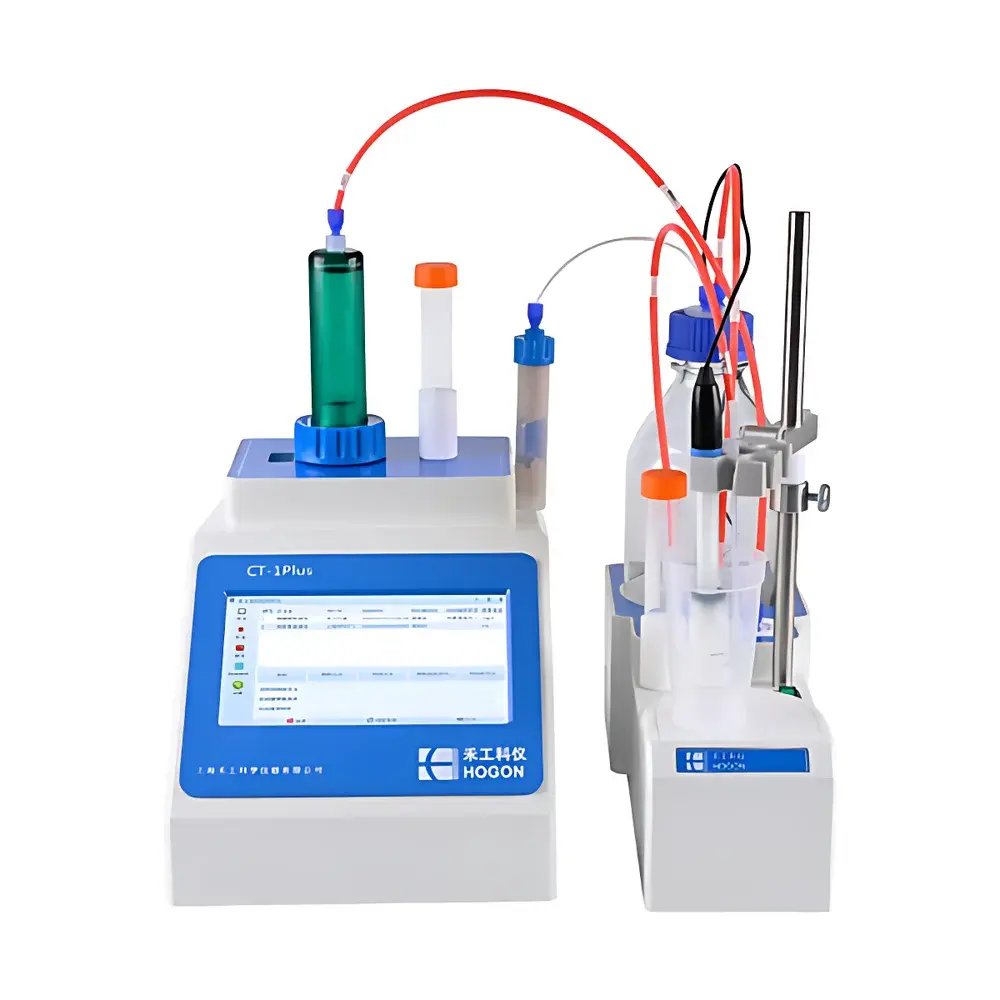
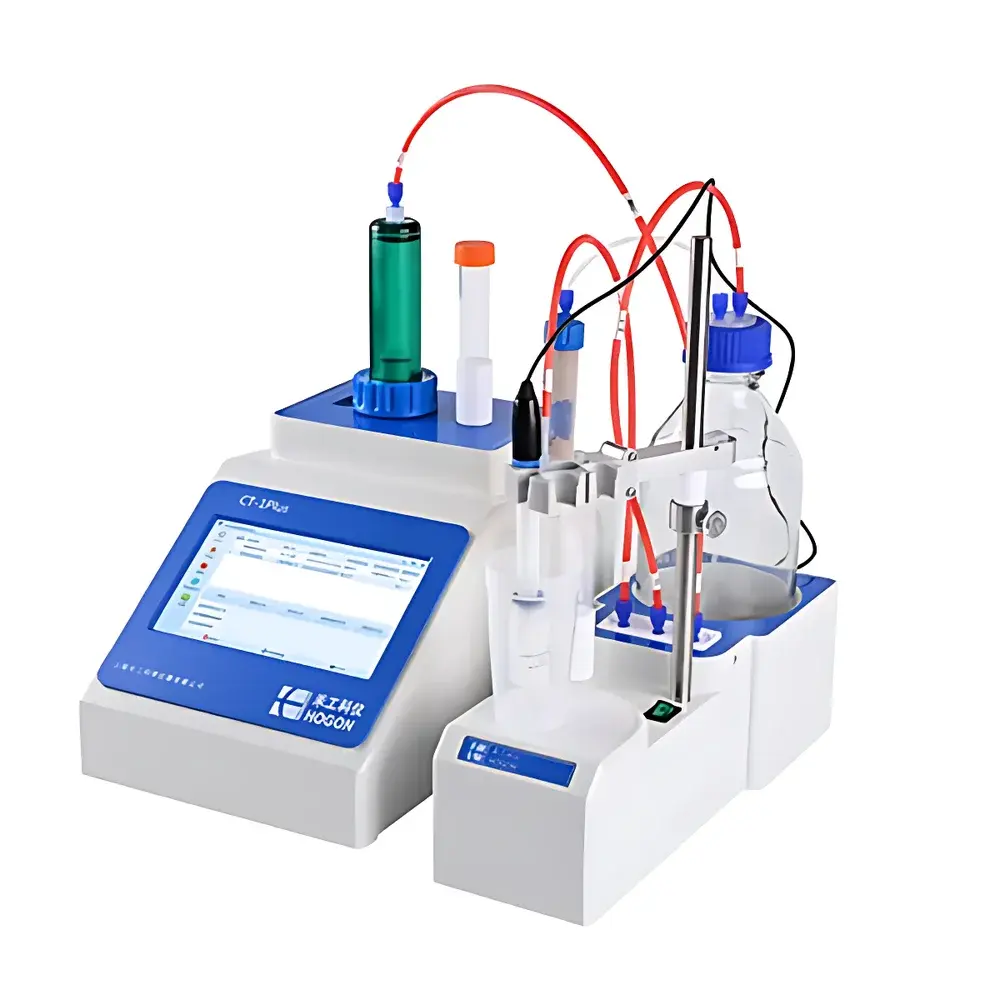
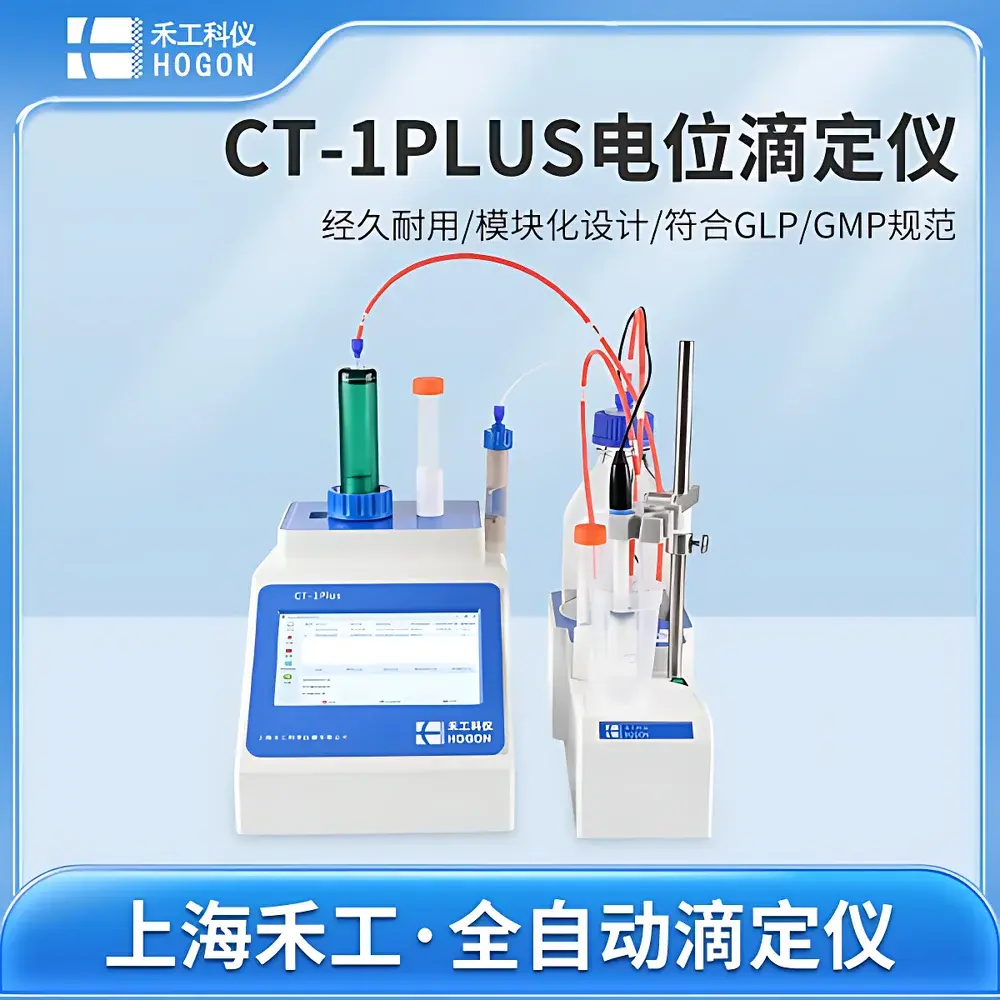
HOGON CT-1Plus Automatic Color-Endpoint Detection Potentiometric Titrator
| Brand | HOGON |
|---|---|
| Origin | Shanghai, China |
| Manufacturer Type | Direct Manufacturer |
| Instrument Type | General-Purpose Automatic Potentiometric Titrator |
| Model | CT-1Plus (Color-Endpoint Detection Enabled) |
| Measuring Range | Potential: ±1024 mV |
| pH | 0–14 pH |
| Meter Accuracy | ±0.5% of full scale |
| Meter Resolution | 0.1 mV (potential), 0.001 pH |
| Titration Accuracy | (±0.3 mV ±1 digit) over 3 h |
| Titration Range | ±2000 mV |
| Resolution | 0.1 mV |
| Absolute Accuracy | ±0.2 mV |
Overview
The HOGON CT-1Plus Automatic Color-Endpoint Detection Potentiometric Titrator is a dual-mode analytical instrument engineered for precision and versatility in quantitative chemical analysis. It integrates classical potentiometric titration—based on Nernst equation-driven potential measurement at the indicator electrode—with an optically coupled color-endpoint detection module grounded in machine vision principles. This hybrid architecture enables reliable endpoint determination in samples where electrochemical signal stability is compromised—such as turbid, colored, or low-conductivity matrices—where conventional potentiometric methods may yield ambiguous inflection points. Designed for compliance with international laboratory quality frameworks, the CT-1Plus supports fully traceable, auditable workflows aligned with GLP and GMP requirements. Its modular construction separates fluidic control (high-precision burette assembly), electronic measurement (low-drift analog front-end), and endpoint decision logic (real-time algorithmic processing), ensuring long-term operational stability and metrological integrity.
Key Features
- Dual-mode endpoint detection: Simultaneous support for potentiometric (voltage/pH-based) and colorimetric (RGB-channel visual recognition) endpoint identification, eliminating method development bottlenecks in complex sample matrices.
- High-fidelity fluidic control: Peristaltic-free, glass syringe-based burette system delivering ≤1 µL volumetric precision per dispensing step, validated across 10,000+ operational cycles under ISO 8655-3 conditions.
- Stable electrochemical measurement: Low-noise, auto-calibrating potentiostat circuitry with 0.1 mV resolution and ±0.2 mV absolute accuracy over extended drift testing (72 h continuous operation).
- Modular hardware architecture: Physically decoupled titration unit, control module, and sensor interface—enabling field-replaceable components without system recalibration or firmware reflash.
- Fail-safe operational logic: Hardware-level emergency stop circuitry integrated into motor drivers and valve actuators; independent watchdog timer ensures deterministic shutdown upon communication timeout or voltage anomaly.
Sample Compatibility & Compliance
The CT-1Plus accommodates aqueous and mildly organic solvent systems (up to 20% v/v methanol, ethanol, or acetone) compatible with standard glass pH and redox electrodes. It supports ASTM D1120 (acid number), ISO 8294 (free fatty acid), and USP (acid-base titrations) methodologies. All data acquisition, method storage, and report generation comply with FDA 21 CFR Part 11 requirements—including electronic signature enforcement, audit trail logging (immutable timestamped records of all parameter changes), and role-based access control. PDF reports generated to USB storage are digitally signed and cryptographically hashed to prevent post-acquisition tampering—fully satisfying GLP documentation mandates for regulatory submissions.
Software & Data Management
The embedded Linux-based control software provides intuitive touchscreen navigation while maintaining full command-line interface (CLI) accessibility for automated integration via RS-232/USB-serial or Ethernet (Modbus TCP). Method templates include preconfigured protocols for acid-base, redox, precipitation, and complexometric titrations—with customizable derivative thresholding, equivalence point smoothing algorithms (Savitzky-Golay 3rd-order), and multi-step titration sequences. All raw sensor data (mV, pH, time, volume) is logged at ≥10 Hz and stored in open-format CSV alongside metadata (operator ID, ambient temperature/humidity, electrode serial number). U disk export produces ISO 32000-1 compliant PDF/A-2u files containing embedded calibration certificates, method version history, and digital signatures—ensuring long-term readability and forensic reproducibility.
Applications
- Pharmaceutical QC: Quantification of active pharmaceutical ingredients (APIs) via non-aqueous acidimetry (e.g., amine titration in glacial acetic acid).
- Foods & Beverages: Determination of total acidity (TA) in fruit juices, titratable acidity in dairy products, and chloride content in processed meats using argentometric titration.
- Environmental Testing: Alkalinity profiling in wastewater effluents and sulfide quantification in sediment pore water using iodometric back-titration.
- Chemical Manufacturing: Assay of sodium hydroxide concentration in caustic soda solutions and purity verification of sodium carbonate batches.
- Academic Research: Teaching laboratories requiring robust, low-maintenance platforms for fundamental electrochemical concepts and endpoint detection theory.
FAQ
Does the CT-1Plus require external PC connectivity for routine operation?
No—the instrument operates autonomously with its integrated touchscreen interface and onboard method library. PC connection is optional and used only for advanced data export, remote diagnostics, or LIMS integration.
Can the color-detection module be calibrated against NIST-traceable color standards?
Yes—calibration employs CIE LAB space mapping using certified ceramic tile standards (NIST SRM 2789, 2790) with user-defined tolerance thresholds for hue, saturation, and luminance deviation.
Is electrode maintenance supported directly through the instrument UI?
Yes—built-in electrode diagnostics include impedance spectroscopy sweep (10 Hz–100 kHz), junction potential monitoring, and automatic slope validation alerts per IUPAC-recommended protocols.
What is the maximum number of titration steps supported in a single method sequence?
Up to 16 sequential titration stages, each with independent endpoint criteria (fixed potential, dynamic dE/dV threshold, or color delta-E limit), volume limits, and pause intervals.
How is data integrity ensured during power interruption?
Non-volatile FRAM memory retains real-time titration state (volume dispensed, current potential, timestamp) with sub-second write latency—enabling seamless resumption after recovery without result corruption.






