
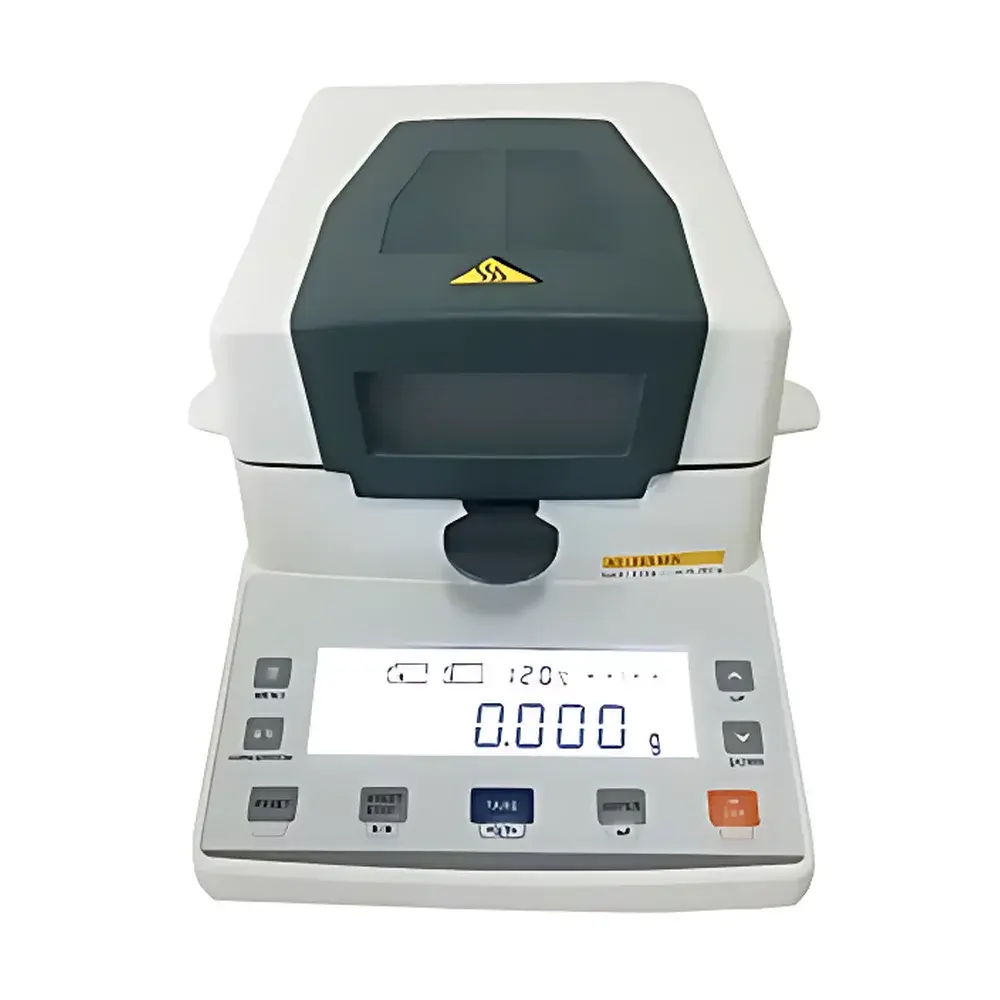
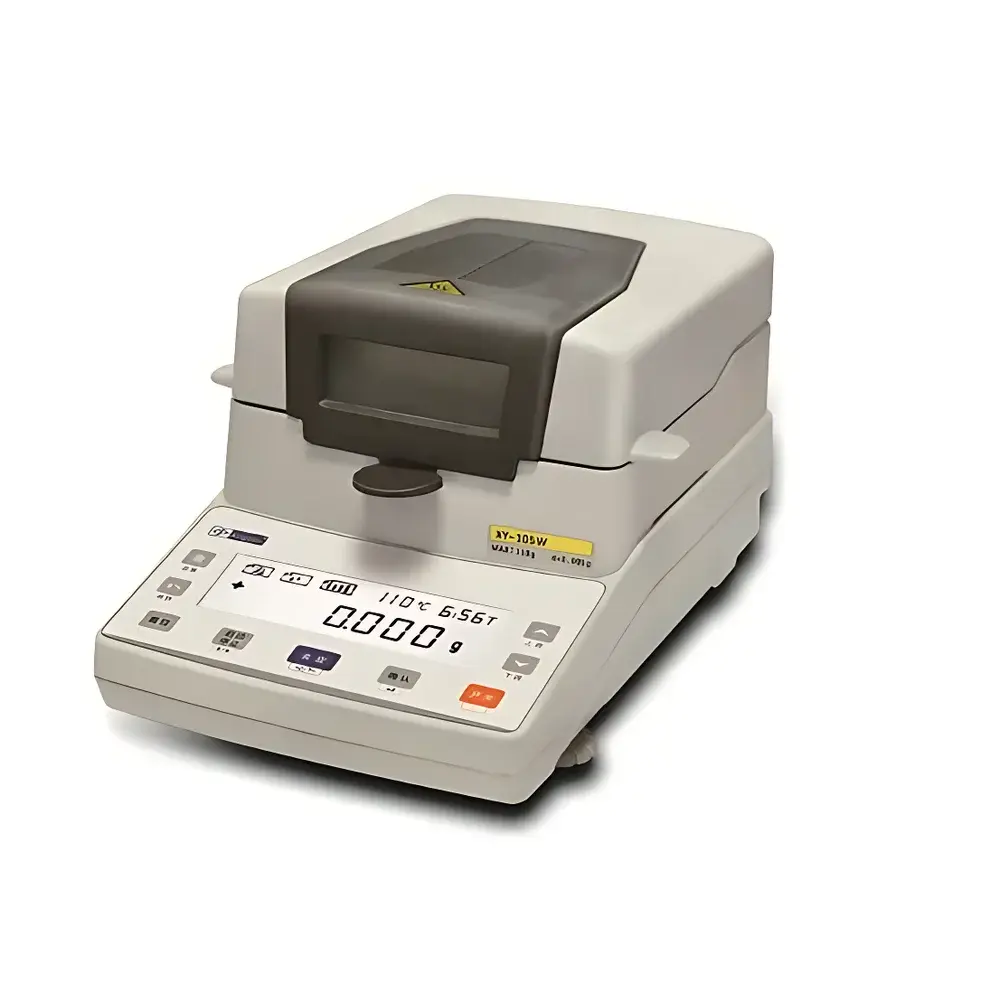
HOGON HM Series Halogen Moisture Analyzer
| Brand | HOGON |
|---|---|
| Origin | Shanghai, China |
| Manufacturer Type | Direct Manufacturer |
| Model | HM Series |
| Heating Method | Halogen Lamp |
| Measurement Principle | Loss-on-Drying (LOD) via Halogen Radiant Heating |
| Weighing Range | 110 g |
| Weighing Resolution | 0.0001 g to 0.005 g (model-dependent) |
| Temperature Range | Ambient to 199 °C |
| Drying Modes | Standard / Rapid / Gentle |
| Preheating Time | < 60 s to 50–180 °C |
| Data Storage | 15 measurement records |
| Programs Stored | Up to 16 user-defined methods |
| Interface | RS-232 serial port |
| Compliance | GLP/GMP/GCP, ISO/IEC 17025-aligned operation, meets JJG 1084–2013 (Chinese National Metrological Verification Regulation for Moisture Analyzers) |
Overview
The HOGON HM Series Halogen Moisture Analyzer is a precision loss-on-drying (LOD) instrument engineered for rapid, reproducible moisture content determination in solid and semi-solid samples. Unlike conventional oven-drying methods—subject to thermal lag, uneven heat distribution, and operator-dependent endpoint judgment—the HM Series employs a high-intensity, ring-shaped halogen lamp heating system coupled with a high-stability analytical balance. This integrated architecture delivers uniform radiant heating across the sample surface, minimizing thermal gradients and enabling precise control of drying temperature (ambient to 199 °C) and time. The instrument operates on the fundamental gravimetric principle: moisture content is calculated as the mass loss between initial and final weight after controlled thermal dehydration. Designed for routine QC/QA laboratories and production environments, it conforms to internationally recognized metrological practices—including alignment with ISO 8587 (sensory analysis), ASTM D4457 (moisture in resins), and USP & EP general chapters on LOD testing—while satisfying national verification requirements per JJG 1084–2013.
Key Features
- Ring-shaped halogen heating system: Delivers rapid, homogeneous thermal energy transfer; achieves target temperature (50–180 °C) in under 60 seconds, reducing total analysis time to 3–8 minutes for most routine samples.
- High-resolution weighing module: Models offer selectable readability from 0.0001 g to 0.005 g, supporting accurate moisture quantification down to 0.001% (HM-100S) with full-scale repeatability ≤ 0.0002 g (2σ).
- Programmable method library: Stores up to 16 user-defined drying protocols—including temperature ramp profiles, hold times, endpoint criteria (e.g., Δm ≤ 0.1 mg/10 s), and auto-shutdown logic—to ensure inter-operator consistency and eliminate setup errors.
- GLP-compliant data handling: Each measurement record includes timestamp, operator ID, calibration status, ambient temperature/humidity, and full drying curve metadata. Output supports traceable reporting per FDA 21 CFR Part 11 requirements when paired with compliant software.
- Intuitive LCD interface: Large backlit display shows real-time moisture %, residual dry mass, elapsed time, current temperature, and drying rate—enabling immediate process monitoring without external software.
- Robust mechanical design: Ergonomically contoured housing with heat-resistant shielding; stainless steel sample pan (Ø90 mm); front-accessible draft shield; and passive cooling architecture to maintain stable internal thermal environment during repeated use.
Sample Compatibility & Compliance
The HM Series accommodates diverse matrices across regulated and industrial sectors. Validated applications include polymeric granules (PA, PC, PET, PPS), agricultural commodities (corn, soybean, coffee beans, tea leaves), pharmaceutical actives and excipients (lactose, microcrystalline cellulose, herbal powders), food ingredients (starches, flours, dairy powders), and inorganic materials (clays, carbonates, metal oxides, battery cathode precursors). For volatile or thermally labile samples—such as solvated crystals, low-melting-point APIs, or solvent-containing slurries—the instrument supports gentle drying modes with programmable low-temperature ramps and dynamic endpoint detection to prevent decomposition or splattering. All models meet electrical safety standards IEC 61010-1 and EMC directive 2014/30/EU. Operation in GMP environments requires documented IQ/OQ/PQ validation; built-in self-test routines and calibration traceability (via certified weights) support audit readiness.
Software & Data Management
Standard RS-232 interface enables direct connection to laboratory printers or PCs running third-party data acquisition software (e.g., LabX, WinCT-Moisture, or custom Python/Excel VBA scripts). Raw data export includes ASCII-formatted time-stamped logs containing initial mass, final mass, moisture %, dry residue %, drying curve points (mass vs. time), and method parameters. Optional HOGON MoistureLink™ software provides enhanced functionality: automated report generation (PDF/CSV), statistical trend analysis across batches, user access controls, electronic signature capture, and audit trail logging compliant with 21 CFR Part 11 Annex 11 principles. Calibration history and maintenance logs are retained separately to support ISO/IEC 17025 clause 6.4.10 requirements.
Applications
The HM Series serves as a primary moisture testing platform in quality control laboratories across multiple industries. In polymer manufacturing, it verifies resin moisture prior to extrusion or injection molding to prevent hydrolysis-induced degradation. In food production, it ensures compliance with Codex Alimentarius moisture limits for shelf-life prediction and labeling accuracy. Pharmaceutical users apply it for excipient qualification (e.g., anhydrous vs. hydrated lactose), stability study endpoints, and release testing per USP . Feed mills rely on its speed and precision for raw material acceptance of soybean meal and corn gluten. Additionally, it supports R&D workflows in battery material development (e.g., moisture quantification in NMC cathodes), ceramic processing (green body moisture control), and construction material certification (e.g., gypsum purity assessment).
FAQ
What safety precautions apply when measuring flammable or reactive samples?
Always conduct a preliminary risk assessment. Use the “Gentle” drying mode at reduced temperatures (<100 °C), limit sample mass to ≤1 g, wear ANSI Z87.1-rated eye protection, and operate only in a fume hood with explosion-proof ventilation. Never measure solvents, nitrocellulose, or peroxide-forming compounds without engineering controls.
How often must the instrument be calibrated?
Internal calibration using certified weights (e.g., 10 g, 50 g, 100 g) is recommended before each shift or daily in high-throughput labs. External verification against NIST-traceable reference standards should occur quarterly or per your SOP’s metrological control plan.
Can the HM Series replace Karl Fischer titration?
It complements but does not replace KF for bound water or low-moisture samples (0.05% range; KF remains superior for hygroscopic salts or azeotropic solvents.
Is method transfer possible between HM models?
Yes—method parameters (temperature profile, endpoint criterion, hold time) are portable across HM-100S, HM-101X, HM-102F, and HM-105L. However, due to differing weighing resolutions, reported moisture precision must be adjusted per model specification.
Does the instrument support regulatory audit trails?
When used with validated software (e.g., MoistureLink™), full electronic audit trails—including user actions, parameter changes, and result modifications—are generated and exportable in tamper-evident format per 21 CFR Part 11 §11.10(e).
Related Products




