
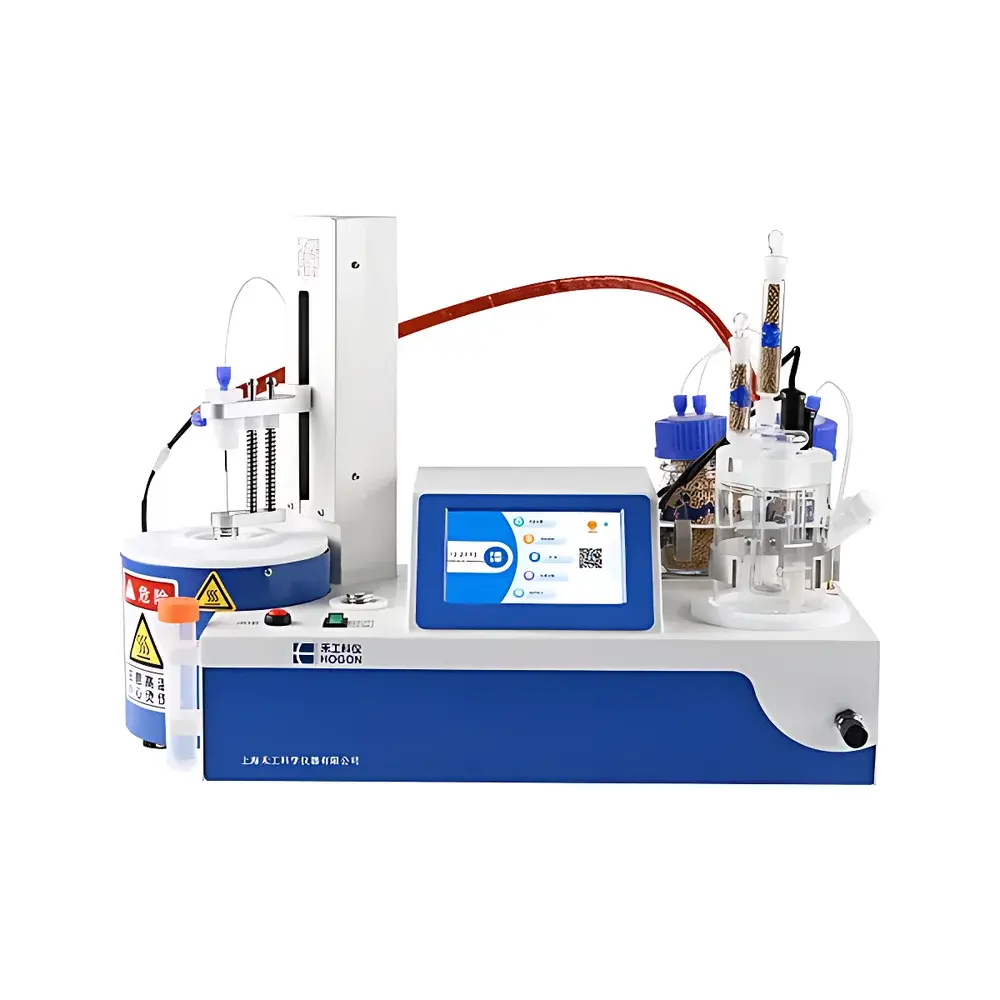
HOGON AKF-CH6 Coulometric Moisture Analyzer for Li–P–S–Cl Solid-State Electrolytes
| Brand | HOGON |
|---|---|
| Origin | Shanghai, China |
| Manufacturer | HOGON Scientific Instruments Co., Ltd. |
| Type | Coulometric Karl Fischer Moisture Analyzer |
| Detection Principle | Coulometric Karl Fischer Titration |
| Measurement Range | 1 µg – 200 mg H₂O |
| Detection Limit | <0.1 µg H₂O |
| Resolution | 0.1 µg |
| Temperature Control Range | Ambient to 300 °C (adjustable in 0.1 °C increments) |
| Heating Accuracy | ±0.5 °C |
| Gas Compatibility | High-purity N₂ or Ar (flow rate: 0–500 mL/min, controllable) |
| Electrode System | Dual-platinum generator and detector electrodes with polarization current monitoring |
| Data Output | H₂O mass (µg), concentration (ppm or %), and statistical summary (n ≥ 3) |
| Compliance | ASTM E203, ISO 760, USP <921>, EP 2.5.12, GLP-compliant audit trail (optional firmware module) |
Overview
The HOGON AKF-CH6 is a purpose-built coulometric Karl Fischer moisture analyzer engineered exclusively for the quantitative determination of trace water content in air- and moisture-sensitive solid-state electrolyte materials—particularly lithium phosphorus sulfide chloride (Li–P–S–Cl) systems. Unlike general-purpose moisture analyzers, the AKF-CH6 integrates a hermetically sealed sample handling pathway, programmable low-thermal-stress heating, and high-fidelity coulometric detection to address the unique analytical challenges posed by sulfide-based electrolytes. These materials exhibit extreme reactivity toward ambient humidity: exposure to even sub-ppm levels of H₂O triggers hydrolytic decomposition, liberating toxic H₂S and degrading ionic conductivity. Consequently, accurate moisture quantification is not merely a quality control requirement—it is a prerequisite for reproducible electrochemical performance, safe material handling, and regulatory compliance in solid-state battery R&D and pilot-scale manufacturing. The instrument operates on the fundamental principle of coulometric Karl Fischer titration: water reacts stoichiometrically with iodine generated electrochemically at the anode; the total charge consumed (Q, in coulombs) is directly proportional to water mass via Faraday’s law (m = Q × M / (2 × F), where M = 18.015 g/mol, F = 96,485 C/mol). This method delivers inherent accuracy, minimal reagent consumption, and a theoretical detection limit below 0.1 µg—making it the internationally recognized reference technique for ultra-trace moisture analysis in inert-atmosphere-sensitive solids.
Key Features
- Hermetic sample introduction and transfer system: All critical pathways—including sample vial penetration, carrier gas routing, and vapor transport ducts—are fully sealed and purgeable with high-purity inert gas (N₂ or Ar), eliminating ambient moisture ingress during weighing, loading, and thermal desorption.
- Programmable precision heating module: A Peltier-assisted furnace enables stepwise or isothermal heating from ambient to 300 °C with ±0.5 °C stability and 0.1 °C resolution—critical for controlled release of adsorbed and lattice-bound water without inducing thermal decomposition of Li–P–S–Cl phases.
- Dual-platinum coulometric cell architecture: Features separate generator and detector electrodes with real-time polarization current monitoring to ensure rapid endpoint discrimination and suppression of side reactions (e.g., electrode passivation or solvent oxidation).
- Automated method-driven workflow: Pre-configured SOPs for Li–P–S–Cl matrices include optimized temperature ramps, gas flow profiles, and titration parameters; users input only sample mass and select method—system handles injection, titration, calculation, and reporting autonomously.
- GLP-ready data integrity framework: Optional firmware extension provides 21 CFR Part 11–compliant electronic signatures, full audit trail (user actions, parameter changes, calibration events), and encrypted raw data storage compliant with ISO/IEC 17025 documentation requirements.
Sample Compatibility & Compliance
The AKF-CH6 is validated for direct analysis of powders, pressed pellets, and thin films of Li–P–S–Cl, Li₃PS₄, Li₁₀GeP₂S₁₂ (LGPS), and related thio-LISICON analogues. It accommodates sample masses from 10 mg to 500 mg within standard 10-mL crimp-top vials equipped with silicone/PTFE septa. No derivatization, solvent extraction, or pre-drying is required. Method validation adheres to ICH Q2(R2) guidelines for specificity, linearity (1–200 µg H₂O), accuracy (recovery 98.5–101.2%), repeatability (RSD ≤ 1.8% at 50 ppm level), and robustness (±2 °C, ±10 mL/min flow variation). Regulatory alignment includes ASTM E203 (Standard Test Method for Water Using Coulometric Karl Fischer Titration), ISO 760 (Determination of Water—Coulometric Titration Method), USP (Water Determination), and European Pharmacopoeia 2.5.12.
Software & Data Management
The embedded HOGON MoistureControl™ v3.2 software provides intuitive touchscreen operation, multi-language UI (English, Chinese, Japanese, Korean), and export-capable reporting in CSV, PDF, and XML formats. Each measurement record contains timestamped metadata: operator ID, environmental RH/T (if external sensor integrated), vial ID, heating profile, gas flow history, raw current-time curve, and statistical summary (mean, SD, RSD, confidence interval). Data files are digitally signed and stored with SHA-256 hash verification. Network-enabled models support centralized database logging via OPC UA or MODBUS TCP for integration into LIMS or MES platforms.
Applications
- Quantitative moisture mapping across synthesis batches of Li–P–S–Cl precursors and final electrolytes
- In-process verification of glovebox transfer integrity and dry-room storage conditions
- Stability studies assessing hygroscopic degradation kinetics under accelerated humidity exposure
- QC release testing for cathode composite slurries containing sulfide electrolytes
- Root-cause analysis of premature capacity fade correlated with residual H₂O content
- Method transfer between R&D labs and GMP-compliant production facilities
FAQ
Can the AKF-CH6 analyze samples that contain reducing agents or strong acids?
Yes—its coulometric design minimizes interference from common redox-active species. However, samples with >100 ppm free halogens or elemental sulfur require prior stabilization via controlled oxidation or matrix dilution; application notes are available upon request.
Is calibration required before each analysis?
No. The instrument performs automatic background drift correction and uses primary-standard water standards (e.g., 1.00 mg/g sodium tartrate dihydrate) for periodic verification per ISO 760; daily zero-point validation is sufficient for routine use.
What inert gas purity is recommended?
≥99.999% N₂ or Ar with dew point ≤ −70 °C is mandatory to prevent false positives; optional inline moisture scrubbers (Mg(ClO₄)₂ + molecular sieve) are available as accessories.
How does the system handle sample heterogeneity?
Statistical reliability is ensured through triplicate analysis per batch; optional autosampler integration supports unattended 24-sample sequencing with randomized vial positioning to mitigate positional bias.
Is service and technical support available outside mainland China?
Yes—HOGON maintains authorized service centers in Germany, South Korea, and the United States, with remote diagnostics, firmware updates, and application engineering support provided in English.






