
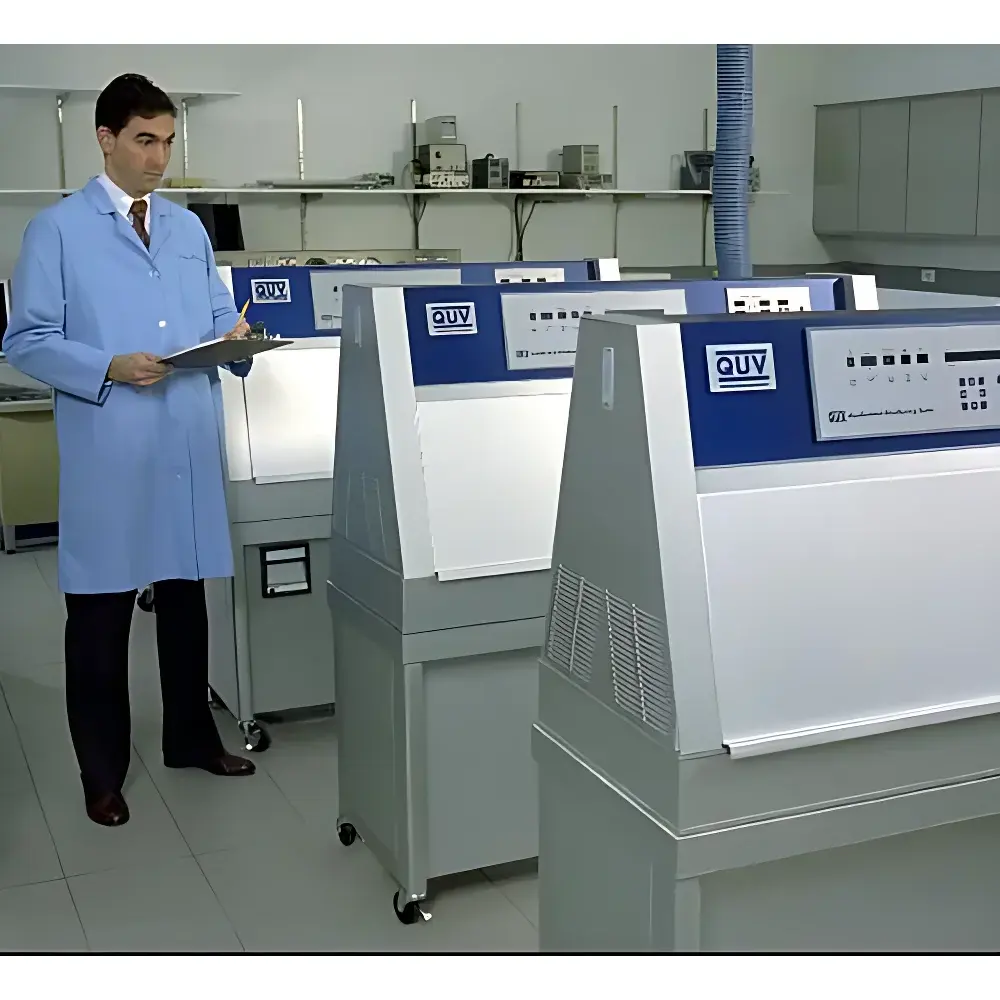
Q-Lab QUV UV Aging Test Chamber
| Brand | Q-LAB |
|---|---|
| Origin | USA |
| Manufacturer Type | Authorized Distributor |
| Product Origin | Imported |
| Model | QUV UV Aging Test Chamber |
| Pricing | Available Upon Request |
| UV Wavelength Range | 280–400 nm |
| UV Lamp Types | UVA-340, UVA-351, UVB-313 |
| Sample Capacity | Customizable Mounting (Up to 20 mm Thickness) |
| Compliance Standards | ASTM G151, ASTM G154, ISO 4892-3, JIS D0205, SAE J2020, ISO 11507, DIN 53384, GM 9125P, NACE TM-01-84, ANSI C57.12.28 |
Overview
The Q-Lab QUV UV Aging Test Chamber is an industry-standard accelerated weathering instrument engineered for precision simulation of solar ultraviolet (UV) radiation effects on polymeric, coating, and composite materials. Based on fluorescent UV lamp technology, the QUV chamber replicates the most damaging portion of natural sunlight—short-wave UV radiation between 280 nm and 400 nm—while enabling controlled thermal and moisture stress cycles. Unlike xenon-arc or carbon-arc systems, the QUV platform employs calibrated fluorescent UV lamps to deliver highly reproducible spectral output with minimal variability across lamp batches and operational lifetimes. Its fundamental design adheres to the principles of photochemical degradation kinetics, where photon energy absorption initiates bond scission, oxidation, and chromophore formation in organic matrices. This makes the QUV system particularly suitable for comparative durability assessment, formulation screening, and regulatory-compliant aging protocols in R&D, quality assurance, and certification laboratories.
Key Features
- Three standardized UV lamp options: UVA-340 (sunlight-simulating, 295–365 nm), UVA-351 (window-filtered sunlight simulation), and UVB-313 (enhanced short-wave irradiance for aggressive testing)
- Independent control of UV irradiance, black-panel temperature, and condensation or spray cycles—enabling precise replication of outdoor exposure conditions
- Integrated CR10 radiometer calibration system compatible with UVA-340, UVA-351, and UVB-313 lamps for traceable irradiance monitoring per ASTM E2583 and ISO 17987
- Modular sample mounting architecture supporting specimens up to 20 mm thick; optional custom fixtures accommodate lenses, 3D components, and oversized substrates
- Self-diagnostic microprocessor controller with real-time system status monitoring, error logging, service reminders, and fail-safe shutdown protocols
- Optional purified water recirculation system for spray function—reducing consumable water usage and minimizing wastewater discharge in compliance with ISO 14001 environmental management frameworks
- Space-efficient stackable frame configuration (two-tier installation) for constrained laboratory footprints
Sample Compatibility & Compliance
The QUV chamber accommodates flat, rigid, or semi-rigid specimens from diverse material classes—including thermoplastics, thermosets, elastomers, architectural coatings, automotive interior trim, optical films, adhesives, and roofing membranes. Its standardized exposure geometry ensures uniform irradiance distribution across the test plane per ASTM G151 Annex A2. The system meets or exceeds requirements specified in over 50 international test standards, including ASTM D4329 (plastics), ASTM D4587 (coatings), ISO 4892-3 (laboratory light exposure), JIS K 5600-7-8 (Japanese industrial paints), and SAE J2020 (automotive exterior materials). All lamp types are validated against spectral power distribution (SPD) reference data published by NIST and referenced in ISO/TR 11341. Black-panel temperature sensors are user-calibratable using NIST-traceable reference thermometers, ensuring measurement continuity aligned with GLP and ISO/IEC 17025 audit requirements.
Software & Data Management
The QUV controller supports full-cycle programmability—including UV intensity ramping, timed condensation phases, intermittent spray sequences, and multi-step temperature profiles. While the base unit operates via intuitive front-panel interface, optional PC-based software (Q-Support™) enables remote monitoring, automated report generation, and secure data archiving. Audit trails record all parameter changes, sensor readings, alarm events, and maintenance logs—fully compliant with FDA 21 CFR Part 11 electronic record and signature requirements when configured with user authentication and electronic signature modules. Export formats include CSV, PDF, and XML for integration into LIMS environments and enterprise QA databases.
Applications
The QUV UV Aging Test Chamber serves as a primary tool in material qualification workflows across aerospace (e.g., cabin interior polymers per Boeing D6-17487), automotive OEM supply chains (GMW14124, Ford CETP), photovoltaic encapsulant validation (IEC 61215), and medical device packaging stability studies (ISO 11607). It is widely deployed for benchmarking UV stabilizer efficacy, evaluating pigment fade resistance in architectural coatings, assessing hydrolytic degradation of polyurethanes under cyclic humidity, and verifying colorfastness of textile laminates per AATCC TM16. Its reproducibility and standardization make it a preferred method for inter-laboratory round-robin testing and regulatory submissions to agencies including the EPA, EU REACH, and China GB/T standards bodies.
FAQ
What UV lamp type should I select for outdoor durability testing?
UVA-340 lamps are recommended for general outdoor exposure simulation, as they closely match terrestrial solar UV spectra down to 295 nm.
Can the QUV chamber replicate dew formation?
Yes—the condensation cycle uses heated water vapor to generate non-pressurized dew on specimen surfaces, simulating nocturnal moisture accumulation per ASTM G154 Cycle 1.
Is black-panel temperature calibration required?
Yes—users must perform periodic calibration using a certified reference thermometer to maintain traceability to national metrology institutes.
Does the QUV system support automated data export?
When equipped with Q-Support™ software, the system exports timestamped irradiance, temperature, and cycle event logs in CSV and PDF formats.
How often do UV lamps require replacement?
Lamp life is typically 1,600–2,000 hours depending on operating mode; Q-Lab provides spectral output decay curves to guide replacement timing.



