
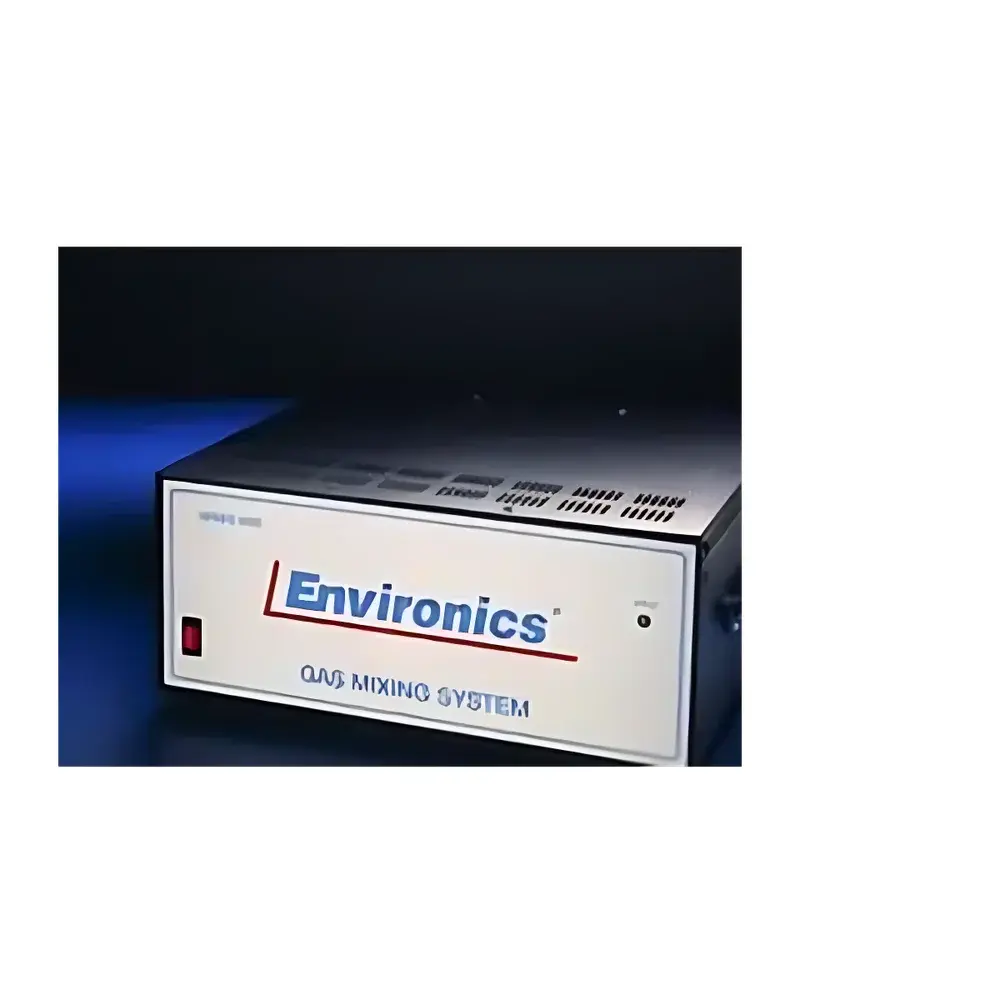
Environics 4000 Series Customizable High-Precision Gas Dilution System
| Brand | Environics |
|---|---|
| Origin | USA |
| Model | 4000 Series |
| Dilution Ratio | Up to 10,000:1 |
| Concentration Range | % to ppb |
| Flow Accuracy | ±1.0% of setpoint (concentration & flow) |
| Flow Repeatability | ±0.05% |
| Warm-up Time | 30 min |
| Gas Connection | 1/4" Swagelok® or compatible |
| Operating Pressure | 10–75 psig (0.67–5.04 bar) |
| UHP Leak Rate | ≤1×10⁻⁹ atm·cm³/sec He |
| Humidity Range (optional) | 0–95% RH (±5% accuracy, NIST-traceable) |
| Heating | Optional heated gas pathways (temperature-controlled) |
| Surface Treatment | Optional silanized stainless-steel tubing |
| Purge Pathway | Integrated electromagnetic valve purge system |
| Permeation Oven | Optional multi-zone permeation furnace with dual-permeation-tube capacity |
Overview
The Environics® 4000 Series Customizable Gas Dilution System is an engineered solution for high-fidelity, gravimetrically traceable gas mixture generation and dynamic dilution across environmental monitoring, calibration laboratory, and industrial process control applications. Based on precision thermal mass flow control (MFC) architecture, the system operates on the principle of volumetric blending—where certified standard gases are metered at independently controlled, NIST-traceable flow rates and combined in a low-dead-volume mixing manifold. This enables reproducible generation of calibration standards spanning from percent-level concentrations down to sub-ppb (parts-per-quadrillion) levels, with full auditability of flow paths, dwell times, and pressure differentials. Designed for compliance-critical environments, the 4000 Series supports GLP/GMP-aligned workflows through configurable data logging, user-access controls, and electronic record integrity—fully compatible with FDA 21 CFR Part 11 requirements when deployed with validated software configurations.
Key Features
- Wide dynamic dilution range up to 10,000:1—enabling single-cylinder utilization for multi-concentration calibrations without manual cylinder swaps
- Modular architecture supporting up to seven independent gas inputs; scalable via field-installable MFC modules and valve manifolds
- Automated K-factor compensation—self-calibrating against cylinder-specific composition drift using stored MFC characterization tables
- Integrated real-time flow calculation engine that dynamically adjusts diluent and analyte flows to maintain target concentration under variable backpressure or temperature conditions
- UHP-grade fluidic pathway options: electropolished 316L stainless steel tubing, VCR fittings, helium-leak-tested to ≤1×10⁻⁹ atm·cm³/sec, and optional Nafion®-based humidity addition with NIST-traceable RH calibration
- Configurable auxiliary modules including heated gas pathways (up to 120°C), silanized surface treatment for reactive sulfur compounds (H₂S, COS), automated purge sequences for toxic residue mitigation, and multi-zone permeation ovens for volatile organic compound (VOC) standard generation
Sample Compatibility & Compliance
The 4000 Series accommodates a broad spectrum of gas matrices—including inert carriers (N₂, Ar, He), oxidizing agents (O₂, NO, NO₂), reducing species (CO, H₂S, NH₃), and highly reactive VOCs (e.g., formaldehyde, benzene, chlorinated hydrocarbons). All wetted surfaces comply with ASTM E2654-21 for ultra-high-purity gas handling systems. Optional silanization meets EPA Method TO-15 and EU EN 13649-1 requirements for sulfur-sensitive applications. The system’s pressure-rated design (10–75 psig operating range) ensures compatibility with standard lecture-bottle and high-pressure cylinder sources. Full documentation packages—including IQ/OQ protocols, MFC calibration certificates (NIST-traceable), and material compatibility reports—are provided per ISO/IEC 17025 and ISO 17034 accreditation frameworks.
Software & Data Management
Control and configuration are executed via Environics’ Windows-based DiluSoft™ application, communicating over USB 2.0 (standard) or RS-232 serial interface. The software provides role-based access control (administrator/operator), time-stamped event logging, automatic report generation (PDF/CSV), and exportable audit trails compliant with FDA 21 CFR Part 11 Annex 11. All concentration calculations, flow setpoints, and hardware status parameters are stored with cryptographic hash verification. Raw MFC output data—including temperature-compensated voltage readings and internal diagnostics—is accessible for third-party integration via OPC UA or Modbus TCP protocols. Optional LIMS connectivity supports automated calibration certificate generation aligned with ISO/IEC 17025 Clause 7.8.3.
Applications
- Multi-point calibration of ambient air monitors (e.g., EPA EQOA-certified ozone, CO, SO₂ analyzers)
- Preparation of certified reference materials (CRMs) for GC-MS, FTIR, and cavity ring-down spectroscopy (CRDS) validation
- Dynamic dilution of VOC standards into SUMMA® canisters and Tedlar® bags per EPA Method TO-11A and TO-15
- Generation of humidified calibration gases for optical hygrometers and dew point sensors (traceable to NIST SRM 2680a)
- In-process gas standard delivery for semiconductor fab tool qualification (SEMI F21-0218)
- Permeation tube-based trace-level standard generation for odorant detection (e.g., mercaptans, thiophenes) in natural gas quality control
FAQ
Is the 4000 Series suitable for regulated environmental laboratories?
Yes—it supports full 21 CFR Part 11 compliance when configured with signed digital logs, user authentication, and audit trail retention. Validation documentation aligns with ISO/IEC 17025 Clause 5.5.2.
Can the system dilute corrosive or adsorptive gases like H₂S or Cl₂?
With optional silanized tubing and heated pathways (≥80°C), the system maintains quantitative recovery for sulfur- and chlorine-containing compounds per ASTM D6728-22.
How is humidity introduced—and is it traceable?
Humidity is added via a Nafion® membrane humidifier calibrated against NIST SRM 2680a; RH accuracy is ±5% under stable flow/temperature conditions.
What maintenance is required for long-term accuracy?
Annual recalibration of MFCs against NIST-traceable standards is recommended; silanized surfaces require re-coating every 18–24 months in high-reactivity service.
Does the system support remote monitoring or integration with SCADA?
Yes—via Modbus TCP or OPC UA interfaces; real-time flow, pressure, and concentration data are streamable to enterprise MES or cloud analytics platforms.







