
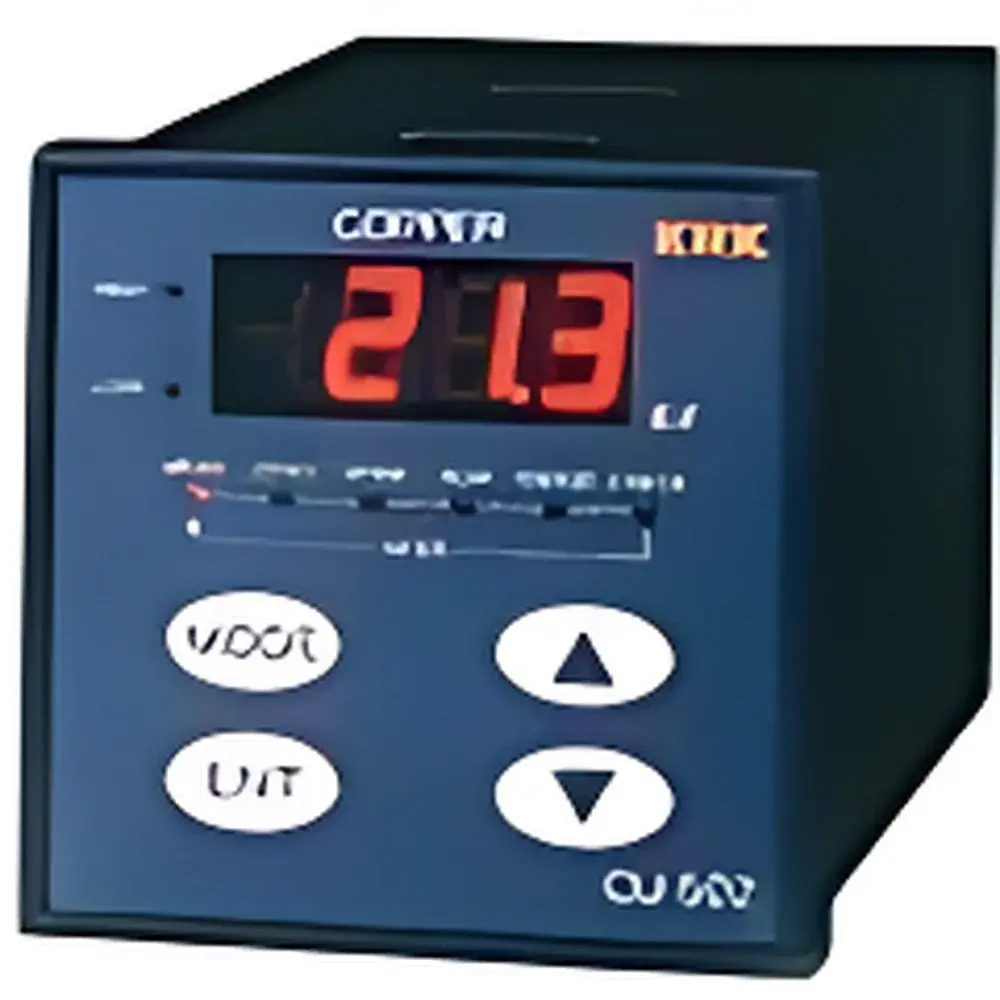
Kasahara CU-502 Online Copper Ion Monitor
| Brand | Kasahara |
|---|---|
| Origin | Japan |
| Model | CU-502 |
| Instrument Type | Online Multi-Ion Analyzer |
| Measurement Principle | Absorption Photometry (LED-based, AC-driven dual-beam) |
| Measuring Range (Cu) | 0–20 g/L, 0–50 g/L, 0–80 g/L (selectable) |
| Measuring Range (CuSO₄) | 0–100 g/L, 0–200 g/L, 0–300 g/L (selectable) |
| Detection Limit | 1 g/L (Cu) |
| Resolution | 0.1 g/L (Cu), 1 g/L (CuSO₄) |
| Accuracy | ±2% FS |
| Repeatability | ±2% |
| Response Time | ≤5 s |
| Operating Temperature | –5 °C to +40 °C |
| Humidity Limit | ≤85% RH (non-condensing) |
| Power Supply | AC 85–240 V, 50/60 Hz |
| Output Signal | DC 4–20 mA (isolated, 2-wire) |
| Dimensions (H×W×D) | 96 × 96 × 163 mm |
| Weight | ~1.3 kg |
| Compliance | CE-marked for industrial environments |
| Enclosure Rating | IP65 front panel |
Overview
The Kasahara CU-502 is a dedicated online copper ion monitor engineered for continuous, real-time quantification of dissolved copper (Cu²⁺) and copper sulfate (CuSO₄) concentration in aggressive electroplating and etching electrolytes—primarily acidic copper sulfate baths used in PCB manufacturing, semiconductor interconnect processing, and decorative plating lines. It employs a robust AC-driven dual-beam absorption photometric principle: a reference LED channel compensates for intensity drift and thermal aging of the measurement LED, ensuring long-term baseline stability without manual recalibration. Unlike conventional single-beam spectrophotometers, the CU-502’s alternating illumination scheme eliminates zero-point drift caused by LED output decay or window fouling, delivering high reproducibility in high-ionic-strength, turbid, or particulate-laden process streams. Its optical path is optimized for the characteristic absorbance peak of Cu²⁺ in aqueous H₂SO₄ media (~800 nm), minimizing interference from common bath additives (e.g., chloride, SPS, PEG) and enabling direct correlation between optical density and total soluble copper mass concentration.
Key Features
- Dual-beam AC-modulated LED photometry with real-time reference channel compensation for LED aging and temperature-induced intensity variation
- Three user-selectable linear ranges for Cu (0–20 / 0–50 / 0–80 g/L) and three corresponding CuSO₄ ranges (0–100 / 0–200 / 0–300 g/L), configurable via front-panel DIP switches
- High-resolution analog output (DC 4–20 mA, galvanically isolated) compatible with PLCs, DCS, and SCADA systems for closed-loop bath control
- Compact DIN-rail mountable housing (96 × 96 × 163 mm) with IP65-rated front panel for installation in humid, chemically exposed production environments
- Stable operation across –5 °C to +40 °C ambient; designed for uninterrupted monitoring in plating line utility rooms and wet benches
- No reagents, no consumables, no moving parts—maintenance-free operation with typical service intervals exceeding 24 months
Sample Compatibility & Compliance
The CU-502 is validated for direct in-line measurement of sulfuric acid-based copper electrolytes containing up to 200 g/L H₂SO₄, 50–80 g/L Cu²⁺, and standard organic additives (accelerators, suppressors, levelers). It tolerates suspended particulates <5 µm and exhibits minimal sensitivity to minor pH fluctuations (pH 0.5–2.0). While not intended for ultrapure water or low-conductivity deionized rinse streams, it meets IEC 61000-6-2 (immunity) and IEC 61000-6-4 (emissions) standards for industrial environments. The device carries CE marking under the EU Machinery Directive and Low Voltage Directive. For regulated pharmaceutical or biotech applications requiring audit trails, optional analog signal logging via external data acquisition systems supports GLP-compliant record retention. It does not comply with FDA 21 CFR Part 11 out-of-the-box due to lack of built-in electronic signature or user role management—but may be integrated into compliant architectures via third-party SCADA historians.
Software & Data Management
The CU-502 operates as a standalone analog transmitter with no embedded firmware, GUI, or network interface. All configuration (range selection, zero/span adjustment via potentiometers) is performed manually on-device. Data integrity relies entirely on the stability of its analog output signal and the downstream acquisition system. For traceability, users are advised to log calibration events, range changes, and maintenance actions in external laboratory notebooks or LIMS. When interfaced with a certified DCS historian (e.g., Emerson DeltaV, Honeywell Experion), the 4–20 mA signal enables time-stamped trend analysis, alarm generation (e.g., Cu >75 g/L), and integration into automated replenishment logic. No proprietary software drivers or cloud connectivity are provided—ensuring deterministic timing and eliminating cybersecurity attack surfaces inherent in connected instrumentation.
Applications
- Real-time copper concentration control in acid copper electroplating baths for printed circuit board (PCB) fabrication
- Process monitoring of copper sulfate etchant solutions in semiconductor wafer bumping and RDL processes
- Automated dosing feedback for copper anode dissolution rate optimization in barrel plating lines
- Quality assurance in decorative copper-nickel-chromium plating where Cu concentration directly impacts deposit brightness and ductility
- Preventive maintenance support—detecting abnormal Cu accumulation indicative of anode passivation or filtration failure
FAQ
Does the CU-502 require periodic calibration with standard solutions?
Yes. While the dual-beam design minimizes drift, Kasahara recommends quarterly verification using NIST-traceable CuSO₄ reference standards at two points within the selected range (e.g., 10 g/L and 70 g/L Cu). Zero adjustment is performed with deionized water or blank electrolyte.
Can it measure copper in cyanide-based or alkaline plating baths?
No. The optical method is calibrated exclusively for Cu²⁺ in acidic sulfate matrices. Cyanide complexes (e.g., [Cu(CN)₃]²⁻) exhibit different molar absorptivity and are not quantified accurately.
Is the flow cell included, or must it be purchased separately?
The CU-502 sensor head is supplied without a flow cell. Kasahara offers optional stainless steel (SUS316) or PVDF wetted-path flow cells with 1/4″ NPT ports, rated for 0.5–3.0 L/min flow rates and compatible with inline bypass loops.
What is the expected lifetime of the LED light source?
Rated minimum operational life is 50,000 hours at 25 °C ambient. Under typical plating line conditions (35 °C average), projected service life exceeds 8 years with continuous operation.







