
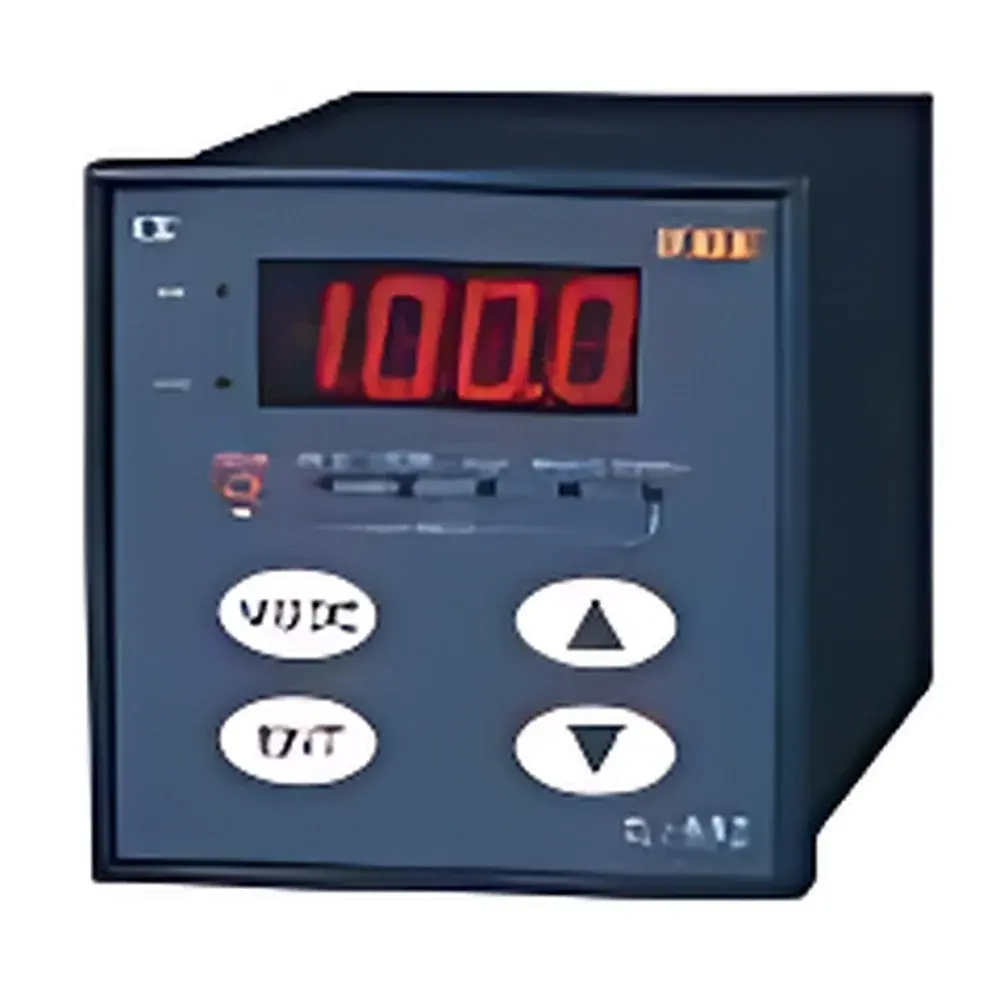
Riken Keiki CL-502 Online Chloride Ion Monitor
| Brand | Riken Keiki |
|---|---|
| Origin | Japan |
| Model | CL-502 |
| Instrument Type | Online Analyzer |
| Measurement Principle | Solid-State Membrane Chloride-Selective Electrode (CSE) |
| Measuring Range | 10–1000 mg/L (customizable up to >1000 mg/L) |
| Detection Limit | 1 mg/L |
| Response Time | ≤1 s |
| Accuracy | ±1% of full scale |
| Repeatability | ±2% FS |
| pH Operating Range | 3.0–10.0 |
| Output Signal | Isolated DC 4–20 mA (load ≤500 Ω, three selectable ranges: 0–100 / 0–500 / 0–1000 mg/L) |
| Power Supply | AC 85–240 V, 50/60 Hz |
| Operating Environment | 0–40 °C, ≤85% RH |
| Dimensions | 96 W × 96 H × 163 D mm |
| Weight | ~1.3 kg |
| Compliance | Designed for continuous industrial water monitoring per ISO 5667-3 and ASTM D3370 guidelines |
| Electrode Configuration | Dual-junction reference electrode with solid-state chloride-selective membrane, maintenance-free internal electrolyte |
Overview
The Riken Keiki CL-502 Online Chloride Ion Monitor is an industrial-grade, fixed-mount electrochemical analyzer engineered for continuous, real-time quantification of free chloride ion concentration in aqueous process streams and environmental water systems. It operates on the potentiometric principle using a solid-state chloride-selective membrane electrode paired with a dual-junction reference electrode—eliminating the need for internal electrolyte refilling and significantly enhancing long-term measurement stability under variable flow and temperature conditions. Unlike optical or titrimetric methods, this direct potentiometric approach delivers sub-second response kinetics (≤1 s), enabling rapid detection of chloride excursions critical in corrosion control, desalination pre-treatment, wastewater discharge compliance, and boiler feedwater monitoring. The instrument is calibrated traceably to NIST-traceable chloride standards and designed to function reliably within a defined pH window (3.0–10.0), where hydrogen ion interference and junction potential drift are minimized. Outside this range, sample conditioning—such as pH adjustment or addition of Ionic Strength Adjustment Buffer (ISAB)—is required prior to analysis to ensure thermodynamic activity-based accuracy.
Key Features
- Solid-state chloride-selective membrane electrode: No liquid-filled internal reference compartment; eliminates leakage, clogging, and electrolyte depletion—ideal for unattended operation in remote or hazardous locations.
- Dual-junction reference electrode architecture: Provides robust isolation from interfering ions (e.g., sulfide, cyanide, heavy metals) commonly present in industrial effluents and seawater-influenced brines.
- Three programmable output ranges (0–100 / 0–500 / 0–1000 mg/L): Enables optimal signal resolution across diverse applications—from low-level groundwater monitoring to high-concentration reverse osmosis reject streams.
- Zero and span calibration functionality: Supports field verification and adjustment using certified standard solutions without disassembly or service tools.
- Hysteresis setting and moving average filtering: Configurable digital signal processing options suppress transient spikes caused by particulate fouling or air entrainment, improving data integrity for SCADA integration.
- Fail-safe analog output behavior: 4–20 mA signal remains latched at last valid value during maintenance or sensor replacement—ensuring uninterrupted DCS alarm logic and regulatory record continuity.
Sample Compatibility & Compliance
The CL-502 is validated for use with clarified, non-viscous aqueous matrices including potable water, surface water, cooling tower blowdown, membrane concentrate, and treated municipal wastewater. It is not suitable for highly turbid, oily, or suspended-solids-laden samples without inline filtration (<5 µm). For regulatory reporting, the system supports audit-ready operation when deployed with documented calibration logs and maintenance records aligned with ISO/IEC 17025 quality management requirements. While the analyzer itself does not carry CE or UL certification out-of-box, its electrical design complies with IEC 61000-6-2 (EMC immunity) and IEC 61000-6-4 (EMC emissions) standards. When integrated into validated water treatment systems, it contributes to meeting EPA Method 325B, ISO 9297 (chloride in water), and EU Drinking Water Directive (2020/2184) monitoring objectives.
Software & Data Management
The CL-502 operates as a standalone analog transmitter and does not include embedded firmware-based data logging or network connectivity. Its 4–20 mA output is compatible with all industry-standard PLCs, DCS platforms (e.g., Siemens PCS7, Emerson DeltaV), and SCADA systems supporting HART-enabled analog inputs. For enhanced data governance, users may integrate third-party edge gateways supporting Modbus RTU or MQTT protocols via optional analog-to-digital converters. All calibration events, range changes, and output configuration modifications must be recorded manually or via external historian systems to satisfy GLP/GMP documentation requirements. The device supports 21 CFR Part 11-compliant workflows only when paired with validated electronic record systems that enforce user authentication, audit trails, and electronic signatures.
Applications
- Corrosion inhibitor dosing control in oil & gas produced water systems, where chloride concentration directly correlates with pitting and stress corrosion cracking risk.
- Pre-treatment monitoring upstream of reverse osmosis (RO) membranes to prevent premature scaling and biofouling induced by chloride-driven osmotic pressure shifts.
- Effluent compliance tracking against local discharge permits (e.g., NPDES limits) requiring real-time chloride reporting at outfall points.
- Desalination plant intake screening to detect seawater intrusion events in coastal aquifers or surface reservoirs.
- Pharmaceutical clean-in-place (CIP) rinse water validation, ensuring residual chloride removal prior to sterile processing.
FAQ
What is the recommended calibration frequency for the CL-502 in continuous operation?
For critical applications, weekly two-point calibration (zero and mid-range standard) is advised; for stable, low-risk streams, biweekly verification suffices. Calibration intervals must be justified and documented per facility SOPs.
Can the CL-502 measure chloride in seawater (≈19,000 mg/L)?
No—the standard configuration is limited to 1000 mg/L. For seawater, custom high-range electrode modules and dilution systems are required; contact technical support for application-specific configuration.
Is pH compensation automatic or manual?
The CL-502 does not feature built-in pH sensing or automatic compensation. Sample pH must be independently verified and maintained between 3.0 and 10.0; deviation requires external pH adjustment or ISAB addition.
Does the unit support digital communication protocols like Modbus or Profibus?
No—only isolated 4–20 mA analog output is provided. Digital interface requires external signal converters compliant with ISA-50.00.01 standards.
What maintenance is required beyond calibration?
Quarterly mechanical inspection of electrode housing seals, annual replacement of the reference junction sleeve (if exposed to high-sulfide environments), and periodic cleaning of the membrane surface with mild detergent and deionized water.







