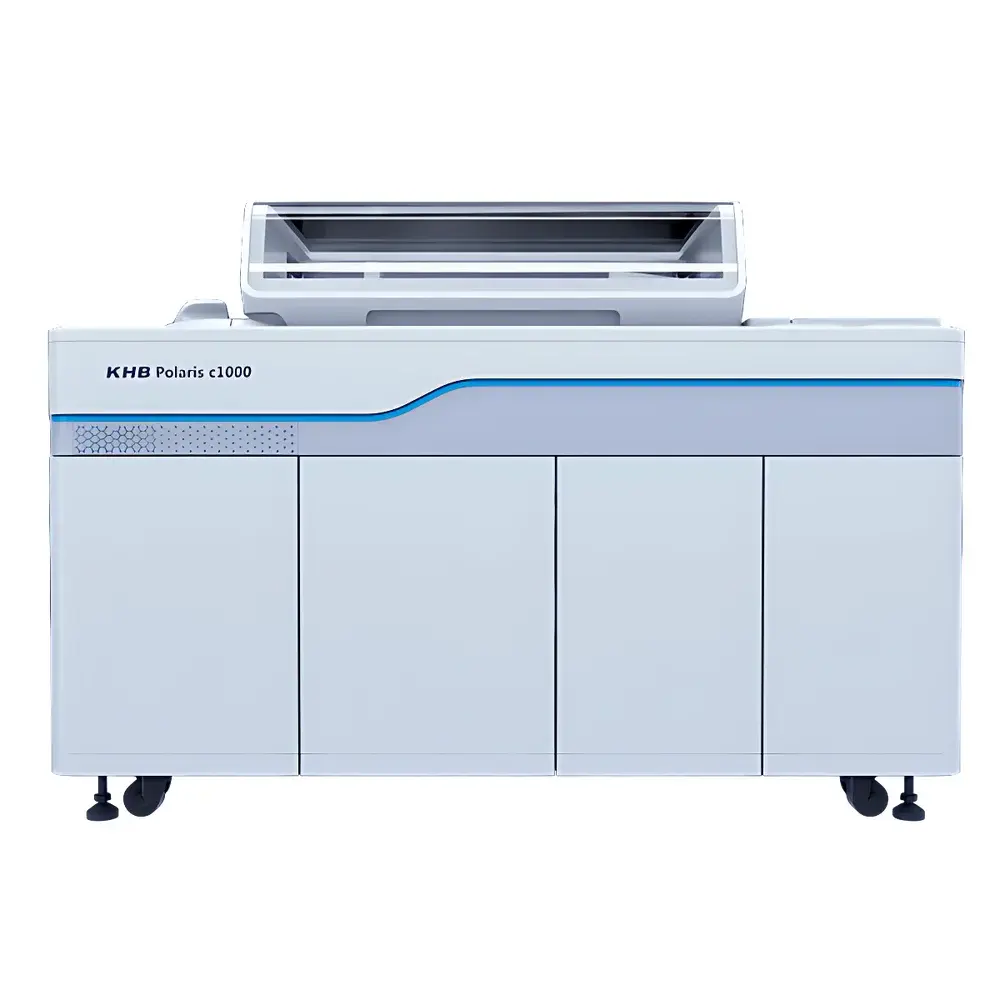
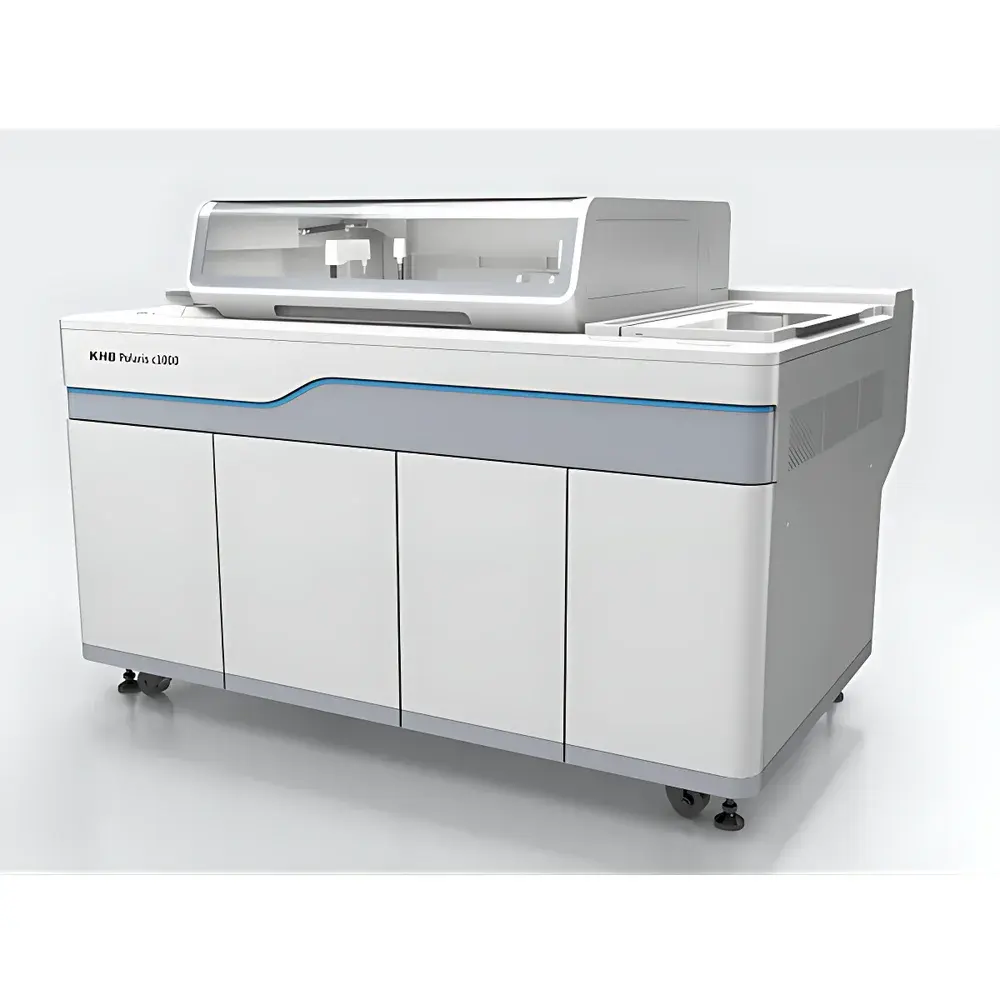
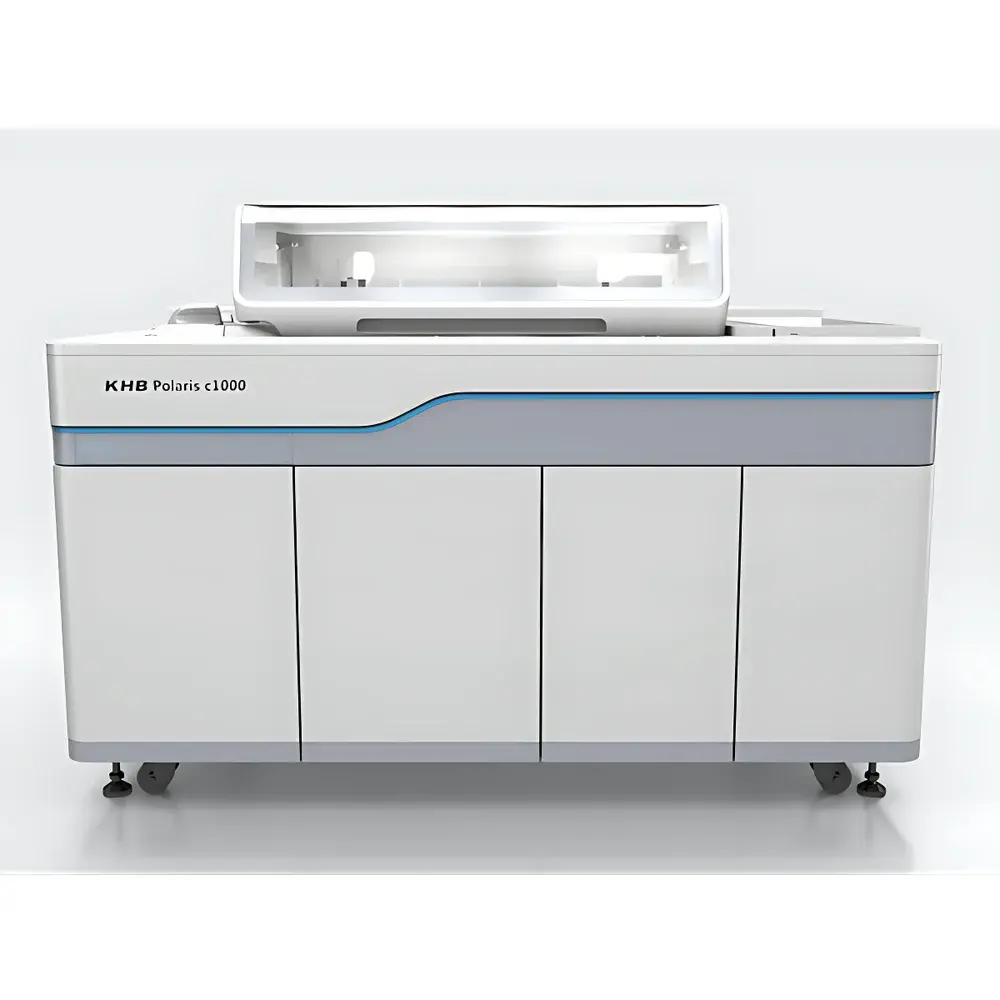
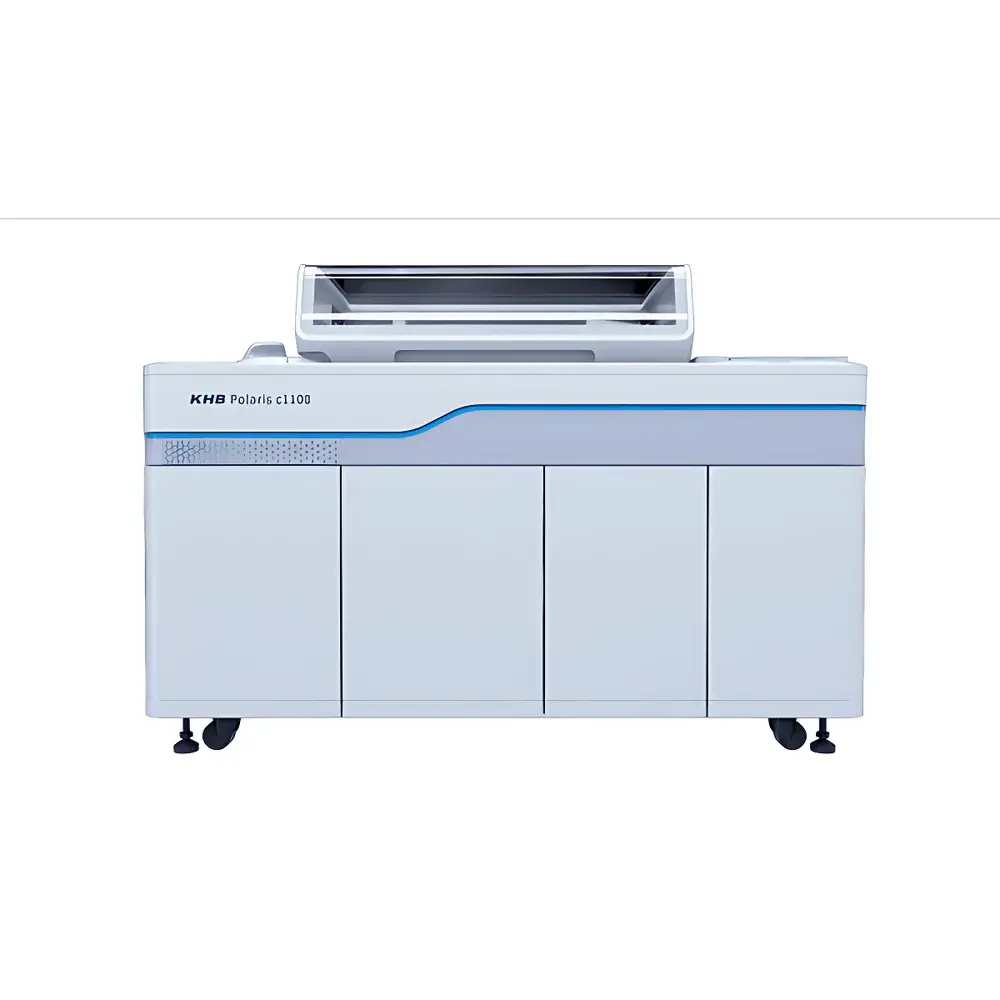
KHB Polaris c1000 Fully Automated Modular Clinical Biochemistry Analyzer
| Brand | KHB |
|---|---|
| Origin | Shanghai, China |
| Manufacturer Type | Authorized Distributor |
| Product Category | Domestic |
| Model | Polaris c1000 |
| Price Range | USD 63,000 – 91,500 (based on EUR/USD exchange parity and typical export pricing) |
| Instrument Type | Mid-Speed Fully Automated Analyzer (400–1000 tests/hour) |
| Reagents | KHB-licensed reagents only |
| Sample Types | Serum, Plasma, Urine, Whole Blood, Cerebrospinal Fluid (CSF) |
| Throughput | Constant-speed 1000 tests/hour |
| ISE module | 600 tests/hour (optional) |
Overview
The KHB Polaris c1000 is a fully automated, modular clinical biochemistry analyzer engineered for high-efficiency routine and emergency laboratory operations in mid-to-high volume diagnostic settings. Based on photometric absorbance measurement principles—employing dual-beam spectrophotometry across 16 standardized wavelengths (340–800 nm)—the system delivers quantitative analysis of enzymatic, colorimetric, and turbidimetric assays. Its optical architecture features a halogen light source, permanent glass cuvettes with 5 mm light path, and an ultra-wide absorbance range (0–3.5 AU), enabling precise detection of low-concentration analytes without dilution. The instrument operates at a constant throughput of 1000 tests per hour for standard biochemical assays and integrates an optional ion-selective electrode (ISE) module capable of 600 electrolyte tests/hour—supporting simultaneous Na⁺, K⁺, Cl⁻, and Ca²⁺ quantification via indirect potentiometry. Designed for regulatory-compliant clinical environments, the Polaris c1000 meets core performance requirements aligned with CLSI EP10-A3 and ISO 15197:2013 for analytical precision, carryover control (<0.08%), and inter-assay reproducibility.
Key Features
- Modular, scalable architecture supporting seamless integration with KHB immunoassay platforms (e.g., Lumina i-series) via standardized LIS/HIS interfaces—enabling unified workflow management across biochemistry and immunochemistry disciplines.
- Dual refrigerated reagent discs (2 × 100 positions), each maintaining 2–8 °C stability; supports online reagent loading without interrupting assay runs and accommodates R1/R2 volumes from 80–300 µL and 10–300 µL respectively, adjustable in 0.5 µL increments.
- High-capacity sample handling: 325-position track-based sample carrier with 30 dedicated emergency slots; barcode scanning enabled; sample volume range 1.0–35.0 µL (0.1 µL increment); liquid level sensing, real-time volume tracking, anti-collision, and optional clot detection.
- Reaction system with 216 permanent glass cuvettes; minimum reaction volume 80 µL; maximum 450 µL; integrated thermostatic control at precisely regulated 37.0 ± 0.1 °C using maintenance-free Peltier-heated air circulation.
- Intelligent parameter customization: user-defined stirring speed/duration, incubation timing, multi-point calibration curves, and kinetic rate calculation windows—critical for specialty assays including LDH, ALT, and CK-MB.
- Automated daily maintenance: scheduled wash cycles, probe cleaning, cuvette rinsing, and self-diagnostic routines; remote firmware updates via secure cloud portal compliant with TLS 1.2 encryption.
Sample Compatibility & Compliance
The Polaris c1000 accepts primary tubes (vacutainers) and secondary containers across standard diameters (12–16 mm) and heights (75–100 mm). Validated sample matrices include serum (clotted or gel-separated), lithium heparin or EDTA plasma, random and 24-hour urine, whole blood (for glucose and lactate), and cerebrospinal fluid (CSF) for protein and glucose profiling. All assays are developed and verified under KHB’s traceable calibration hierarchy—linking instrument response to NIST-traceable reference materials and WHO International Standards where applicable. The system supports full audit trail functionality required for GLP/GMP and CAP-accredited laboratories, including user action logging, reagent lot tracking, calibration history, and QC result archiving—all compliant with FDA 21 CFR Part 11 electronic record requirements when deployed with KHB’s validated LIMS interface.
Software & Data Management
Operating on KHB’s proprietary LabLink™ v4.2 software platform, the Polaris c1000 provides role-based access control, customizable report templates (PDF/CSV/XLSX), and bidirectional HL7 v2.5.1 and ASTM E1384 connectivity. Built-in QC tools support Westgard multirules, Levey-Jennings charts, and method comparison (EP9-A3) workflows. Data retention complies with HIPAA and GDPR standards: raw absorbance traces, kinetic plots, and calibration curves are stored for ≥12 months with SHA-256 hash integrity verification. Software updates are delivered via KHB CloudCare™—a secure over-the-air service requiring no local IT intervention and validated per IEC 62304 Class B medical device software lifecycle requirements.
Applications
The Polaris c1000 serves as a central analytical hub in hospital core labs, regional reference centers, and clinical research units. Routine applications include liver function panels (ALT, AST, ALP, GGT, TBil), renal profiles (Cr, BUN, UA), lipid metabolism (TC, TG, HDL-C, LDL-C), cardiac biomarkers (CK, CK-MB, LDH), electrolyte balance (Na⁺, K⁺, Cl⁻, Ca²⁺), and therapeutic drug monitoring (phenytoin, digoxin). Its low-volume capability (80 µL min. reaction volume) and broad dynamic range support pediatric testing and resource-constrained settings. The modular design allows deployment as a standalone biochemistry unit or as part of a KHB Integrated Diagnostic System (IDS) combining biochemistry, immunoassay, and hematology modules under unified middleware orchestration.
FAQ
Does the Polaris c1000 support non-KHB reagents?
No. The system is validated exclusively with KHB-manufactured or KHB-licensed reagents and calibrators to ensure metrological traceability and compliance with CE-IVD and NMPA registration specifications.
What is the minimum required maintenance interval?
Daily automated cleaning is mandatory; monthly preventive maintenance (PM) by KHB-certified engineers is recommended. PM includes optical alignment verification, pipetting accuracy validation per CLSI EP15-A3, and temperature uniformity mapping across the reaction disk.
Is the ISE module field-upgradable?
Yes—the ISE module can be installed post-purchase provided mechanical and electrical interfaces are pre-configured during initial installation; upgrade requires factory-issued activation key and software license update.
How is data backup handled in case of network failure?
Local RAID-1 mirrored storage retains all operational data for ≥72 hours; automatic failover to encrypted USB archive occurs if cloud sync is interrupted for >15 minutes.
Can the system interface with third-party LIMS without KHB middleware?
Direct ASTM/HL7 integration is supported, but full audit trail, QC rule enforcement, and electronic signature capabilities require KHB LabLink™ middleware deployment per ISO 15189:2022 Annex A.5.2 requirements.