
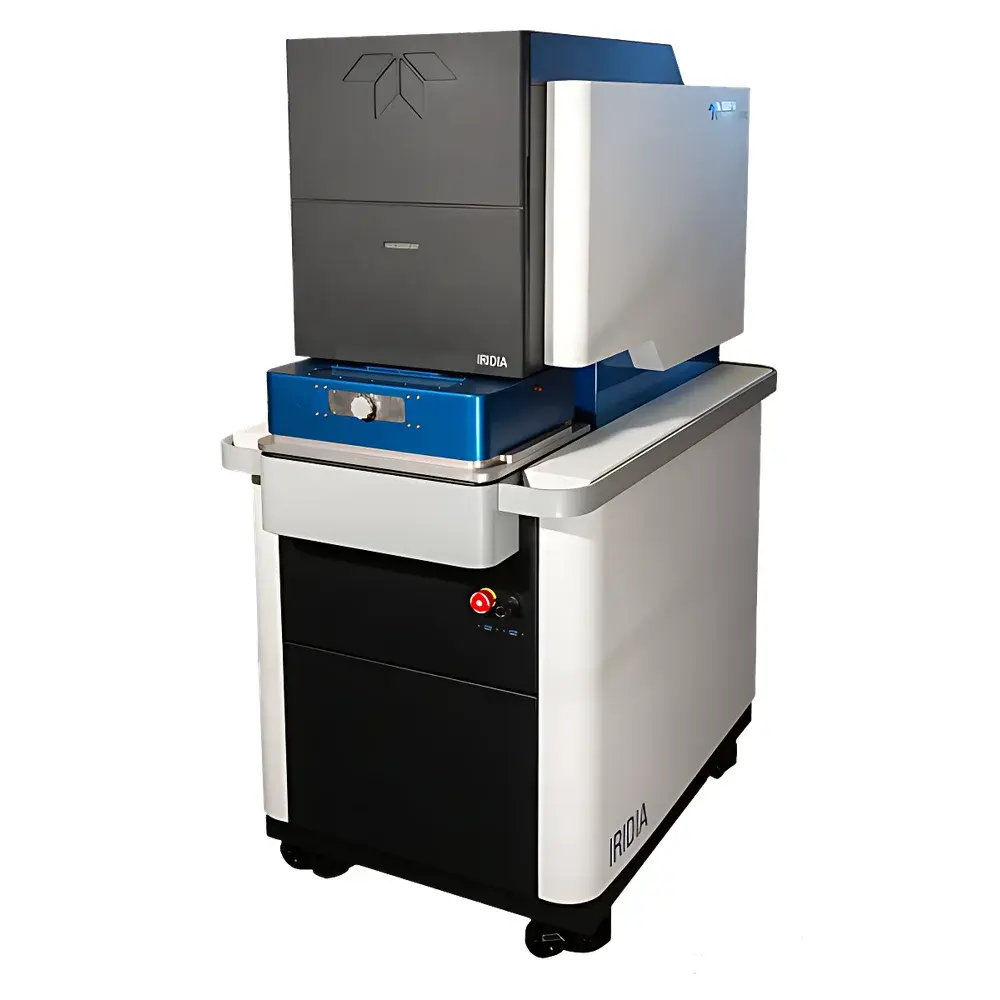
IRIDIA Teledyne Photon Machines High-Speed Imaging Laser Ablation System
| Brand | Teledyne Photon Machines |
|---|---|
| Origin | Imported |
| Manufacturer Type | Authorized Distributor |
| Model | IRIDIA |
| Laser Type | ArF Excimer (193 nm) |
| Repetition Rate | 300 Hz / 500 Hz |
| Ablation Cell | Cobalt™ Fast-Washout Chamber (< 5 ms aerosol washout) |
| Gas Integration | Integrated ArF pre-mixed and He gas cylinders with active venting & full enclosure |
| Gas Management | Patented ExiCheck™ automated ArF gas exchange module |
| Optical Path | Dual-polarization optics (Geo version) / Dual-attenuator optics (BIO version) |
| Laser Safety Class | Class 1 |
| Mirror Lifetime | 5× extended service life via multi-use reflective optics |
| Warranty | 2 years / 2 billion laser shots |
Overview
The IRIDIA Laser Ablation System, engineered by Teledyne Photon Machines (PMI), represents a dedicated platform for high-speed, spatially resolved elemental imaging—specifically optimized for coupling with time-of-flight or multi-collector ICP-MS instruments. Built upon over two decades of laser ablation innovation since PMI’s first commercial system in 1995, the IRIDIA leverages a stabilized 193 nm ArF excimer laser source operating at repetition rates of 300 Hz or 500 Hz to deliver exceptional pulse-to-pulse stability and shot-to-shot reproducibility. Its core measurement principle relies on controlled photolytic ablation of solid samples under inert carrier gas flow, generating transient aerosol plumes with minimal thermal fractionation and high spatial fidelity. The system is designed for routine operation in regulated laboratories requiring GLP-compliant trace element mapping, geological microanalysis, biological tissue imaging, and forensic material characterization.
Key Features
- Class 1 laser safety architecture—fully enclosed beam path, interlocked access points, and integrated optical shielding compliant with IEC 60825-1:2014.
- Cobalt™ ablation cell featuring sub-5 millisecond aerosol washout kinetics, enabling high-temporal-resolution imaging without peak broadening or signal memory effects.
- Integrated gas management subsystem housing pre-mixed ArF excimer gas and ultra-high-purity helium cylinders, with active pressure-controlled venting and leak-tight enclosure.
- ExiCheck™ automated gas exchange module—programmable ArF gas replacement at user-defined intervals (e.g., every 10⁷–10⁸ shots), eliminating manual cylinder swaps and reducing operational downtime.
- Dual-configuration optical train: Geo version includes dual-polarization optics for enhanced depth-of-field control in heterogeneous mineral matrices; BIO version integrates dual-attenuator optics for precise energy modulation across soft biological tissues.
- Multi-use reflective mirror design—engineered for ≥5× longer service life versus conventional single-use optics, reducing consumable costs and calibration drift over extended campaigns.
- Factory-calibrated optical attenuator ensuring stable fluence delivery down to ≤0.5 J/cm²—critical for low-energy ablation of volatile-rich phases and hydrated specimens.
Sample Compatibility & Compliance
The IRIDIA supports flat, polished, and conductive or carbon-coated non-conductive solids—including silicate minerals, metal alloys, ceramics, polymer composites, frozen-hydrated tissue sections, and thin-film coatings. Sample stage travel (X/Y/Z) accommodates standard 25 mm × 75 mm petrographic slides, 1-inch wafers, and custom mounts up to 100 mm diameter. All hardware and firmware comply with ISO/IEC 17025:2017 requirements for analytical instrumentation validation. Gas handling components meet ASTM D6166-20 specifications for high-purity excimer gas systems. Software logs support 21 CFR Part 11 audit trails, electronic signatures, and instrument configuration history for FDA-regulated environments.
Software & Data Management
Control and acquisition are managed via PMI’s LA-ICP-MS Suite v5.2—compatible with Windows 10/11 64-bit platforms. The software provides real-time ablation parameter monitoring (pulse energy, chamber pressure, gas flow rates), synchronized image overlay with optical microscope feeds (via HDMI or USB3), and pixel-aligned data export in HDF5 and .csv formats. Automated stage scripting supports raster, line-scan, spot-grid, and ROI-based acquisition protocols. Data integrity safeguards include automatic checksum verification, session-level metadata embedding (operator ID, timestamp, calibration file hash), and optional integration with LIMS via RESTful API.
Applications
- High-definition elemental mapping of zoned igneous and metamorphic minerals (e.g., zircon U–Pb geochronology, garnet Fe–Mg zoning).
- Quantitative trace metal imaging in human brain tissue sections for neurodegenerative disease research (e.g., Cu, Fe, Zn distribution in Alzheimer’s plaques).
- In situ analysis of inclusion chemistry in gemstones and meteoritic olivine without vacuum-induced dehydration artifacts.
- Depth-profiling of multilayer thin films in semiconductor R&D (e.g., HfO₂/SiO₂ gate stacks, perovskite solar cell interfaces).
- Forensic glass and paint chip discrimination using multi-isotope ratio imaging (e.g., ⁸⁷Sr/⁸⁶Sr + ²⁰⁸Pb/²⁰⁶Pb + ¹⁴³Nd/¹⁴⁴Nd).
FAQ
Is the IRIDIA compatible with both single-collector and multi-collector ICP-MS instruments?
Yes—the system outputs a standardized 6 mm OD aerosol transfer line with Swagelok® VCR fittings, fully compatible with Thermo Fisher, Nu Instruments, and Element series mass spectrometers.
Does the ExiCheck module require external power or network connectivity?
No—it operates autonomously via embedded microcontroller and draws power solely from the main IRIDIA chassis supply.
Can the Cobalt chamber be retrofitted onto legacy PMI laser ablation systems?
No—the Cobalt chamber is mechanically and pneumatically integrated only with IRIDIA platform electronics and firmware.
What maintenance intervals are recommended for optical components?
Mirror inspection is advised every 500 million shots; full optical alignment verification is required annually or after any chamber opening event.
Is remote diagnostics supported?
Yes—Teledyne Photon Machines offers optional Secure Remote Access (SRA) licensing for Tier-2 technical support and firmware update deployment.




