
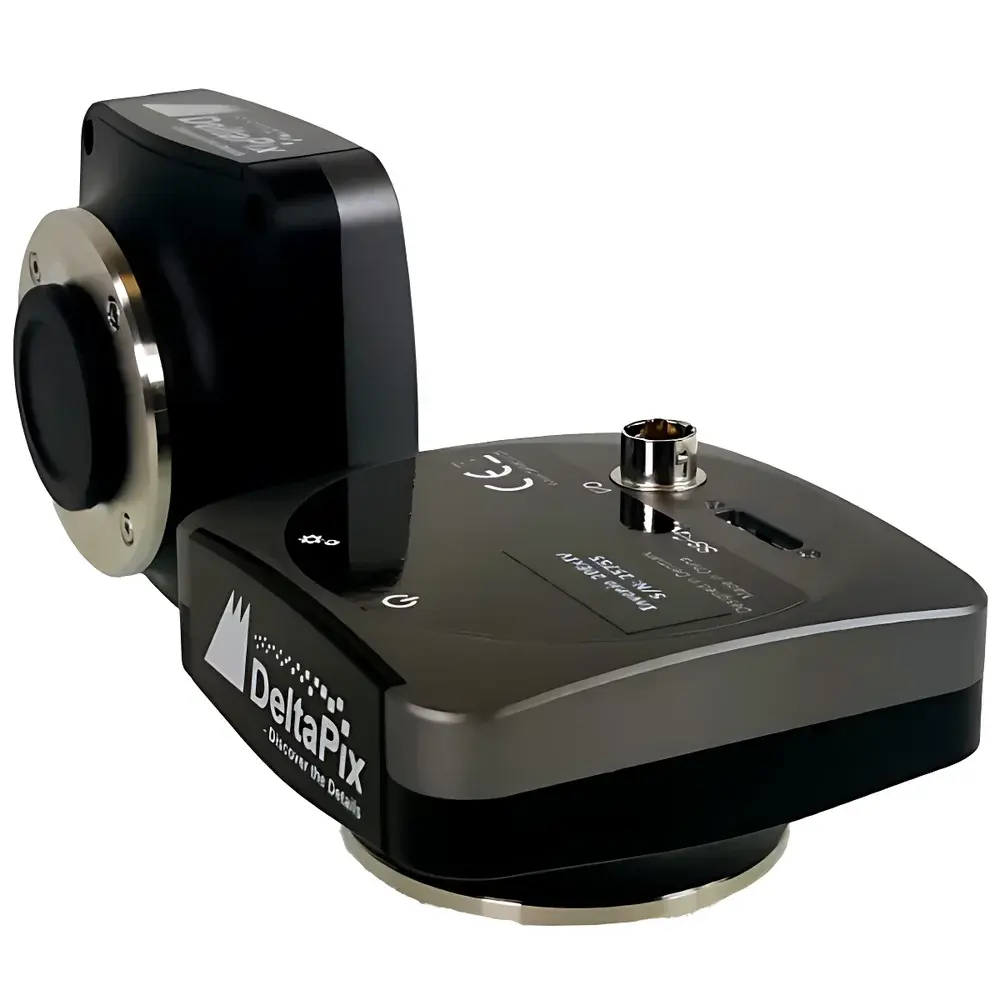
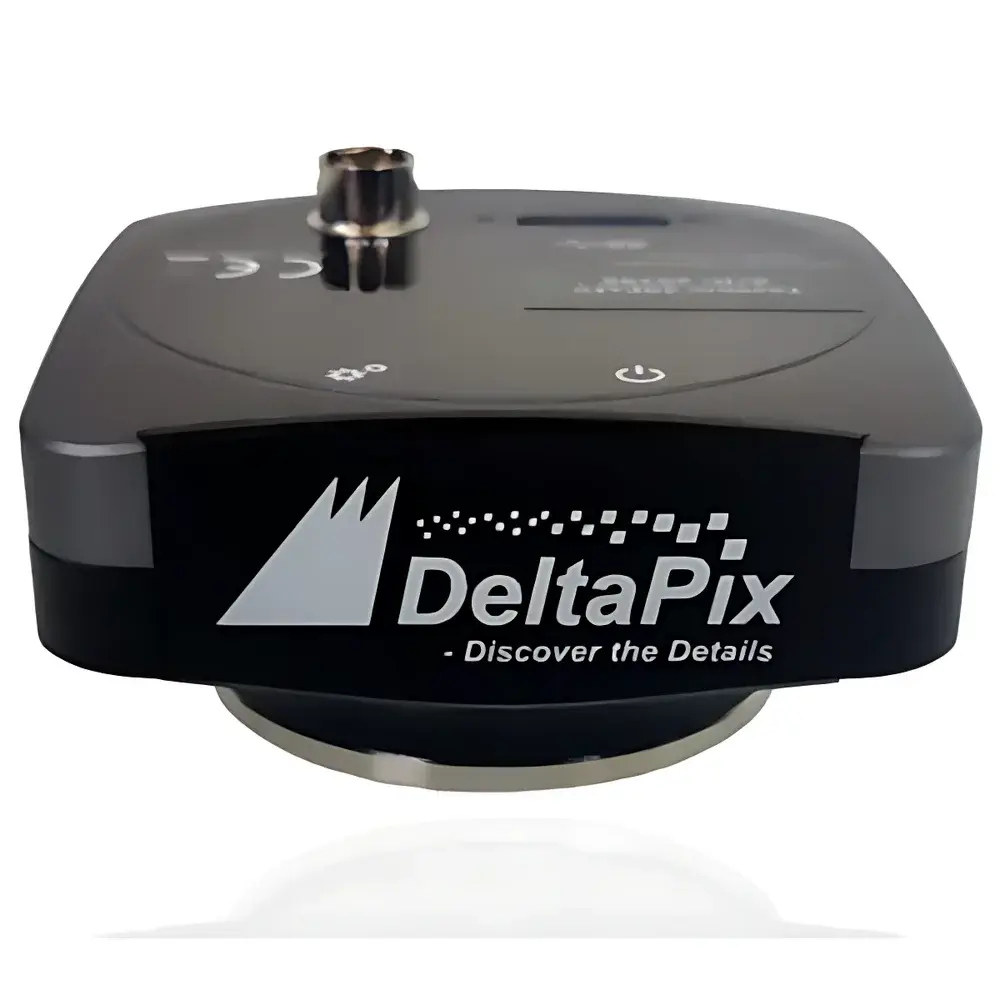
DeltaPix Invenio 20ExIV / 20EMxIV USB 3.0 Microscope Camera
| Brand | DeltaPix |
|---|---|
| Origin | Denmark |
| Model | Invenio 20ExIV (Color) / Invenio 20EMxIV (Monochrome) |
| Sensor | 1.1" Sony CMOS |
| Resolution | 20 MP |
| Frame Rate | 17 FPS (full resolution), up to 64 FPS (binned/subsampled) |
| Interface | USB 3.0 |
| Shutter Type | Global Shutter |
| Key Feature | Synchronous Delta Motion (SDM) timing control |
| Compliance | CE, RoHS, FCC Class B |
Overview
The DeltaPix Invenio 20ExIV and 20EMxIV are high-performance USB 3.0 microscope cameras engineered for demanding optical microscopy applications requiring high spatial fidelity, temporal precision, and quantitative repeatability. Built around a 1.1-inch Sony CMOS sensor with true global shutter architecture, these cameras eliminate motion distortion in dynamic or stage-scanned imaging—critical for time-lapse cytology, particle tracking, metallurgical inspection, and live-cell fluorescence quantification. Unlike rolling-shutter sensors, the global shutter ensures pixel-synchronized exposure across the entire 20-megapixel array (5496 × 3672 pixels), preserving geometric integrity during rapid specimen movement or automated stage translation. Manufactured in-house at DeltaPix’s ISO-certified cleanroom facility in Denmark, each unit undergoes rigorous calibration for dark current uniformity, gain linearity, and pixel response non-uniformity (PRNU) correction—ensuring traceable image quality across instrument lifecycles.
Key Features
- True global shutter CMOS sensor delivering artifact-free imaging at full 20 MP resolution (5496 × 3672) with up to 17 FPS sustained frame rate
- USB 3.0 interface enabling high-bandwidth, low-latency data transfer (up to 64 FPS in binned or region-of-interest modes)
- Synchronous Delta Motion (SDM) technology for hardware-level synchronization between camera exposure, motorized stage movement, and external triggers—enabling precise multi-position tiling, Z-stacking, and time-resolved acquisition
- Two optical configurations: Invenio 20ExIV (color Bayer-pattern sensor with integrated IR-cut filter) and Invenio 20EMxIV (monochrome variant optimized for peak quantum efficiency >80% at 550 nm and compatibility with narrowband fluorescence filters)
- On-sensor binning, ROI cropping, and real-time histogram-based exposure control for adaptive imaging under variable illumination conditions
- Thermally stabilized sensor housing minimizing dark current drift during extended acquisitions (>30 min)
Sample Compatibility & Compliance
The Invenio 20ExIV/20EMxIV is compatible with standard C-mount and CS-mount microscope adapters, supporting integration into upright, inverted, and stereo platforms from Olympus, Zeiss, Leica, Nikon, and Motic. Its mechanical design conforms to EN 61326-1 (EMC for laboratory equipment) and EN 61000-6-3 (emission limits). All firmware and driver software comply with Windows 10/11 (x64) and Linux kernel 5.4+ via UVC-compliant protocols. For regulated environments, the camera supports audit-trail–enabled acquisition logging when used with DeltaPix InSight Pro software, satisfying documentation requirements under GLP and ISO/IEC 17025 for metrological traceability of image-based measurements.
Software & Data Management
Each camera ships with DeltaPix InSight Basic—a modular, scriptable application supporting live preview, focus-assist tools (contrast-based sharpness metric), multi-channel overlay, and calibrated measurement (µm/pixel scaling via stage calibration or reference slide). Optional modules include InSight Quant (for intensity profiling, particle counting, and morphometric analysis per ASTM E1245), InSight Tiling (automated mosaic stitching with sub-pixel alignment), and InSight Automation (Python API integration for custom workflows). Raw image data is saved in lossless TIFF or vendor-neutral HDF5 format, preserving 12-bit or 16-bit linear intensity values without gamma compression or JPEG artifacts—essential for post-acquisition radiometric analysis and machine learning pipeline ingestion.
Applications
- High-resolution histopathology digitization (whole-slide imaging at 20×–40× magnification with <1 µm pixel size)
- Fluorescence co-localization studies requiring precise temporal registration across multiple emission bands
- Materials science characterization: grain boundary mapping, phase contrast analysis of alloys, and defect detection in semiconductor wafers
- Quality control in pharmaceutical tablet coating uniformity assessment per USP analytical instrument qualification guidelines
- Educational microscopy labs requiring robust, maintenance-free imaging systems with consistent color fidelity and minimal setup overhead
FAQ
Does the Invenio 20ExIV/20EMxIV support hardware triggering via TTL or opto-isolated inputs?
Yes—both models feature a 5-pin LEMO connector supporting external trigger input (TTL-compatible, 3.3 V logic), exposure duration control, and synchronous strobe output for coordinated illumination.
Is the camera compatible with third-party software such as ImageJ/Fiji or Micro-Manager?
Yes—DeltaPix provides a GenICam-compliant SDK and TWAIN/WIA drivers; full UVC mode enables plug-and-play operation in Micro-Manager v2.0+ and ImageJ via the Bio-Formats plugin.
What is the calibrated dynamic range and read noise specification at 17 FPS?
At full-frame 17 FPS, the monochrome 20EMxIV achieves ≤2.3 e⁻ RMS read noise (measured at unity gain) and ≥68 dB peak SNR; color 20ExIV maintains equivalent photon shot-noise dominance above 100 photons/pixel.
Can the SDM function synchronize with motorized Z-axis controllers from Prior or Ludl?
Yes—SDM uses industry-standard STIM (Synchronous Trigger Input/Output Mapping) protocol, interoperable with Prior ProScan III, Ludl MAC5000, and other RS-232/USB-controlled stages via DeltaPix’s StageLink module.
Is firmware update capability available over USB without proprietary hardware?
Yes—firmware updates are delivered via DeltaPix Update Manager (Windows/Linux GUI), requiring only the camera connected via USB 3.0 and no additional programming hardware.




