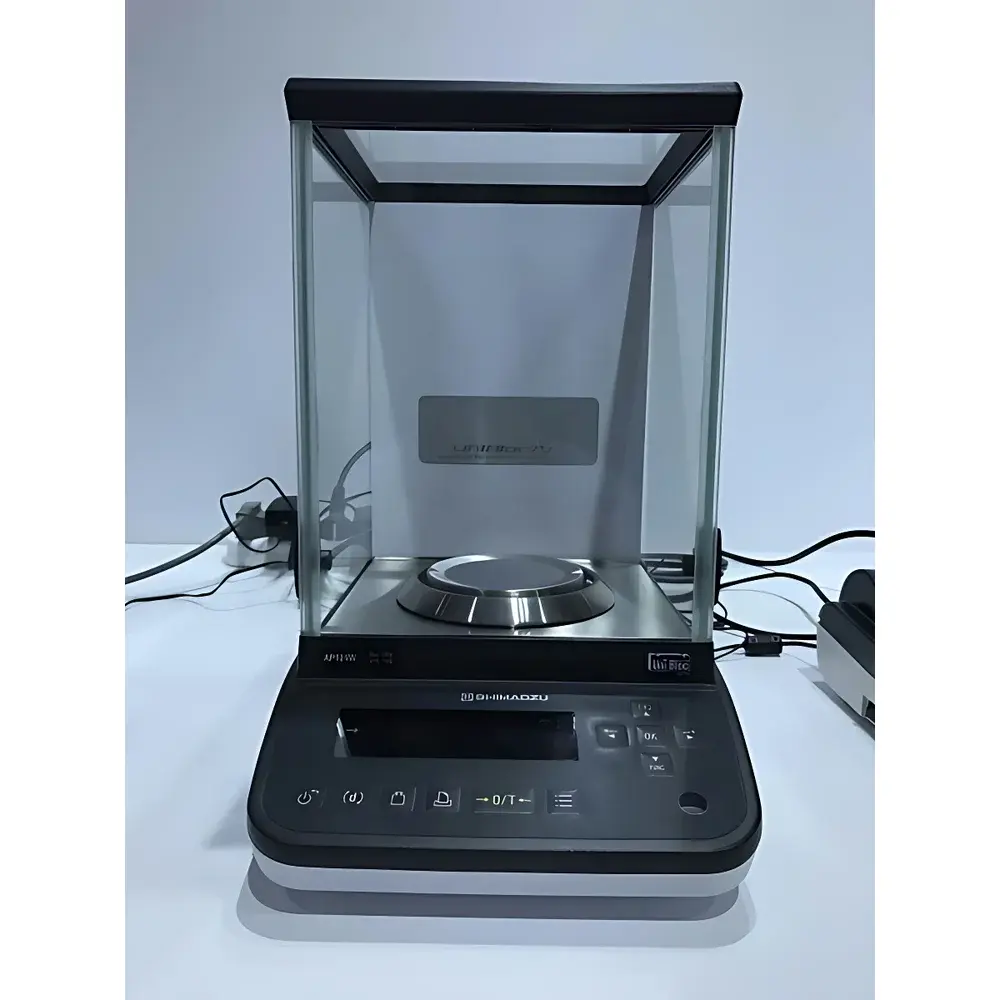
Shimadzu AP224W Analytical Balance
| Brand | Shimadzu |
|---|---|
| Origin | Japan |
| Product Type | Imported Analytical Balance |
| Model | AP224W |
| Maximum Capacity | 220 g |
| Readability | 0.1 mg |
| Repeatability | ±0.1 mg |
| Calibration | Internal and External |
| Compliance | ISO/IEC 17025, USP <41>, ASTM E898, GLP/GMP-ready |
| Connectivity | USB interface for data export, image capture (BMP), and peripheral integration |
Overview
The Shimadzu AP224W Analytical Balance is a high-precision mass measurement instrument engineered for laboratories requiring traceable, reproducible, and regulatory-compliant weighing in analytical chemistry, pharmaceutical quality control, and materials research. Operating on electromagnetic force compensation (EMFC) principle, the AP224W delivers stable, drift-compensated measurements with 0.1 mg readability across its 220 g maximum capacity. Its advanced load cell architecture and temperature-compensated sensor system minimize thermal drift and mechanical hysteresis—critical for applications demanding ≤0.1 mg repeatability under routine environmental fluctuations (20–25 °C, <60% RH). Designed to meet the metrological requirements of ISO 9001-certified labs and FDA-regulated environments, the balance supports full audit trail generation when paired with compliant software and user management protocols.
Key Features
- High-speed stabilization: Achieves stable reading in ≤1.5 seconds under standard lab conditions—optimized via adaptive damping algorithm and low-mass weighing pan design.
- Integrated electrostatic mitigation: Optional STABLO AP anti-static module reduces charge-induced weighing errors on insulating samples (e.g., polymers, powders), improving measurement robustness without manual ionizing tools.
- Regulatory-ready operation: Built-in user management with role-based access control (administrator, operator, reviewer); supports password-protected method locking and electronic signature logging per 21 CFR Part 11 guidelines.
- On-device verification suite: Guided self-check workflow for repeatability, eccentricity (four-corner test), linearity, and sensitivity—executed without external calibration weights or PC software.
- Workflow-integrated functions: Dedicated modes for buffer solution preparation, concentration adjustment (AP-W variant only), and formulation batching—each storing metadata (user ID, timestamp, target mass, tolerance) directly to USB storage.
- Traceable data capture: Full-screen BMP image export of active weighing interface—including real-time display of net mass, tare status, stability indicator, pass/fail judgment, and user-defined notes.
Sample Compatibility & Compliance
The AP224W accommodates standard analytical sample containers (weighing boats, vials, crucibles) up to Ø120 mm diameter. Its draft shield (included) meets ISO 17025 Annex A.3 requirements for environmental isolation during sub-milligram weighing. The balance complies with international metrological standards including OIML R76-1 (Class I), EN 45501, and USP for accuracy and repeatability testing. All internal calibration routines reference NIST-traceable mass standards; external calibration is compatible with Class E2 or better砝码 per ISO/IEC 17025 clause 6.5.2. Device firmware includes configurable reporting templates aligned with GxP documentation practices—including automatic inclusion of instrument ID, calibration due date, and environmental monitoring flags.
Software & Data Management
Data transfer occurs exclusively via USB 2.0 interface—no Bluetooth or Wi-Fi—to maintain network segregation in regulated environments. The balance exports BMP images and CSV-formatted measurement logs (including timestamps, user IDs, stability flags, and pass/fail outcomes) directly to FAT32-formatted USB drives. No proprietary software installation is required for basic data retrieval; however, optional Shimadzu LabSolutions Balance Module enables automated report generation, trend analysis, and integration with LIMS via HL7 or ASTM E1384 messaging. Audit trail records—comprising all configuration changes, calibration events, and user logins—are retained onboard for ≥30 days and exportable as encrypted binary logs for GLP audit review.
Applications
- Pharmaceutical QC: Active pharmaceutical ingredient (API) assay, reference standard weighing, dissolution tablet sampling per USP .
- Academic research: Gravimetric preparation of standard solutions (e.g., ICP-MS calibration standards), catalyst loading quantification, and thermogravimetric sample conditioning.
- Materials science: Powder density determination (tap/untapped), additive manufacturing feedstock batch verification, and nanomaterial dispersion mass fractioning.
- Environmental testing: Filter membrane weighing pre/post-extraction per EPA Method 1633, particulate matter (PM2.5/PM10) gravimetric analysis.
- Food & beverage: Nutrient fortification validation, moisture content calculation via loss-on-drying, and allergen cross-contamination threshold checks.
FAQ
What calibration standards are required for external calibration of the AP224W?
External calibration requires certified weights conforming to OIML Class E2 or ASTM E617 Class 2 specifications, with certificate of calibration traceable to NIST or equivalent national metrology institute.
Does the AP224W support GLP-compliant electronic signatures?
Yes—when configured with multi-level user accounts and enabled audit trail logging, it satisfies 21 CFR Part 11 Subpart B requirements for electronic records and signatures when deployed within a validated IT environment.
Can measurement images be annotated before saving to USB?
No—BMP exports capture the exact screen state at time of save; annotation must be performed post-export using external image editing tools compliant with your organization’s document control SOPs.
Is the STABLO AP anti-static module included by default?
No—it is an optional accessory (Order Code: STABLO-AP-KIT) requiring separate configuration and mounting; compatibility is verified only with AP-W series balances.
How is repeatability verified on the AP224W without external weights?
The built-in repeatability check uses internal reference mass and dynamic load cycling over 10 consecutive trials; results are displayed with statistical summary (mean, SD, max deviation) and compared against ISO 17025 acceptance criteria.