
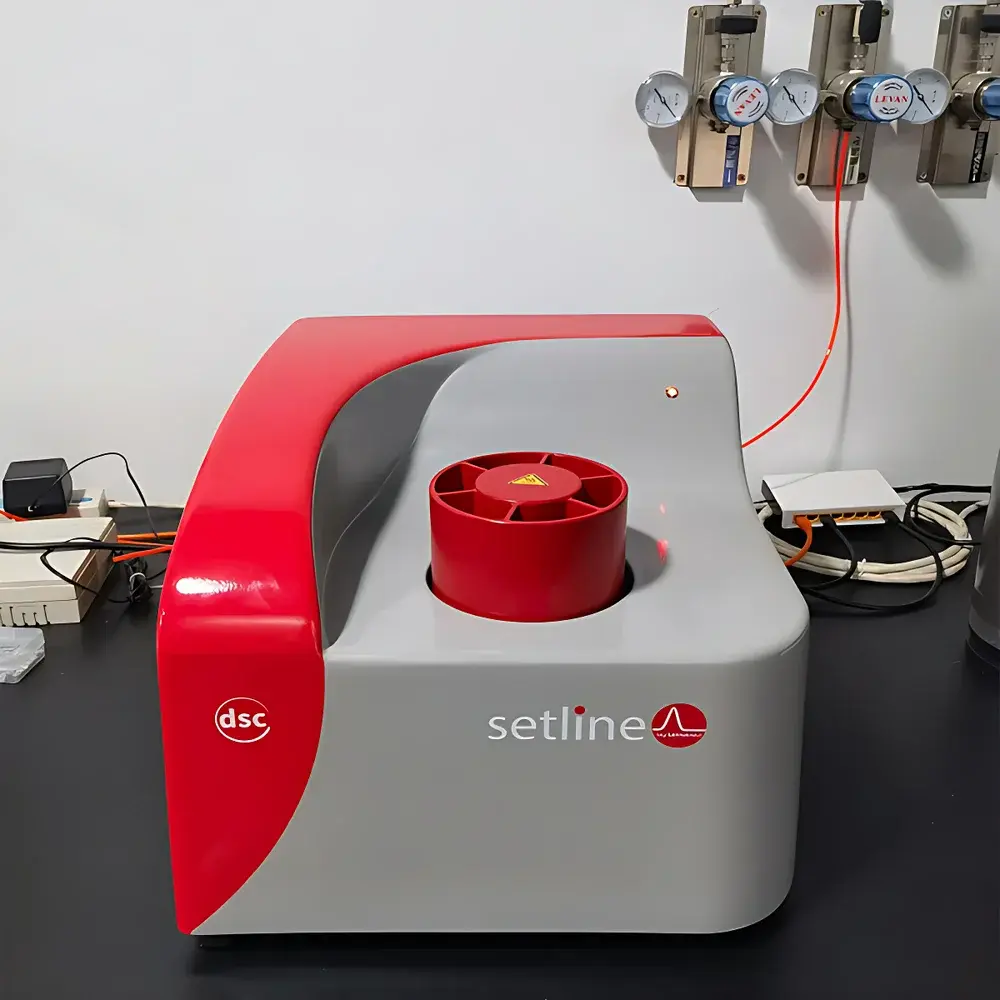
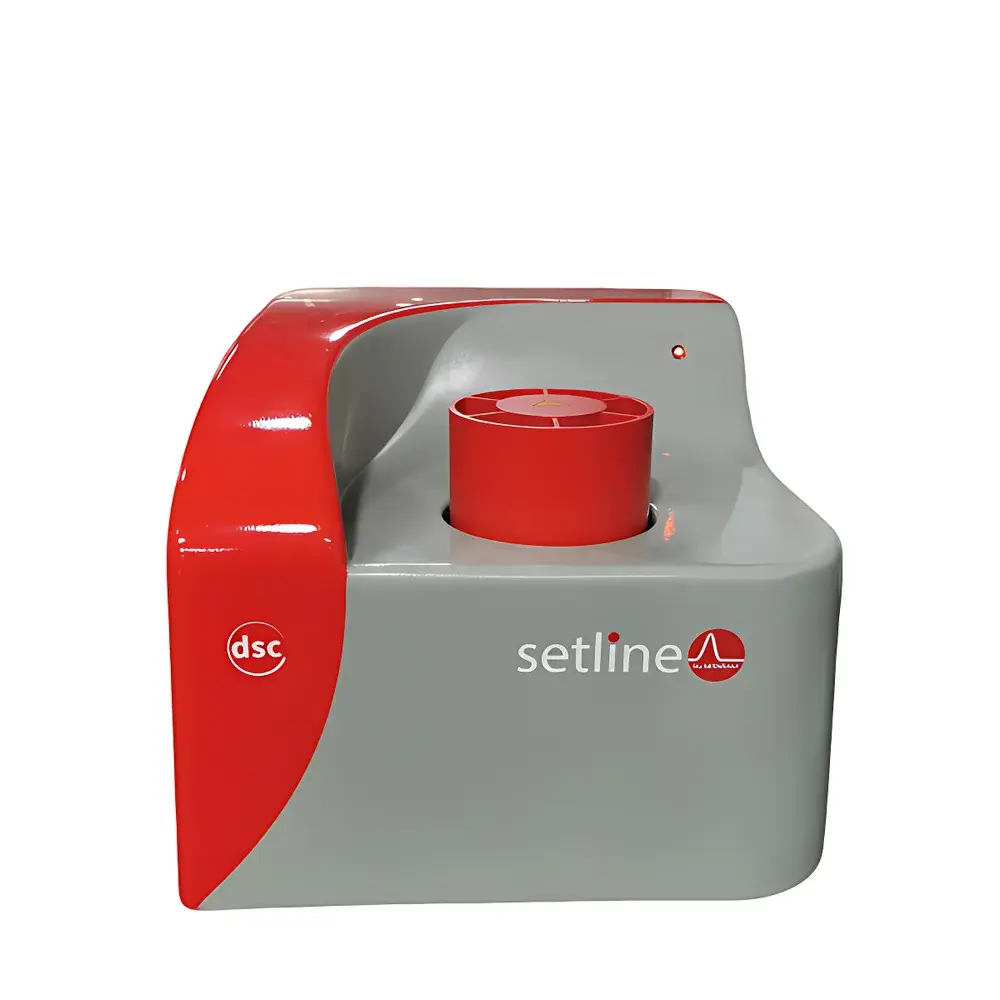
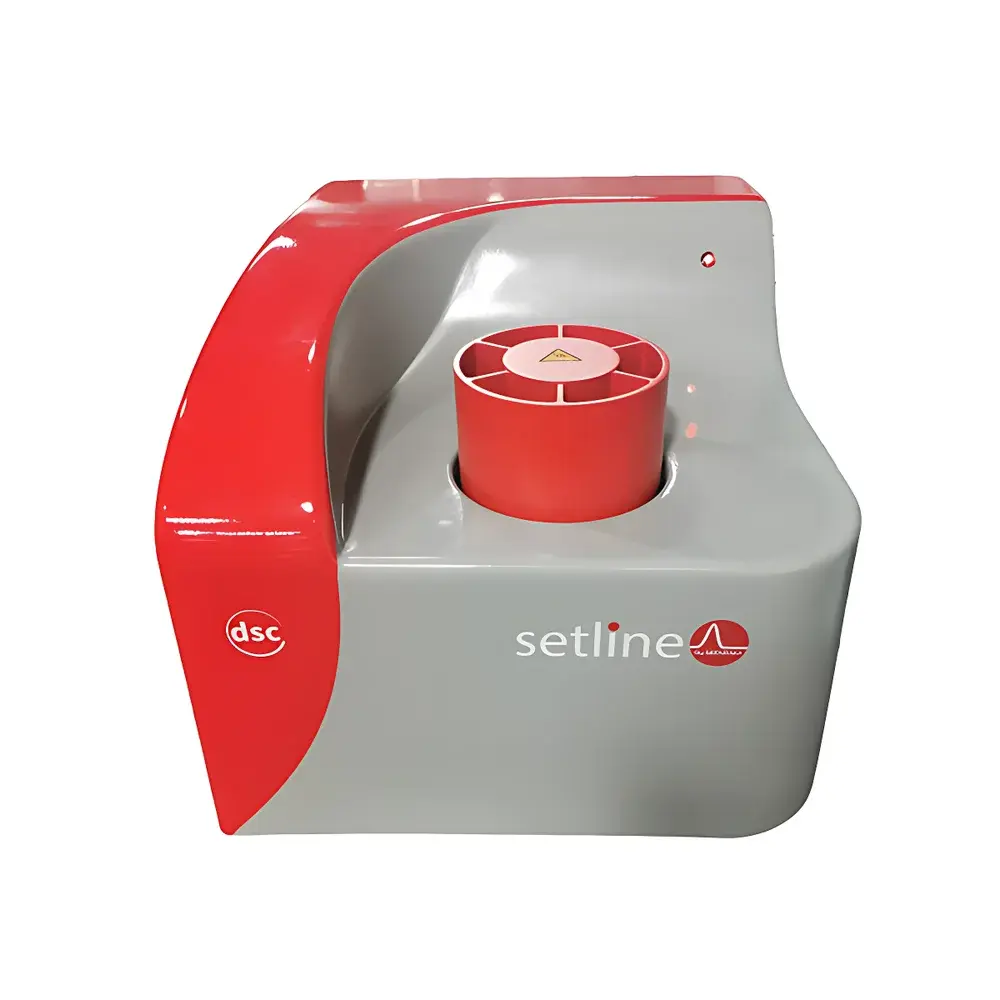
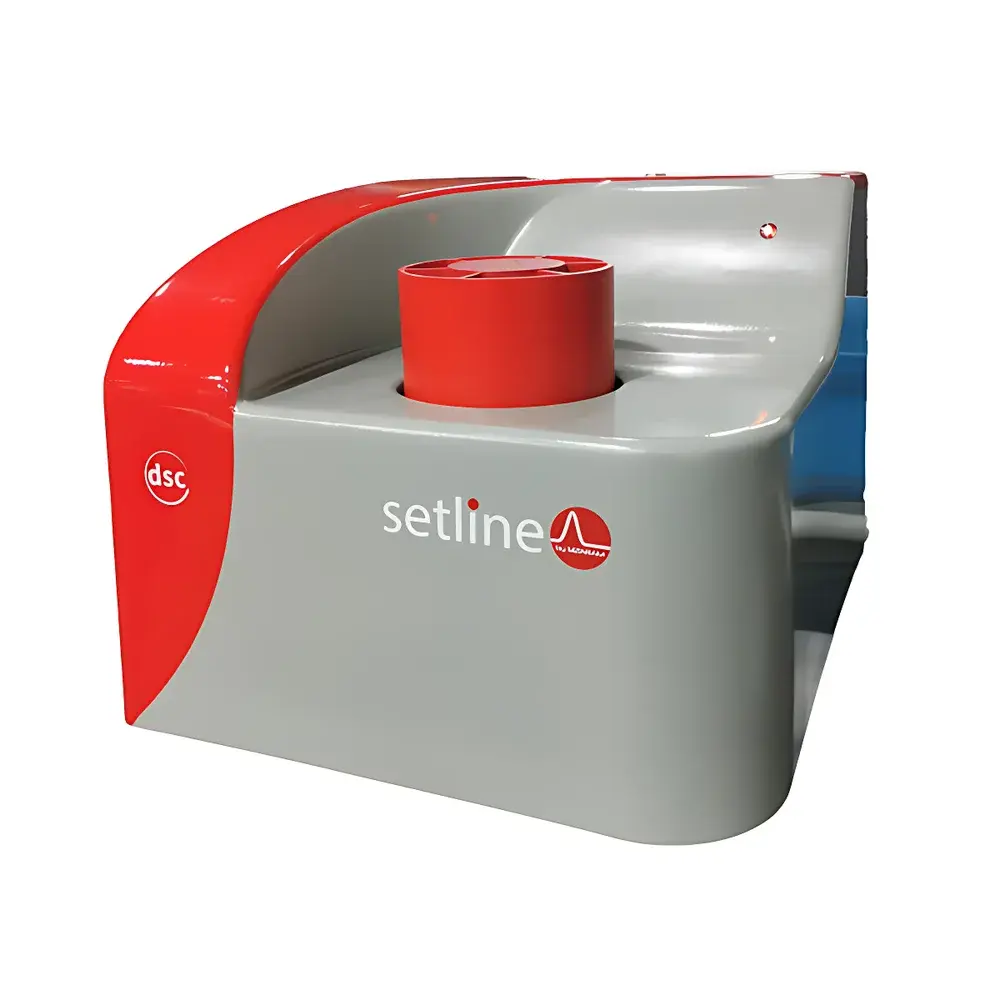
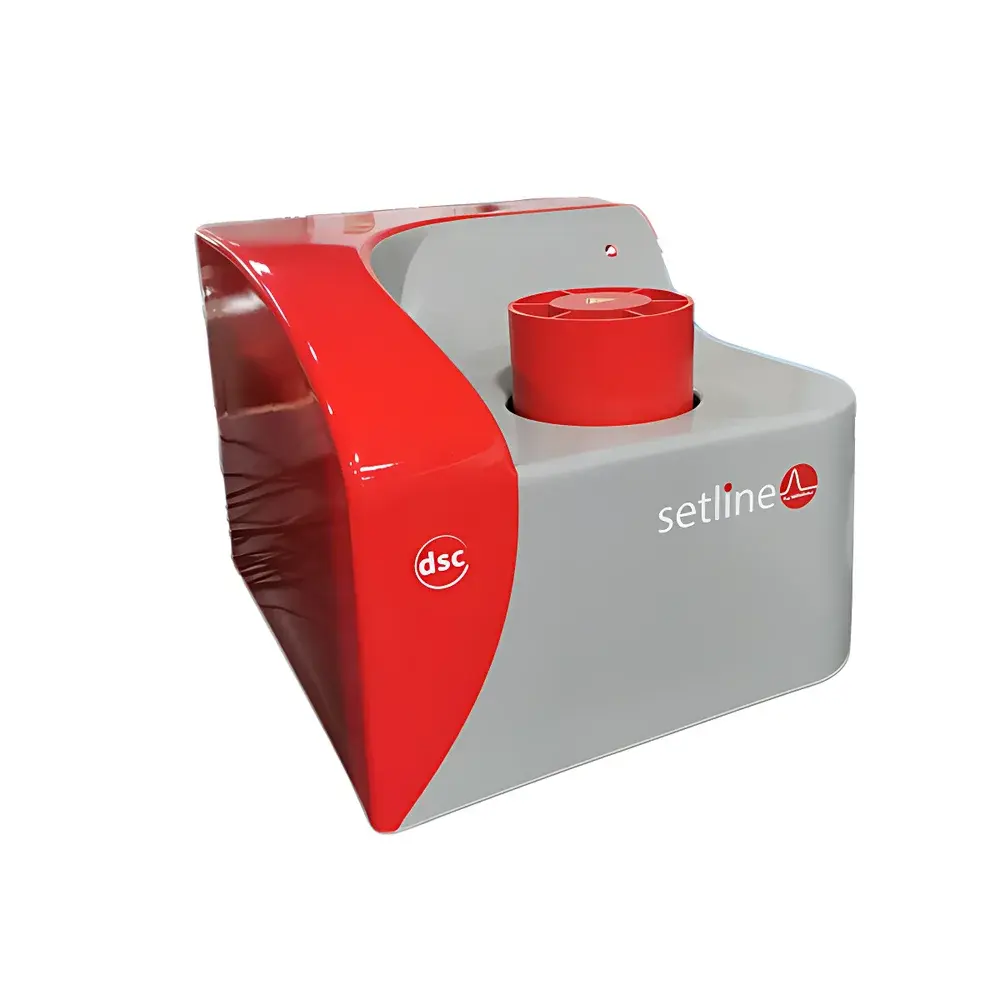
SETARAM Setline DSC+ Differential Scanning Calorimeter
| Brand | SETARAM |
|---|---|
| Origin | Beijing, China (Manufactured under French R&D supervision) |
| Model | Setline DSC+ |
| Temperature Range | −170 °C to 700 °C |
| Temperature Accuracy | ±0.1 °C (vs. certified standards) |
| Heating/Cooling Rate | 0.01–100 K/min |
| Heat Flow Resolution | 0.1 µW |
| Heat Flow Range | ±6000 mW |
| Calorimetric Accuracy | ±0.8% (vs. standard metals) |
| Calorimetric Precision | ±0.1% |
| Atmosphere Control | Dual independent gas flow channels with software-programmed auto-switching |
| Sensor Type | Flat-plate NiCr–Constantan thermopile |
| Cooling Options | Manual/automated LN₂ (−170 °C to 400 °C), He gas cryo-cooling (−70 °C to 200 °C), dry air/N₂/Ar (−50 °C to 400 °C) |
| Crucible Options | Al₂O₃, Al (30 & 100 µL), Incoloy high-pressure (30 µL, up to 500 bar at 600 °C), 316L stainless steel (optional) |
Overview
The SETARAM Setline DSC+ is a high-performance differential scanning calorimeter engineered for precision thermal characterization across academic, industrial, and quality control laboratories. Based on the internationally recognized heat-flux DSC principle—measuring the differential heat flow between a sample and an inert reference as both are subjected to identical, controlled temperature programs—the instrument delivers quantitative data on enthalpic transitions, phase changes, reaction kinetics, and thermal stability. Designed collaboratively by R&D teams in France, Switzerland, and China, the Setline DSC+ integrates European metrological rigor with localized manufacturing scalability. Its core sensor—a flat-plate NiCr–Constantan thermopile—ensures exceptional signal-to-noise ratio and linearity over its full operational range (−170 °C to 700 °C). The low-thermal-inertia furnace enables rapid, reproducible heating and cooling rates (0.01–100 K/min), supporting both high-throughput screening and detailed kinetic investigations. All thermal calibration procedures comply with ISO 11357 and ASTM E794 standards, and system validation includes traceable metal standards (In, Sn, Zn, Ag, Au) for temperature and enthalpy verification.
Key Features
- Wide dynamic temperature range: −170 °C to 700 °C, enabled by modular cooling solutions including automated liquid nitrogen purging, helium gas cryo-cooling, and ambient gas-based low-temperature control.
- High-resolution heat flow detection: 0.1 µW resolution and ±0.1% precision support detection of subtle transitions in low-mass or weakly exothermic/endothermic samples.
- Dual independent gas flow control: Programmable switching between inert (N₂, Ar) and reactive (O₂, air) atmospheres during a single run—essential for oxidation induction time (OIT), decomposition, and catalytic studies.
- Robust, interchangeable crucible system: Standard Al and Al₂O₃ crucibles ensure optimal thermal contact; Incoloy high-pressure crucibles (rated to 500 bar at 600 °C) enable safe analysis of volatile, pressurized, or reactive systems without compromising sensor integrity.
- Modular automation-ready platform: Optional DSC+ autosampler supports unattended sequential analysis of up to 48 samples—critical for QC labs operating under GLP/GMP frameworks requiring audit-trail-compliant workflows.
- Comprehensive thermal calibration suite: Built-in routines for temperature, enthalpy, and sensitivity coefficient calibration using certified reference materials per ISO 11357-1 and USP <1163> guidelines.
Sample Compatibility & Compliance
The Setline DSC+ accommodates solid, semi-crystalline, amorphous, and liquid samples—from milligram-scale polymer films and pharmaceutical APIs to ceramic precursors and energetic materials. Its design meets key regulatory expectations for analytical instrumentation used in regulated environments: full compliance with 21 CFR Part 11 requirements for electronic records and signatures (via Calisto V2 audit trail logging), adherence to ISO/IEC 17025 documentation practices, and compatibility with laboratory quality management systems (QMS) requiring instrument qualification (IQ/OQ/PQ). High-pressure crucible configurations support testing per ASTM D3895 (OIT), ASTM E2070 (polymer curing), and IEC 60695-11-10 (fire safety thermal stability). All hardware and firmware undergo periodic factory recalibration traceable to NIST and LNE standards.
Software & Data Management
Calisto V2 is a Windows-native, standalone software suite comprising two integrated modules: Experiment Programming and Data Analysis. The programming module supports multi-step, multi-ramp temperature profiles with real-time atmosphere switching, user-defined hold segments, and pre-run baseline subtraction from stored reference curves. It features role-based access control, password-protected method templates, and automatic metadata tagging (operator ID, sample ID, timestamp, instrument serial). The analysis module provides ISO-compliant peak identification algorithms—including onset, peak, and endset determination per ASTM E794—and one-click calculation of glass transition (Tg), crystallinity, degree of cure (DCL), oxidation induction time (OIT), specific heat capacity (Cp), and purity via Van’t Hoff analysis. Baseline correction offers seven algorithmic options plus adaptive baseline generation. Export formats include ASCII, CSV, Excel, PDF, and universal .tda (thermal data archive) files compatible with third-party thermal analysis platforms. Multi-language UI (English, French, Chinese) and full Unicode support ensure global deployment readiness.
Applications
The Setline DSC+ serves as a foundational tool in polymer science (melting point, crystallinity, Tg, crosslink density), pharmaceutical development (polymorph screening, excipient compatibility, stability profiling), food science (fat crystallization, starch gelatinization), battery materials (electrolyte decomposition, SEI formation), and advanced composites (curing kinetics, resin aging). Typical use cases include: quantifying residual monomer conversion in epoxy resins; assessing oxidative stability of lubricants and elastomers; determining eutectic composition and phase diagram boundaries in metallurgical alloys; validating thermal sterilization parameters for medical device packaging; and monitoring degradation pathways in biodegradable plastics under accelerated aging conditions. Its reliability in educational settings stems from intuitive operation, robust mechanical design, and curriculum-aligned experiment libraries covering ASTM D3418, ISO 11357-3, and USP <1230>.
FAQ
What temperature calibration standards are supported?
Certified indium, tin, zinc, silver, and gold reference materials are included for routine temperature and enthalpy calibration per ISO 11357-1 and ASTM E794.
Can the instrument perform heat capacity (Cp) measurements?
Yes—using the quasi-isothermal step-scan method or dual-heat-flux calibration with sapphire reference, compliant with ISO 11357-4.
Is remote diagnostics and software update capability available?
Calisto V2 supports secure remote desktop-assisted troubleshooting; firmware updates are delivered via encrypted USB media or authenticated FTP transfer.
How is data integrity ensured for GxP-regulated environments?
Audit trail logging, electronic signature enforcement, method locking, and 21 CFR Part 11–compliant user access tiers are fully implemented and validated.
What maintenance intervals are recommended?
Annual sensor performance verification and furnace calibration are advised; no consumable parts require replacement under normal operation except purge gases and disposable crucibles.



