
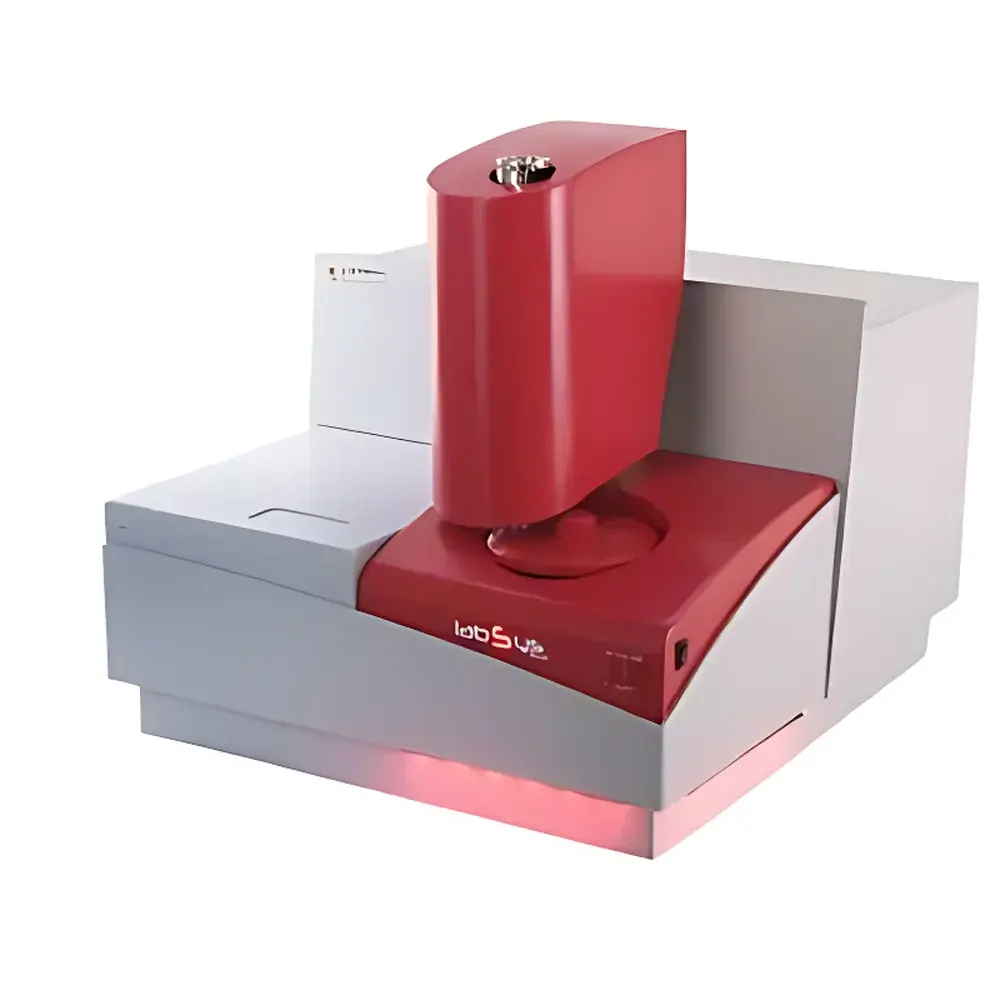



SETARAM Labsys Evo-DSC High-Temperature Differential Scanning Calorimeter (up to 1600 °C)
| Brand | SETARAM |
|---|---|
| Origin | France |
| Model | Labsys Evo-DSC |
| Temperature Range | Ambient to 1600 °C |
| Temperature Accuracy | ±0.1 °C |
| Heating/Cooling Rate | 0.01–100 K/min |
| Balance Max Capacity | 20 g |
| Balance Range | ±1000 mg |
| Balance Resolution | 0.02 µg |
| DSC Sensitivity | 0.4 µW (sensor-dependent) |
| Cp Measurement Uncertainty | <2% |
| Atmosphere Options | Inert, Oxidizing, Reducing, Static, Dynamic, Vacuum |
| Gas Control | 3 Mass-Flow-Controlled Carrier Gases + 1 Auxiliary/Reaction Gas |
| EGA Compatibility | MS, FT-IR, GC |
| Optional Autosampler | 25-position ASC |
Overview
The SETARAM Labsys Evo-DSC is a high-temperature differential scanning calorimeter engineered for precision thermal characterization of advanced materials under extreme conditions. Operating on the principle of heat-flux DSC with integrated thermoelectric compensation, it delivers quantitative measurement of enthalpy changes—including phase transitions, crystallization, glass transitions, oxidation onset, and solid-state reactions—across an extended temperature range from ambient to 1600 °C in a single furnace configuration. Its modular architecture integrates seamlessly into the broader Labsys Evolution platform, enabling optional coupling with thermogravimetric analysis (TGA), simultaneous TGA-DSC, or TGA-DTA configurations via interchangeable sensor rods. This system is specifically designed for laboratories requiring traceable, reproducible thermal data in compliance with ASTM E794, ISO 11357, and USP <1163> guidelines for thermal analysis validation.
Key Features
- High-stability metallic furnace with uniform hot zone (>30 mm axial homogeneity at 1600 °C), supporting heating and cooling rates from 0.01 to 100 K/min without thermal lag or overshoot.
- Patented 3D Calvet-type Cp sensor delivering direct specific heat capacity measurements with ≤2% uncertainty—validated against NIST SRM 720 and certified reference materials.
- Optimized optical microbalance with active drift compensation; no external water bath required, ensuring long-term stability and reduced maintenance overhead.
- Modular sensor rod system: field-replaceable TG, TG-DSC, and TG-DTA rods enable rapid reconfiguration without recalibration or service intervention.
- Four-channel gas management system: three mass-flow-controlled carrier gases plus one independently regulated auxiliary/reaction gas, programmable for dynamic gas switching, gradient mixing, or vacuum-purge sequences.
- Standard EGA interface compliant with ISO 11357-8: supports real-time hyphenation with quadrupole mass spectrometry (QMS), Fourier-transform infrared spectroscopy (FT-IR), or gas chromatography (GC) for evolved gas identification and kinetic modeling.
Sample Compatibility & Compliance
The Labsys Evo-DSC accommodates diverse sample forms—including powders, bulk metals, ceramics, composites, and thin films—in crucibles of alumina, platinum, gold, or graphite (up to 20 mg nominal mass). It supports both open and hermetic crucible configurations for controlled atmosphere studies, including oxidative corrosion testing under air/O2, carburization under CH4/H2, and reduction kinetics under H2/Ar mixtures. The instrument meets IEC 61000-6-3 EMC requirements and is designed for GLP/GMP environments, with full audit trail capability, electronic signature support, and 21 CFR Part 11-compliant software options available upon configuration.
Software & Data Management
SETARAM’s Cahn TA Software provides intuitive method setup, real-time data visualization, and automated baseline correction using adaptive polynomial fitting. All raw and processed data are stored in vendor-neutral HDF5 format with embedded metadata (timestamp, operator ID, calibration history, gas flow logs). Batch processing modules support isoconversional kinetic analysis (Friedman, Ozawa-Flynn-Wall), peak deconvolution (Voigt function), and Cp-derived thermal diffusivity estimation. Export options include CSV, ASCII, and ASTM E1952-compliant XML reports for regulatory submission.
Applications
This instrument serves critical R&D and QA/QC functions across aerospace (superalloy phase stability), nuclear materials (fuel pellet sintering behavior), battery cathode development (high-voltage oxide decomposition), metallurgy (eutectic melting point mapping), and refractory ceramics (thermal shock resistance assessment). Its ability to resolve subtle endothermic events near 1500 °C—such as peritectic reactions in TiAl alloys or spinel formation in MgO-Al2O3 systems—makes it indispensable for high-temperature process optimization and failure root-cause analysis.
FAQ
What is the maximum recommended sample mass for high-temperature DSC measurements?
For optimal signal-to-noise ratio and thermal equilibration at >1200 °C, samples should be limited to 5–15 mg depending on thermal conductivity and crucible type.
Can the system perform heat capacity measurements without prior calibration standards?
No—specific heat quantification requires at least one certified reference material (e.g., sapphire, NIST SRM 720) measured under identical thermal protocol and crucible geometry.
Is vacuum operation compatible with DSC mode?
Yes; the system supports static vacuum down to 10−2 mbar during DSC scans, though pressure-dependent baseline shifts must be accounted for in data interpretation.
How frequently does the balance require recalibration?
Automatic internal calibration is performed at startup and user-initiated; mechanical zero-point verification is recommended every 48 hours of continuous operation.
Does the autosampler option maintain inert atmosphere integrity between runs?
Yes—the 25-position ASC features sealed carousel compartments and purged transfer pathways, preserving O2 <1 ppm during sequential loading under argon or nitrogen.



