
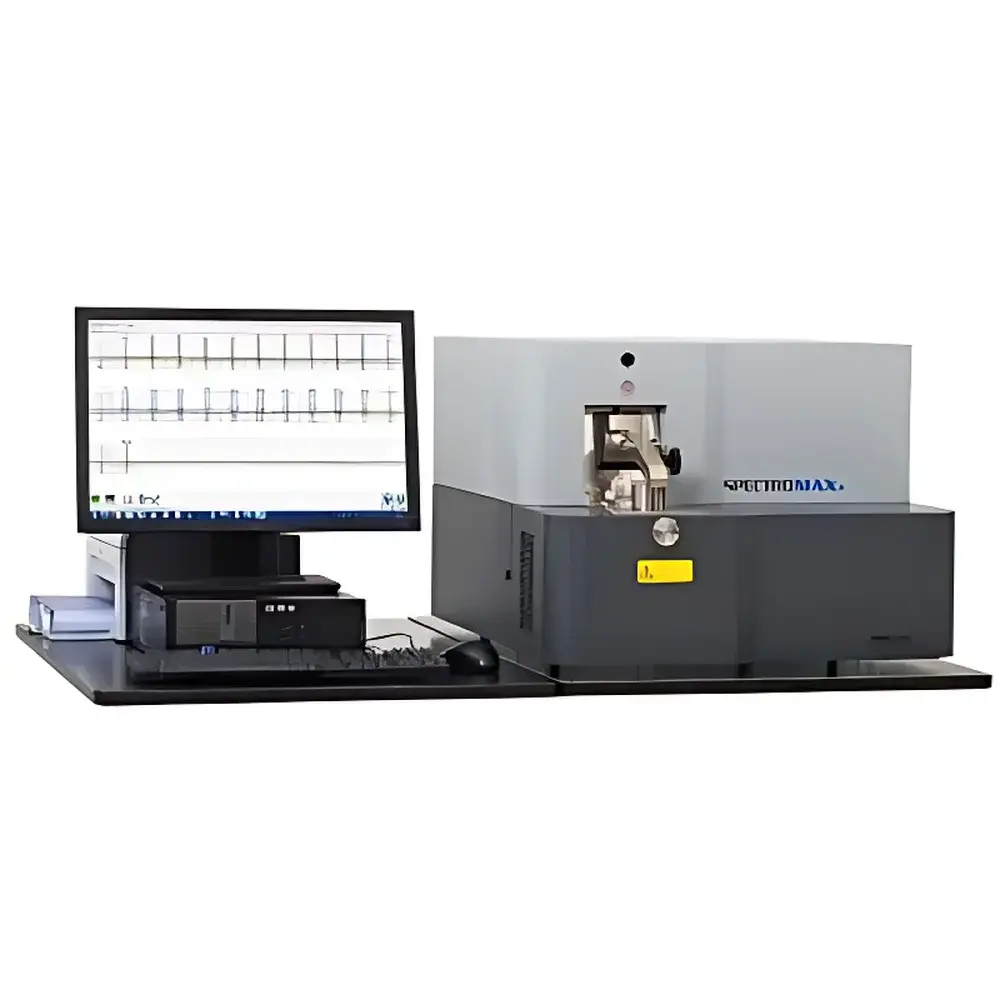
SPECTRO MAXx Desktop Spark Optical Emission Spectrometer
| Brand | SPECTRO |
|---|---|
| Origin | Germany |
| Model | SPECTRO MAXx Desktop |
| Excitation Source | Spark |
| Detector Type | CMOS |
| Focal Length | 500 mm |
| Grating Groove Density | 3600 lines/mm |
| Wavelength Range | 120–670 nm |
Overview
The SPECTRO MAXx Desktop Spark Optical Emission Spectrometer is a high-performance, benchtop optical emission spectrometer (OES) engineered for precise elemental analysis of metallic alloys in industrial and laboratory environments. Based on the fundamental principle of spark-induced plasma excitation and wavelength-dispersive detection, the instrument atomizes and excites solid metal samples under controlled argon atmosphere, generating element-specific atomic emission lines. These spectral signatures are resolved by a Paschen-Runge mounting spectrometer with a 500 mm focal length and a high-resolution 3600 lines/mm grating, enabling accurate identification and quantification across a broad spectral range from 120 nm to 670 nm — including critical vacuum UV lines essential for hydrogen, oxygen, nitrogen, carbon, phosphorus, and sulfur determination in titanium-, aluminum-, and steel-based matrices.
Key Features
- Intelligent Calibration Logic (iCAL): Enables rapid, single-sample standardization without full recalibration — maintaining accuracy across ambient temperature fluctuations and reducing daily setup time by up to 30 minutes versus prior-generation instruments.
- Optimized Argon Consumption: Advanced gas flow management reduces standby argon usage by up to 64%, significantly lowering operational cost and environmental footprint.
- CMOS Linear Array Detector: Provides high quantum efficiency, low noise, and excellent dynamic range across the full UV-VIS spectrum — eliminating photomultiplier tube (PMT) maintenance and enabling simultaneous multi-element detection.
- Automated Diagnostic & Maintenance Guidance: Real-time monitoring of spark stand condition, electrode wear, and optical alignment; software prompts users when cleaning or maintenance is required based on sample type and accumulated sparks.
- Modular Method Architecture: Supports up to 10 base materials (e.g., Fe, Al, Cu, Ti, Ni, Mg, Zn, Pb, Sn, Co), 65 pre-validated analytical methods, and quantitative determination of up to 56 elements — including light elements (C, P, S, N, H, O) critical for metallurgical process control.
- Intuitive Workflow-Driven Interface: Icon-based navigation separates operation from programming; only contextually relevant functions appear during measurement sequences — minimizing operator error and training overhead.
Sample Compatibility & Compliance
The SPECTRO MAXx accepts solid conductive metal samples conforming to ISO 11577, ASTM E415, and EN 10315 standards for OES sample preparation. It accommodates standard 32–40 mm diameter discs and custom geometries via adaptable sample clamping. The system meets CE marking requirements and complies with IEC 61000-6-3 (EMC) and IEC 61010-1 (safety). For regulated environments, optional audit trail logging, electronic signature support, and user role management align with FDA 21 CFR Part 11 and GLP/GMP documentation requirements.
Software & Data Management
Controlled by SPECTRO’s proprietary Spark Analyzer Vision software, the system delivers comprehensive data acquisition, statistical evaluation (RSD, CPK, trend analysis), and reporting in customizable formats (PDF, CSV, XML). All measurement parameters — including integration times, spark counts, background correction, and calibration history — are timestamped and stored with full traceability. Optional AMECARE M2M connectivity enables secure remote diagnostics, predictive maintenance alerts, and direct technical support escalation — minimizing unplanned downtime and supporting Industry 4.0 integration strategies.
Applications
The SPECTRO MAXx serves as a core analytical platform across the metal value chain: incoming raw material inspection at foundries and mills; real-time melt shop process control (e.g., ladle analysis, alloy addition verification); heat-to-heat certification; and final product release testing. Its ability to quantify interstitial elements (N, O, H) in titanium and zirconium alloys, low-level tramp elements in high-purity aluminum, and carbon/sulfur in stainless steels makes it indispensable for aerospace, automotive, energy, and medical device manufacturers requiring strict compositional conformance.
FAQ
What types of metals can the SPECTRO MAXx analyze?
It supports ferrous and non-ferrous alloys including steel, cast iron, aluminum, copper, titanium, nickel, magnesium, zinc, lead, tin, and cobalt-based materials.
Does it require vacuum pumping for UV spectral lines?
No — the sealed optical chamber is purged with argon, enabling stable detection down to 120 nm without mechanical vacuum systems.
How often does the spark stand require cleaning?
The instrument autonomously monitors spark erosion and surface contamination, prompting cleaning only when performance thresholds are approached — typically after 50–200 sparks depending on matrix and grade.
Is method development possible for custom alloys?
Yes — certified application specialists can develop and validate new calibrations using certified reference materials (CRMs) traceable to NIST or BAM standards.
Can measurement data be integrated into LIMS or MES systems?
Yes — via OPC UA, ODBC, or ASCII file export protocols, supporting seamless integration with enterprise laboratory and manufacturing execution systems.
Related Products





