
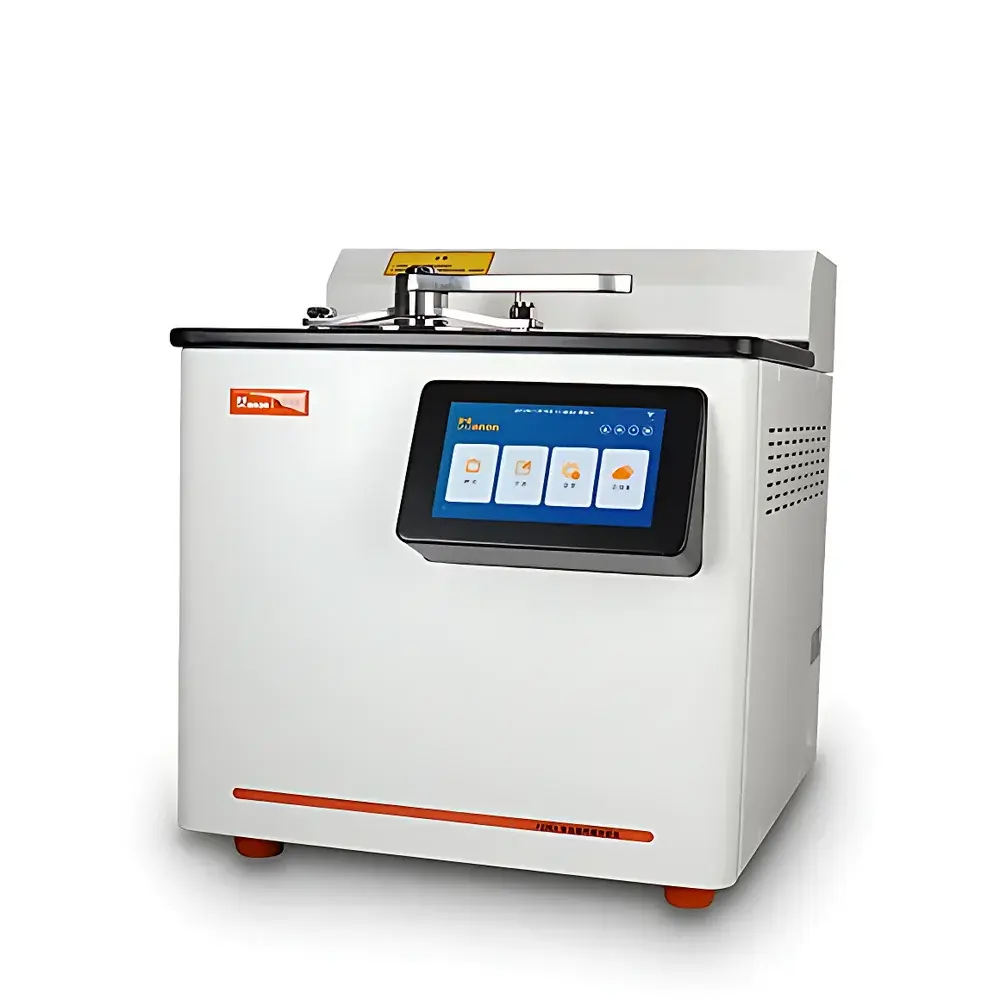
Hanon F2000 Automated Fiber Analyzer
| Brand | Hanon |
|---|---|
| Origin | Shandong, China |
| Model | F2000 |
| Sample Capacity | 24+ positions per batch |
| Temperature Control Accuracy | ±0.1°C |
| Repeatability | ≤0.5% RSD |
| Daily Throughput | ≥96 samples (4 batches) |
| Power Supply | AC 220±10 V, 50±1 Hz |
| Rated Power | 2000 W |
| Dimensions (L×W×H) | 520 × 450 × 510 mm |
| Net Weight | 52 kg |
| Compliance | GB/T 6434-2006, GB/T 20805-2006, GB/T 20806-2006, GB/T 5515-2008, GB/T 8310-2013, GB/T 5009.10-2003 |
Overview
The Hanon F2000 Automated Fiber Analyzer is a fully integrated, benchtop fiber determination system engineered for precision, reproducibility, and regulatory compliance in feed, food, and botanical material analysis. It implements standardized gravimetric fiber fractionation based on the Weende and Van Soest methodologies—specifically adapted for sequential detergent extractions including Crude Fiber (CF), Neutral Detergent Fiber (NDF), Acid Detergent Fiber (ADF), and Acid Detergent Lignin (ADL). Unlike traditional crucible-based systems, the F2000 employs disposable high-strength filter bags as sample containment vessels, eliminating mechanical clogging, filter paper rupture, and heterogeneous ash correction errors inherent in classical filtration approaches. The instrument performs complete digestion, filtration, rinsing, and waste disposal within a sealed, pressurized metal digestion chamber—requiring no external condenser or continuous cooling water supply. Its closed-loop architecture ensures consistent thermal profiles, minimizes reagent exposure, and supports unattended operation for up to four full batches (96 samples) per 24-hour cycle.
Key Features
- 7-inch capacitive touchscreen interface running embedded Android OS, enabling intuitive workflow navigation and real-time status monitoring
- Automated liquid handling with precise metering of neutral/acid detergents, solvents, and rinse water—fully synchronized with temperature and pressure profiles
- Integrated pre-heating module maintains rinse water at standardized temperatures (e.g., 100°C for NDF protocols), ensuring strict adherence to GB/T 20806-2006 and AOAC 973.18 requirements
- Monolithic stainless-steel digestion vessel with electropolished interior surface, rated for sustained operation at 120°C and 0.2 MPa; resistant to sulfuric acid, sodium hydroxide, and alpha-amylase solutions
- Dual safety interlocks: electromagnetic lid lock activated during pressurized digestion, plus redundant thermal and pressure monitoring with automatic shutdown if limits exceed ±0.5°C or 0.22 MPa
- Intelligent solvent level detection with audible/visual alarm and process suspension upon low-reagent condition
- Role-based user access control supporting administrator, technician, and viewer accounts with audit-trail-capable login history
Sample Compatibility & Compliance
The F2000 accommodates solid plant-derived matrices ranging from ground forage and compound feed to cereal grains, legumes, tea leaves, and processed botanical extracts. Sample mass is precisely controlled between 0.5–1.0 g per filter bag, optimized for stoichiometric detergent saturation and uniform fiber solubilization. All operational parameters—including digestion time (30–120 min), temperature ramp rate (1–5°C/min), agitation frequency (0–60 rpm), and rinse volume (2×500 mL)—are programmable per method. The system conforms to national standards including GB/T 6434-2006 (Crude Fiber), GB/T 20806-2006 (NDF), GB/T 20805-2006 (ADL), and GB/T 5009.10-2003 (plant food fiber), and aligns with internationally referenced procedures such as AOAC 962.09, AOAC 973.18, and ISO 13906:2014 (for fiber fraction reporting). Its design facilitates GLP-compliant documentation when paired with external LIMS integration via USB or Ethernet export of raw mass data and timestamped event logs.
Software & Data Management
The onboard Android platform hosts a modular method library supporting over 1,000 customizable assay templates. Users may define, duplicate, and version-control methods for CF, NDF, ADF, ADL, hemicellulose (calculated), and cellulose (difference-based) determinations. Each method stores calibration offsets, default weights, blank subtraction logic, and pass/fail criteria. All run data—including initial dry mass, residue mass post-digestion, ash correction values, and final % fiber content—are stored locally with ISO 8601 timestamps and exported in CSV format for traceability. Audit trails record operator ID, method version, start/stop times, parameter deviations, and safety event triggers (e.g., lid open during pressurization), satisfying basic FDA 21 CFR Part 11 readiness when combined with institutional electronic signature policies.
Applications
The F2000 delivers validated fiber profiling across agricultural and food quality assurance laboratories. In animal nutrition labs, it enables routine NDF/ADF ratio calculation for predicting ruminant digestibility and metabolizable energy (ME) content per NRC (2001) guidelines. Feed mills use it for QC release testing against contractual specifications for alfalfa hay, soybean meal, and distillers’ dried grains. Research institutions apply it to evaluate enzymatic pretreatment efficacy in lignocellulosic biomass studies. Food safety labs deploy it for fiber labeling compliance under GB 28050-2011 (Nutrition Labeling Standard), while tea quality control departments rely on its reproducible CF quantification per GB/T 8310-2013. Its robustness supports high-volume contract testing environments where throughput, inter-operator consistency, and method portability are critical.
FAQ
Does the F2000 require external cooling water or condenser setup?
No—the digestion chamber operates in a sealed, self-contained mode with internal vapor condensation and heat recovery; no chilled water connection is needed.
Can filter bags be sourced from third-party suppliers?
Hanon-certified polyester mesh bags (pore size: 25 µm, burst strength ≥2.5 MPa) are recommended to ensure dimensional stability and chemical resistance during hot acid/alkali exposure.
How is ash correction handled for NDF and ADF results?
The instrument does not perform ash incineration; users must weigh residues before and after muffle furnace treatment (550°C, 3 h) and input ash mass manually into the software for final calculation.
Is remote monitoring or network connectivity supported?
Yes—via optional Ethernet interface, enabling centralized status polling and scheduled CSV log retrieval through standard FTP or SMB protocols.
What maintenance intervals are recommended for long-term reliability?
Daily wipe-down of chamber seal surfaces; quarterly verification of pressure transducer linearity and temperature sensor calibration using NIST-traceable references; annual replacement of silicone gaskets and pump tubing.




