
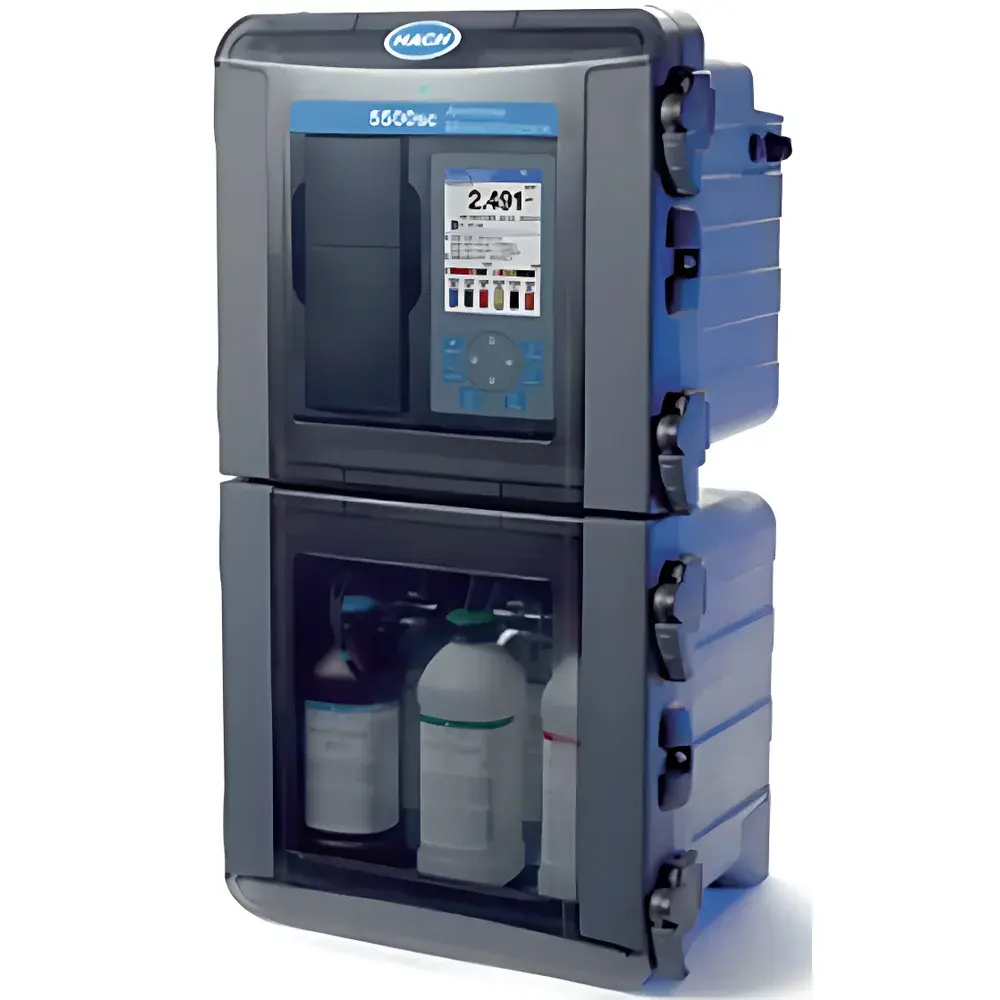
HACH 5500sc Ammonia and Monochloramine Analyzer
| Brand | HACH |
|---|---|
| Origin | Imported |
| Manufacturer Type | Manufacturer |
| Model | HACH 5500sc |
| Instrument Type | Online Water Quality Analyzer |
| Measured Parameters | Total Ammonia, Monochloramine, Free Ammonia |
| Range | 0.01–2 ppm as N |
| Accuracy | ±5% or 0.01 ppm (as N) at 5–40 °C |
| Repeatability | ±3% or 0.01 ppm (as N), whichever is greater |
| Detection Limit | 0.01 ppm as N |
| Response Time | <5 minutes |
| Sample Flow Rate | 100–1000 mL/min |
| Operating Temperature | 5–45 °C |
| Operating Humidity | 5–95% RH (non-condensing) |
| Sample Pressure | 0.17–6.0 bar |
| Sample Temperature | 5–50 °C |
| Power Output | 4 × 0/4–20 mA (600 Ω max load) |
| Communication Options | Modbus RS-485, Profibus DP (with external controller) |
| Enclosure Rating | NEMA 4X / IP56 |
| Dimensions | 804 × 452 × 360 mm |
| Weight | 20.5 kg (empty) |
| Certifications | CE, cETLus, Australian RCM |
Overview
The HACH 5500sc Ammonia and Monochloramine Analyzer is a fully automated, online photometric analyzer engineered for continuous, real-time monitoring of ammonia speciation in drinking water distribution systems. It employs a validated, EPA-compliant modified phenol-hypochlorite colorimetric method—optimized for chloraminated water—to quantitatively determine total ammonia nitrogen (TAN), monochloramine (NH2Cl), and by difference, free ammonia (NH3). This tri-species measurement capability enables operators to maintain optimal chlorine-to-ammonia molar ratios (typically 3:1 to 5:1), thereby preventing nitrification, biofilm resurgence, and associated taste-and-odor events. The analyzer operates on the principle of sequential reagent addition, pH-controlled reaction kinetics, and dual photometric detection—ensuring high specificity for monochloramine in the presence of residual chlorine and organic interferences. Its design complies with ASTM D1426 (ammonia), ASTM D1253 (residual chlorine), and supports GLP/GMP-aligned data integrity requirements.
Key Features
- Dual-colorimeter architecture enabling concurrent measurement of total ammonia and monochloramine within a single 5-minute cycle—reducing analytical lag relative to nitrification onset.
- Pressurized reagent delivery system minimizing air entrapment, bubble formation, and flow variability—critical for long-term precision in low-concentration (<0.1 ppm) applications.
- PROGNOSYS predictive diagnostics engine continuously monitors valve actuation cycles, photometer stability, reagent depletion trends, and optical path fouling—generating actionable maintenance alerts prior to performance drift.
- Modular, field-replaceable reagent cartridges with color-coded labeling and integrated RFID tracking—supporting rapid changeover without calibration interruption or manual parameter entry.
- NEMA 4X/IP56-rated enclosure rated for indoor/outdoor wall, panel, or benchtop mounting—compatible with municipal pump stations, clearwells, and booster chlorination facilities.
- Integrated sample conditioning with programmable dual-sample inlet sequencing—allowing simultaneous monitoring of influent and effluent streams or redundant verification sampling.
Sample Compatibility & Compliance
The 5500sc is validated for use with potable water matrices containing ≤2 mg/L free chlorine, ≤1 mg/L combined chlorine, and turbidity <5 NTU. It tolerates typical municipal water pH ranges (6.5–8.5) and requires no pre-filtration for filtered surface water or groundwater sources. For raw or high-turbidity applications, optional external filtration modules (e.g., 5500.AMC.3.KTO/5500.AMC.4.KTO configurations) integrate seamlessly with backwash control logic. Regulatory alignment includes compliance with US EPA Guidance for Chloramination Monitoring (2018), ISO 7888:2012 (water quality — determination of ammonia nitrogen), and supports audit readiness for FDA 21 CFR Part 11 when paired with HACH’s INTELLIGENT™ Data Manager software (configured with electronic signatures and full audit trail).
Software & Data Management
The embedded firmware supports configurable alarm thresholds (high/low, rate-of-change), automatic zero/span verification scheduling, and diagnostic log export via USB or Modbus TCP. When connected to HACH’s SCADA-integrated DataStream™ platform, the analyzer contributes timestamped, QC-flagged results—including raw absorbance values, reagent lot traceability, and temperature-compensated concentration outputs—to centralized dashboards. All measurement events are logged with immutable timestamps, user IDs (where authenticated), and instrument status flags—fulfilling ALCOA+ principles (Attributable, Legible, Contemporaneous, Original, Accurate, Complete, Consistent, Enduring, Available) for regulated utilities.
Applications
- Optimization of chloramine breakpoint dosing in drinking water treatment plants.
- Early-warning detection of nitrification precursors in distribution system dead-ends and storage reservoirs.
- Verification of ammonia feed control loops in membrane bioreactors (MBRs) and tertiary denitrification basins.
- Regulatory reporting for state primacy agencies requiring monthly or quarterly speciated ammonia data under the Safe Drinking Water Act (SDWA).
- Correlation studies between monochloramine decay rates and pipe material aging (e.g., cast iron vs. ductile iron vs. PVC).
FAQ
How does the 5500sc distinguish monochloramine from free chlorine interference?
It leverages differential reaction kinetics: monochloramine reacts selectively with phenol under controlled pH and excess hypochlorite, while free chlorine is quenched prior to color development using sodium arsenite—validated per Standard Methods 4500-NH3 F.
Can the analyzer operate unattended for extended periods?
Yes—typical reagent consumption is ≤1 L/month at 5-minute cycle intervals, and PROGNOSYS-driven predictive maintenance extends mean time between interventions to ≥90 days under standard operating conditions.
Is calibration traceable to NIST standards?
All factory calibrations use HACH-certified reference standards (SRM 2185a, NH3-N), with certificate of analysis provided per batch; field verification utilizes included 0 ppm and 2 ppm NH3-N standards (25237000/25238000).
What cybersecurity protocols are supported?
Firmware v3.2+ includes TLS 1.2 encryption for remote configuration, role-based access control (admin/operator/viewer), and secure boot validation—aligned with ISA/IEC 62443-3-3 Level 1 requirements.
Does it support integration with legacy SCADA systems?
Yes—native 4–20 mA analog outputs (4 channels, isolated) and optional Modbus RTU/ASCII over RS-485 enable direct integration with Allen-Bradley, Siemens S7, and GE PACSystems controllers without protocol gateways.
Related Products







