
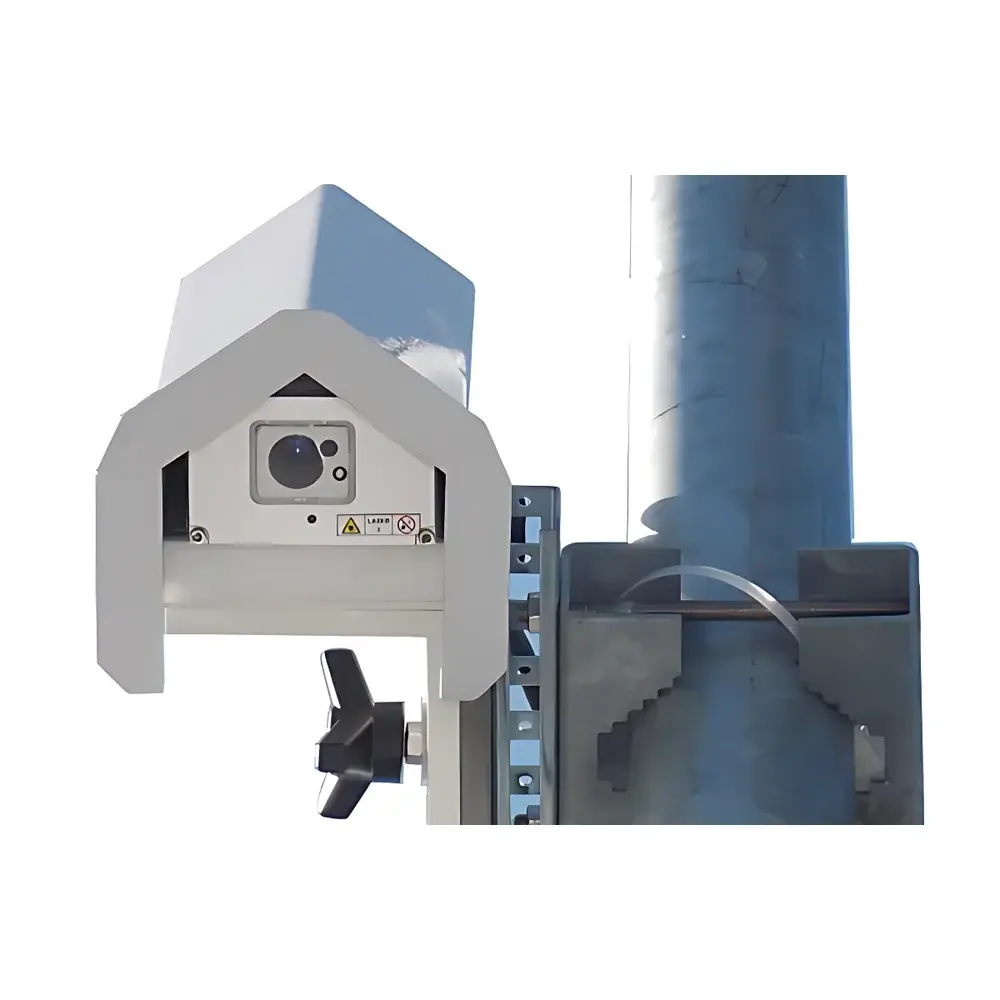
Lufft SHM31-UMB Laser Snow Depth Sensor
| Brand | Lufft |
|---|---|
| Origin | Germany |
| Model | SHM31-UMB |
| Measurement Principle | Time-of-Flight (ToF) Laser Ranging |
| Laser Source | Class 1, 905 nm Pulsed Semiconductor Laser |
| Range | 0.2–30 m (typical snow depth measurement up to 20 m) |
| Resolution | 1 mm |
| Accuracy | ±5 mm or ±0.5 % of reading (whichever is greater) |
| Beam Divergence | < 3 mrad |
| Operating Temperature | –40 °C to +60 °C |
| IP Rating | IP67 |
| Output Interface | SDI-12, RS-232, RS-485, UMB-ASCII, UMB-Binary |
| Power Supply | 6–30 VDC |
| Power Consumption | < 1.5 W (standby), < 3 W (active measurement) |
| Mounting | Adjustable tilt compensation via integrated dual-axis inclinometer |
Overview
The Lufft SHM31-UMB Laser Snow Depth Sensor is an industrial-grade, non-contact optical instrument engineered for continuous, all-weather monitoring of snow accumulation and melt dynamics. It operates on the time-of-flight (ToF) principle: a pulsed, eye-safe Class 1 semiconductor laser (905 nm) emits short-duration light pulses toward the snow surface; the sensor precisely measures the round-trip time of the reflected signal using high-speed photodetectors and digital timing circuitry. By subtracting the real-time distance from a fixed reference plane—typically the sensor’s mounting height—the device computes snow depth with millimeter-level resolution. Unlike ultrasonic sensors, which suffer from acoustic interference due to wind turbulence, temperature gradients, or surface crust formation, the SHM31-UMB delivers stable, drift-free measurements across extreme alpine and polar environments. Its solid-state design eliminates moving parts, ensuring long-term reliability without mechanical wear or recalibration requirements.
Key Features
- True all-weather performance: certified for continuous operation from –40 °C to +60 °C, with condensation-resistant optics and IP67-rated housing.
- Integrated dual-axis inclinometer enables automatic tilt compensation—critical for installations on uneven terrain or vibrating infrastructure (e.g., bridge piers, mountain weather stations).
- Optimized optical path design minimizes stray light interference from fog, blowing snow, or direct solar exposure; advanced signal processing discriminates between snow surfaces and underlying substrates (e.g., ice, rock, vegetation).
- No consumables or desiccants required: fully sealed optical chamber eliminates humidity-induced drift and eliminates routine maintenance cycles.
- Multi-protocol digital interface support: native compatibility with SDI-12 (for Campbell Scientific dataloggers), RS-232/RS-485 (Modbus RTU), and UMB ASCII/Binary protocols—ensuring seamless integration into existing meteorological telemetry networks.
- Low-power architecture: consumes less than 1.5 W in standby mode, making it suitable for solar-powered remote deployments with battery backup.
Sample Compatibility & Compliance
The SHM31-UMB is validated for use across heterogeneous snowpack conditions—including dry powder, wet slush, wind-packed crusts, and refrozen layers—without signal attenuation or false triggering. Its 905 nm wavelength exhibits minimal atmospheric absorption and strong reflectivity from snow crystals, enabling consistent detection even under low-visibility conditions. The sensor complies with IEC 60529 (IP67), EN 61326-1 (EMC for industrial environments), and meets WMO Guide to Meteorological Instruments and Methods of Observation (CIMO Guide) Chapter 12 requirements for automated snow depth observation. Data integrity aligns with ISO/IEC 17025 traceability frameworks when deployed within accredited meteorological monitoring systems.
Software & Data Management
The SHM31-UMB supports standardized data output formats compatible with major environmental data platforms including MeteoIO, ODIM HDF5, and NOAA’s IWXXM schema. Firmware updates are performed remotely via UART or field-programmable UMB commands. When integrated with Lufft’s UMB-Data Logger or third-party systems supporting SDI-12 or Modbus, the sensor provides timestamped, audit-ready records—including raw ToF values, internal temperature, inclination angles, signal quality index (SQI), and diagnostic flags. Optional cloud ingestion via MQTT or HTTP POST enables real-time visualization in Grafana or custom SCADA dashboards, with built-in data buffering (up to 72 hours) during communication outages.
Applications
- Meteorological networks: Primary snow depth input for national weather services (e.g., DWD, Met Office, NOAA NWS) and WMO Global Observing System (GOS) stations.
- Aviation safety: Runway and apron snow monitoring at airports in high-latitude or mountainous regions per ICAO Annex 3 and FAA Advisory Circular 150/5200-30G.
- Transportation infrastructure: Real-time snow load assessment on bridges, tunnels, and highway corridors for winter maintenance dispatch optimization.
- Winter sports operations: Automated snowpack profiling for ski resort grooming, avalanche forecasting support, and lift safety interlocks.
- Hydrological modeling: Input for snow water equivalent (SWE) estimation in catchment-scale runoff simulations (e.g., SWAT, VIC models).
- Renewable energy: Monitoring snow accumulation on photovoltaic arrays and wind turbine foundations in cold-climate installations.
FAQ
Does the SHM31-UMB require periodic calibration?
No. The sensor employs factory-calibrated time-of-flight electronics and thermally stabilized laser diodes. Long-term stability is verified per ISO 17025-accredited test reports; no user-performed calibration is specified or supported.
Can it distinguish between snow and ice-covered surfaces?
Yes. The algorithm analyzes pulse shape, return amplitude, and signal-to-noise ratio to classify surface types. Ice layers produce higher reflectivity and sharper leading edges compared to granular snow, enabling reliable discrimination in mixed-phase conditions.
Is the laser safe for human exposure?
Yes. The 905 nm pulsed laser is classified as Class 1 per IEC 60825-1:2014—safe under all conditions of normal use, including accidental viewing.
How does it perform during heavy snowfall or blizzard conditions?
The sensor maintains functionality during active snowfall due to its narrow beam divergence (95% data capture rate at snowfall intensities up to 5 cm/h.
What mounting options are available?
Standardized M12 threaded base with adjustable tilt bracket; optional pole-mount kits and vibration-damping isolators are available for railway or seismic-prone sites.



