
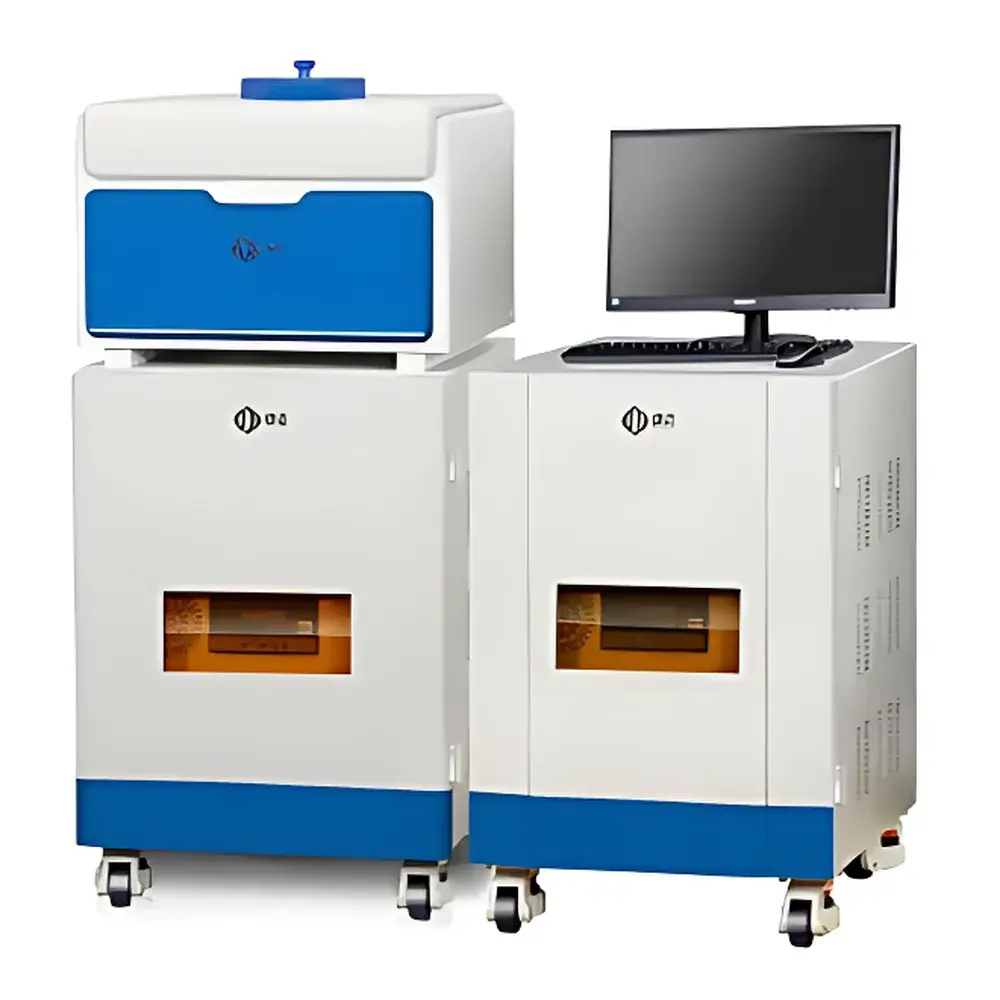
NIUMAG VTRMNMR Crosslink Density Analyzer with NMR Imaging Capability
| Brand | NIUMAG |
|---|---|
| Origin | Jiangsu, China |
| Manufacturer Type | Authorized Distributor |
| Origin Category | Domestic (China) |
| Model | VTRMNMR |
| Pricing | Upon Request |
| Magnet Type | Permanent Magnet |
| Magnetic Field Strength | 0.5 ± 0.05 T |
| Standard Temperature Control Range | Ambient to 130 °C |
| Optional Cryo-Heating Module | −100 °C to 200 °C |
| MRI Function | Optional |
| Core Technology | FLAT (Fast Low-Amplitude Transient) Pulse Sequence for Short-T₂/Weak-Signal Acquisition |
| Measurement Modes | T₁ & T₂ Relaxometry, Quantitative NMR Imaging, In-situ Variable-Temperature NMR |
Overview
The NIUMAG VTRMNMR Crosslink Density Analyzer is a purpose-built benchtop nuclear magnetic resonance (NMR) system engineered for quantitative structural and dynamic characterization of elastomers, thermosets, and polymer composites—specifically optimized for the rubber and plastics industry. Unlike conventional high-field NMR spectrometers, the VTRMNMR operates at a stable 0.5 T permanent magnetic field, enabling robust, low-maintenance operation in industrial QC labs and R&D environments. Its core measurement principle relies on spin–lattice (T₁) and spin–spin (T₂) relaxation time analysis of 1H nuclei, directly correlating relaxation behavior with molecular mobility, network heterogeneity, and crosslink density. Integrated in-situ variable-temperature capability allows real-time monitoring of vulcanization kinetics, thermal aging, solvent uptake, and phase transitions—without sample extraction or destruction. The proprietary FLAT pulse sequence enhances signal fidelity for short-T₂ systems (e.g., highly crosslinked rubbers, filled composites), overcoming traditional sensitivity limitations in low-field NMR.
Key Features
- In-situ temperature control: Standard ambient-to-130 °C stage enables process-relevant curing and aging studies; optional cryo-heating module extends range to −100 °C–200 °C for glass transition mapping and low-temperature network characterization.
- Multi-parameter NMR quantification: Simultaneous acquisition of T₁, T₂, and diffusion-weighted data supports rigorous modeling of crosslink density (ν), segmental mobility, hard/soft domain ratio, plasticizer content, and fluorine concentration via calibrated calibration curves.
- Non-invasive imaging capability (optional): Gradient-based 2D/3D NMR imaging resolves spatial heterogeneity—including filler dispersion uniformity, internal voids, microcracks, and phase segregation—in intact rubber compounds and molded parts.
- FLAT acquisition technology: Optimized for rapid, high-SNR detection of weak, fast-decaying signals from rigid polymer networks—critical for accurate quantification in carbon-black-filled or highly crosslinked systems.
- Modular hardware architecture: Designed for long-term stability in production environments; magnet, probe, and temperature controller are factory-aligned and thermally compensated to minimize drift during extended thermal ramping protocols.
Sample Compatibility & Compliance
The VTRMNMR accommodates solid, semi-solid, gel, and particulate samples—ranging from raw compound batches and cured test slabs to extruded profiles and injection-molded components—without preparation or labeling. Sample tubes (standard 10–25 mm OD) support ASTM D6926 (rubber crosslink density by NMR), ISO 17987 (polymer network characterization), and internal QC protocols aligned with GLP and GMP documentation requirements. Data acquisition and processing comply with FDA 21 CFR Part 11 principles through audit-trail-enabled software logging, electronic signatures, and secure user-role management. All calibration standards and reference materials are traceable to NIST-certified polymers and validated per ICH Q5C guidelines for polymer characterization.
Software & Data Management
NIUMAG’s proprietary MestReNova-NMR™ software suite provides full workflow integration—from automated temperature-ramped experiment setup and real-time relaxation curve fitting to multi-exponential T₂ distribution deconvolution and parametric image reconstruction. Built-in chemometric tools (PCA, PLS regression) enable correlation of NMR parameters with mechanical properties (e.g., Shore A hardness, tensile strength) across formulation libraries. Raw FID data, processed spectra, and imaging DICOM files are stored in vendor-neutral HDF5 format with embedded metadata (temperature, field homogeneity, pulse sequence parameters). Export options include CSV, MATLAB .mat, and PDF reports compliant with ISO/IEC 17025 laboratory accreditation requirements.
Applications
- Quantitative crosslink density (ν) mapping across sulfur, peroxide, and metal oxide cure systems.
- Real-time monitoring of vulcanization onset, rate, and plateau—correlating with rheometer and DSC data.
- Evaluation of thermal and oxidative aging effects on network integrity via T₂ decay profile evolution.
- Characterization of filler–polymer interaction strength through bound rubber fraction analysis.
- Spatial assessment of homogeneity in multi-component blends (e.g., NR/SBR/BR) using T₂-weighted imaging.
- Swelling behavior and solvent diffusion kinetics in elastomeric seals exposed to fuels, lubricants, or refrigerants.
- Validation of accelerated aging protocols against field-service performance metrics.
FAQ
What sample volume is required for reliable crosslink density quantification?
Typical requirement is 0.5–2.0 g of homogeneous material in a standard 15 mm OD tube; minimal mass suffices due to high intrinsic sensitivity of FLAT-acquired T₂ data.
Can the system distinguish between chemical and physical crosslinks?
Yes—via combined T₁/T₂ analysis and temperature-dependent relaxation profiling, enabling differentiation of covalent network nodes from reversible physical entanglements or crystallite domains.
Is method validation support available for regulatory submissions?
NIUMAG provides full IQ/OQ/PQ documentation packages, method transfer protocols, and collaborative validation assistance aligned with USP <1058> and ASTM E2500 standards.
How is instrument performance maintained over long-term thermal cycling?
The permanent magnet features active temperature stabilization; probe tuning and shimming routines are automated before each thermal ramp, ensuring consistent lineshape and reproducibility across >10,000 cycles.
Does the system support custom pulse sequences for advanced research applications?
Yes—source-level access to pulse programming environment is available under NDA for academic and industrial partners developing novel relaxation or diffusion contrast methods.






