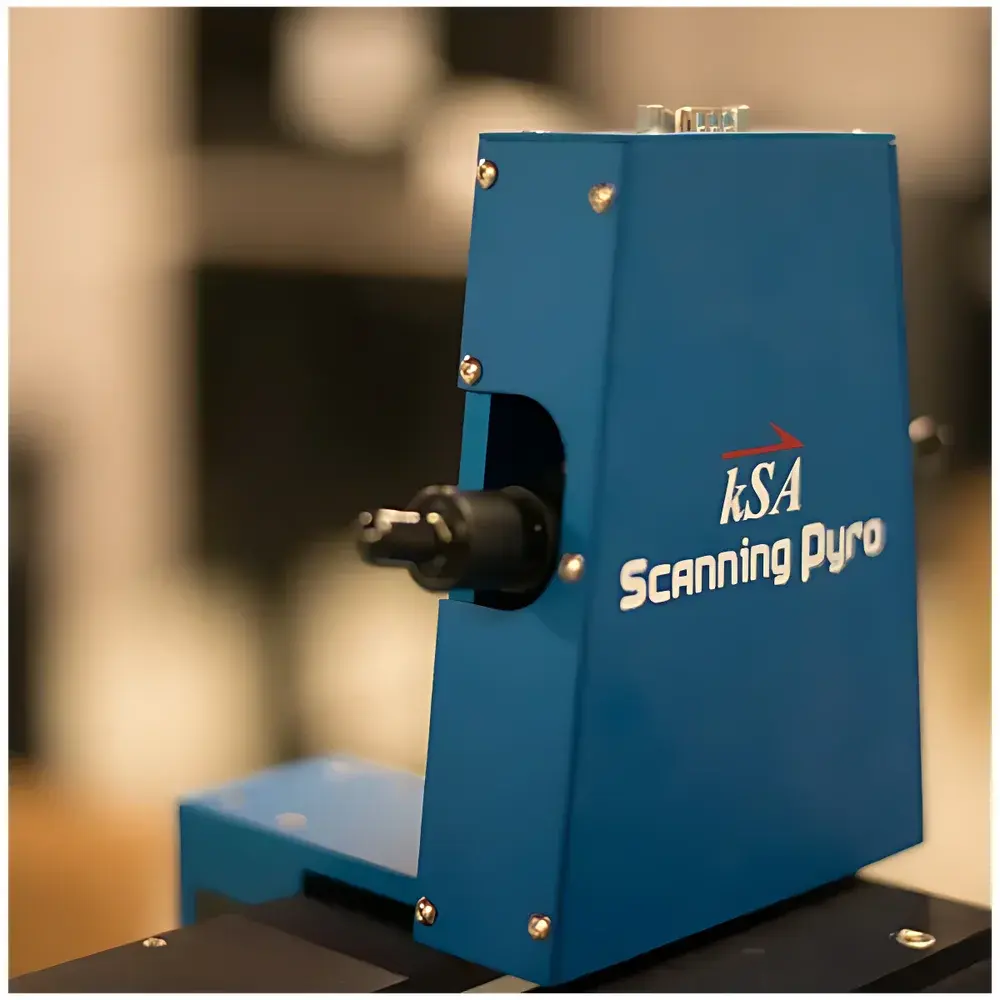
kSA ScanningPyro Graphite Susceptor Temperature Mapping System
| Brand | k-Space |
|---|---|
| Origin | USA |
| Manufacturer Type | Authorized Distributor |
| Product Origin | Imported |
| Model | kSA ScanningPyro |
| Pricing | Available Upon Request |
Overview
The kSA ScanningPyro Graphite Susceptor Temperature Mapping System is a non-contact, in-situ pyrometric measurement platform engineered for high-precision radial and angular temperature profiling of rotating graphite susceptors during Metalorganic Chemical Vapor Deposition (MOCVD) processes. Unlike conventional single-point pyrometers or thermocouple-based monitoring, the ScanningPyro employs dual calibrated infrared sensors mounted on a motorized linear stage that traverses radially across the susceptor’s field of view through the reactor viewport—while the susceptor rotates at controlled speeds. This synchronized motion enables spatially resolved thermal mapping with deterministic sampling density, capturing full-disk temperature distributions in a single pass. The system operates on the principle of multi-wavelength spectral radiometry, optimized for emissivity-stable graphite surfaces under high-temperature vacuum or low-pressure reactive atmospheres typical of III–V and wide-bandgap semiconductor epitaxy.
Key Features
- Dual-sensor scanning architecture enabling simultaneous differential temperature acquisition across radial positions
- Motorized linear translation stage with sub-millimeter positional repeatability (±0.05 mm) and programmable scan velocity
- Real-time synchronization with susceptor rotation via encoder feedback or external TTL trigger input
- Configurable scan parameters: radial step resolution down to 1 mm, angular resolution as fine as 0.3°, and user-defined start/stop radii
- Temperature range: 530 °C to 1250 °C (extended-range calibration options available)
- Accuracy: ±1 °C from 530–700 °C; ±0.3 °C from 700–1250 °C (traceable to NIST-standard blackbody sources)
- Scan duration fully dependent on susceptor RPM and step size—e.g., 93 seconds for full-disk mapping at 600 rpm and 1 mm radial steps
- Integrated thermal drift compensation and ambient background subtraction algorithms
Sample Compatibility & Compliance
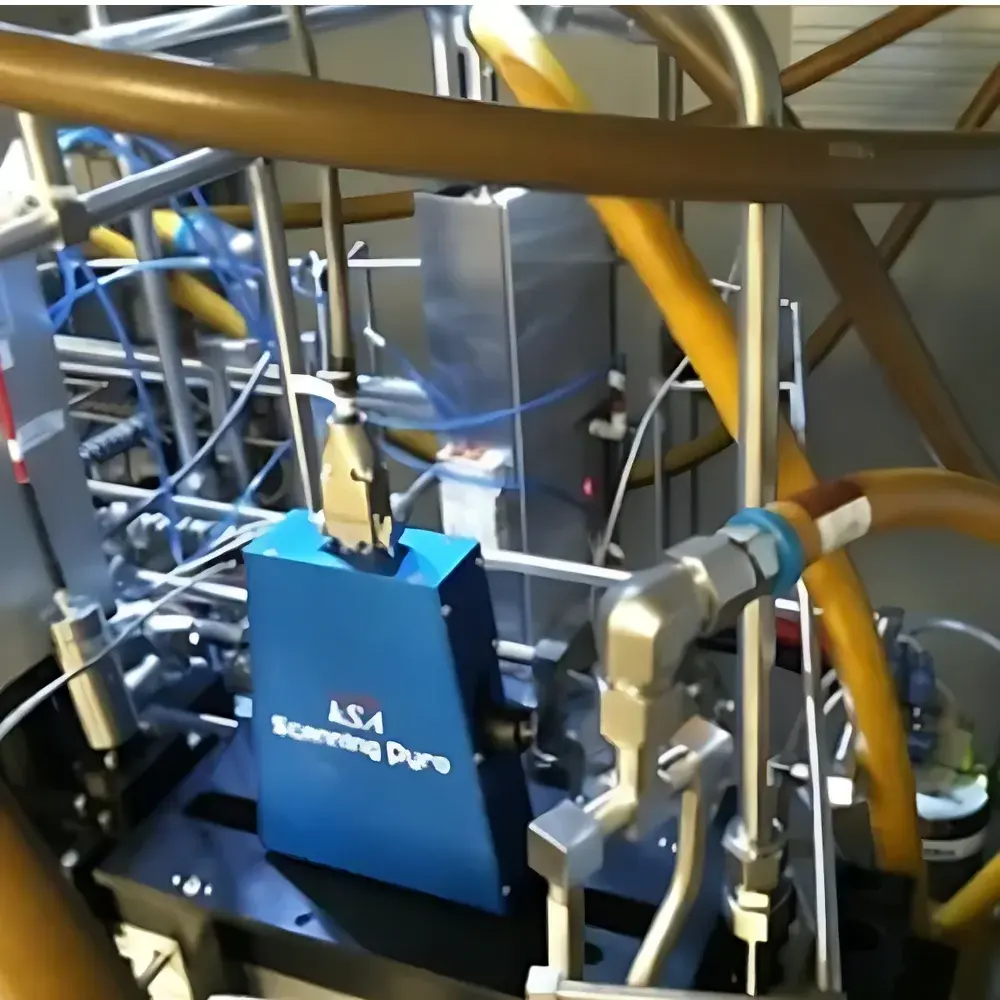
The kSA ScanningPyro is mechanically and optically integrated with industry-standard MOCVD platforms including Veeco K465i and EPIK700 reactors, as well as compatible third-party systems featuring standard viewport geometry (e.g., 8–12 inch diameter fused silica or sapphire windows). It supports both horizontal and vertical reactor configurations with customizable mounting brackets and purge-compatible optical housings. All hardware complies with CE electromagnetic compatibility (EMC) directives and meets UL 61010-1 requirements for laboratory electrical safety. Data acquisition and storage workflows are designed to support GLP/GMP environments: timestamped raw sensor outputs, audit-trail-enabled configuration logs, and export formats compatible with LIMS integration (CSV, HDF5, MATLAB .mat). While not FDA 21 CFR Part 11 certified out-of-the-box, the system supports optional digital signature and user-access control modules for regulated manufacturing use.
Software & Data Management
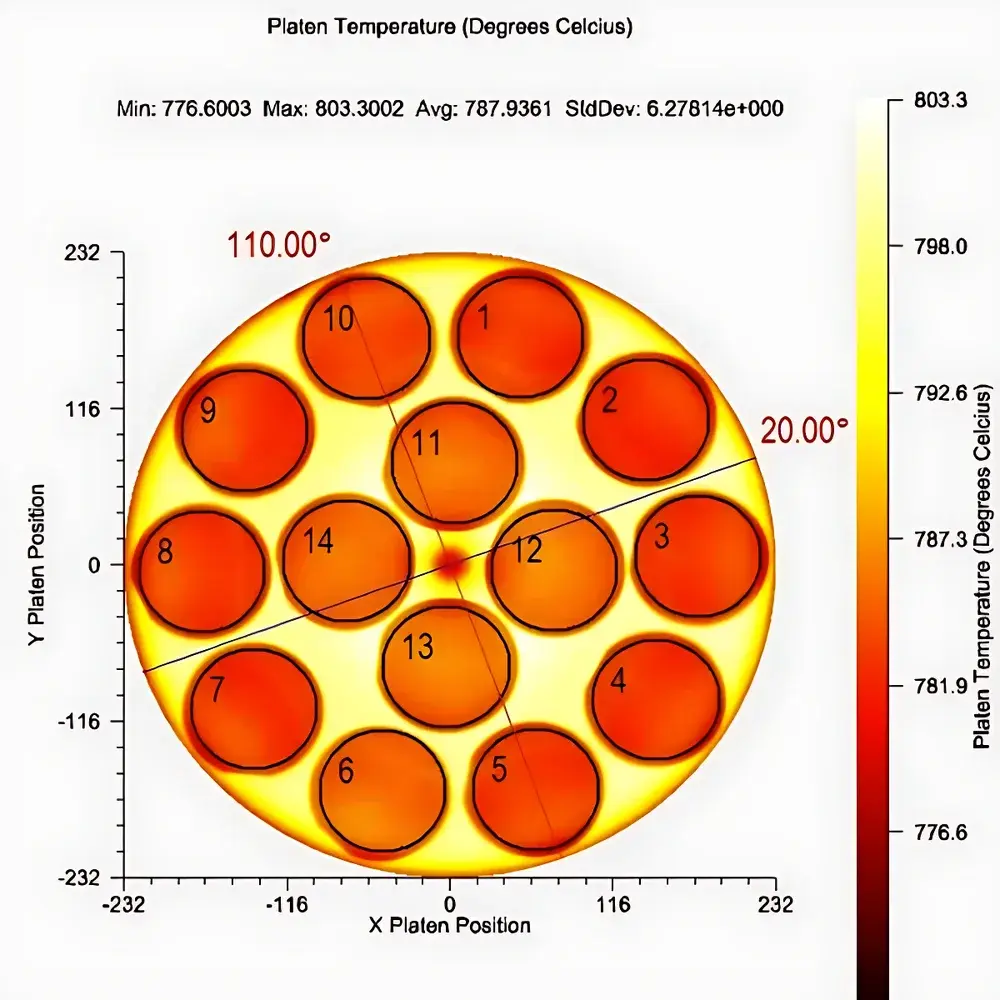
The ScanningPyro Control & Analysis Suite (v4.x) provides a Windows-based GUI for instrument orchestration, real-time visualization, and post-processing. Key capabilities include live 2D thermal contour overlays superimposed on geometrically scaled susceptor diagrams, interactive 3D surface plots with adjustable color mapping and iso-temperature slicing, radial profile extraction along user-specified diameters or annular zones, pocket-wise statistical summaries (min/max/mean/std dev per wafer pocket), and crosshair-driven line-scan analysis. Calibration routines support both fixed-point reference (e.g., furnace-set temperatures) and dynamic validation using the optional kSA SpectraTemp multi-spectral reference pyrometer. All datasets are stored with embedded metadata—including reactor pressure, gas flow rates (if interfaced), and process step identifiers—enabling correlation with film growth metrics such as thickness uniformity or compositional grading.
Applications
This system serves critical process development and production monitoring roles in compound semiconductor manufacturing, particularly for GaN-on-silicon, AlGaN deep-UV LEDs, GaAs-based HBTs, and InP-based photonics. By quantifying radial and azimuthal thermal gradients—especially near edge effects, heater coil misalignment, or shadowing from gas injectors—engineers can iteratively refine heater zoning, ramp profiles, and carrier gas distribution. It further supports qualification of new susceptor geometries, evaluation of thermal soak stability during ramp-hold-cool cycles, and root-cause analysis of macroscopic defects linked to localized overheating or insufficient nucleation temperature. Academic and national lab users apply it to fundamental studies of heat transfer in rotating disk reactors under varying boundary conditions.
FAQ
Can the ScanningPyro be retrofitted onto legacy MOCVD tools not listed in the compatibility guide?
Yes—custom mechanical interfaces and optical path adaptations are available upon engineering review of viewport dimensions, flange type, and available clearance.
Is emissivity correction required for graphite susceptors?
No—the system is factory-calibrated for graphite’s known spectral emissivity curve (0.75–0.85 in the 1.0–1.6 µm band); no user-input emissivity parameter is needed.
Does the software support automated scan triggering synchronized with process recipes?
Yes—via digital I/O interface (TTL or RS-485), the system accepts external start commands and reports completion status to the tool’s PLC or recipe engine.
How frequently should recalibration be performed?
Annual traceable calibration is recommended; however, in-house verification using kSA SpectraTemp or a certified blackbody source can be conducted prior to critical runs.
Is remote operation supported over Ethernet or VPN?
Yes—full GUI remote desktop access and headless data acquisition mode are supported via standard Windows RDP or kSA’s secure REST API.
Related Products