
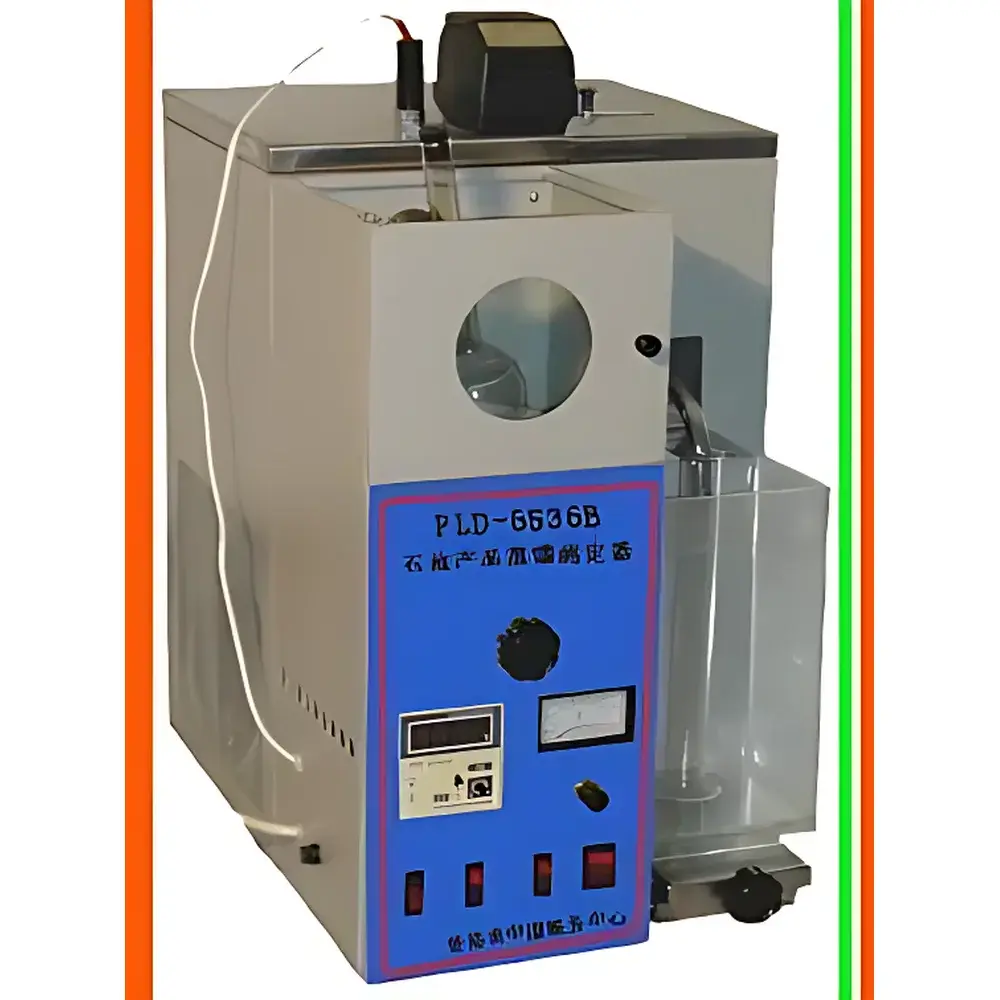
PULUODY PLD-6536B Petroleum Distillation Apparatus
| Brand | PULUODY |
|---|---|
| Origin | Shaanxi, China |
| Manufacturer Type | Direct Manufacturer |
| Country of Origin | China |
| Model | PLD-6536B |
| Heating Power | 0–1200 W (continuously adjustable) |
| Heating Mantle Vertical Adjustment Range | 35 mm |
| Flask Support Plate Apertures | Ø37.5 mm and Ø50 mm |
| Condensate Bath Temperature Range | –5 °C to 80 °C (with integrated refrigeration unit) |
| Power Supply | AC 220 V, 50 Hz |
Overview
The PULUODY PLD-6536B Petroleum Distillation Apparatus is a precision-engineered laboratory instrument designed for standardized atmospheric distillation testing of petroleum fractions in accordance with ASTM D86, ISO 3405, and GB/T 6536. It implements the classical batch distillation principle—measuring the volume percentage distilled at specified temperature intervals under controlled heating and condensation conditions—to determine key volatility characteristics including initial boiling point (IBP), final boiling point (FBP), and recovery percentages at defined cut points (e.g., 10%, 50%, 90% v/v). The apparatus supports routine quality control and specification verification for gasoline, jet fuel, naphtha, kerosene, diesel, and other middle-distillate hydrocarbon streams in refinery laboratories, third-party testing facilities, and regulatory compliance centers.
Key Features
- Modular three-section architecture: independent distillation assembly, condensation subsystem, and receiving system—each optimized for thermal stability, mechanical repeatability, and operator safety.
- Digitally regulated heating mantle with quartz-tube resistive elements: delivers uniform radial heat distribution, eliminates oil-splash hazards, resists oxidation up to 600 °C, and achieves >92% thermal efficiency versus conventional coil-based mantles.
- Stepless power control (0–1200 W) via solid-state voltage regulator: enables precise ramp-rate programming aligned with ASTM D86 heating rate profiles (e.g., 4–5 °C/min for Group 1 fuels; 1–1.5 °C/min for Group 4 heavy distillates).
- Mechanically adjustable heating mantle lift mechanism (35 mm vertical travel): ensures consistent flask immersion depth across varying flask geometries and accommodates both 125 mL and 200 mL ASTM-standard distillation flasks.
- Dual-aperture support plate (Ø37.5 mm and Ø50 mm): compatible with standard ASTM D86 round-bottom flasks and alternative test vessels used in extended-range or modified-method applications.
- Integrated refrigerated condensate bath: maintains bath temperature from –5 °C to +80 °C with ±0.3 °C stability over 24 h; eliminates external chiller dependency and reduces ambient thermal drift during low-end kerosene or high-end diesel tests.
- Hinged observation window on heating chamber: facilitates safe flask loading/unloading, real-time visual monitoring of boiling behavior, and rapid cooling access without disassembly.
- Optically transparent acrylic receiver bath: filled with chilled water or glycol solution; provides unobstructed volumetric reading of condensed distillate while minimizing parallax error and condensate wall adhesion.
Sample Compatibility & Compliance
The PLD-6536B is validated for use with volatile and semi-volatile petroleum products meeting ASTM D86 Group 1 through Group 4 classifications. It accommodates samples with initial boiling points as low as 30 °C (light gasoline fractions) and final boiling points up to 370 °C (heavy diesel cuts). All structural materials—including quartz heating tubes, stainless-steel support frames, borosilicate glass condensers, and food-grade acrylic baths—comply with ASTM E1509 requirements for distillation apparatus material inertness. The instrument’s operational parameters align with GLP documentation standards and support audit-ready traceability when paired with calibrated thermometers (ASTM E77) and certified volumetric receivers (ASTM E1272). While the base unit does not include electronic data logging, its analog output interfaces (0–5 V DC temperature and voltage signals) are compatible with third-party LIMS-integrated DAQ systems compliant with FDA 21 CFR Part 11 requirements.
Software & Data Management
The PLD-6536B operates as a standalone benchtop instrument with analog instrumentation—no embedded microprocessor or proprietary software. Temperature is monitored via calibrated ASTM-certified mercury-in-glass or platinum resistance thermometers (PRTs), and power output is displayed on a front-panel digital voltmeter. For laboratories requiring automated data capture, optional analog-to-digital signal adapters enable connection to PC-based acquisition platforms (e.g., LabVIEW, MATLAB, or custom Python scripts) supporting CSV export, real-time curve plotting, and ASTM D86-compliant report generation. All manual test records generated using this apparatus satisfy ISO/IEC 17025 clause 7.8.2 for handwritten or printed result documentation—provided thermometers are verified per ISO 17032 and calibration certificates are retained for ≥5 years.
Applications
- Refinery QC labs: verification of gasoline vapor pressure (RVP) correlation via IBP and 10% recovery temperatures.
- Fuel certification: conformance testing of Jet A-1 per DEF STAN 91-91 and ASTM D1655 Annex A1.
- Blending optimization: assessing volatility overlap between reformate and alkylate streams prior to tank blending.
- Regulatory submissions: generating distillation data for EPA Tier 3 gasoline registration or EU EN 228 compliance dossiers.
- Research & development: evaluating distillation shifts induced by biofuel co-processing (e.g., hydrotreated esters and fatty acids).
- Contract testing labs: accredited testing per ISO/IEC 17025 for third-party certification of marine distillate fuels (ISO 8217).
FAQ
Does the PLD-6536B meet ASTM D86 official method requirements?
Yes—the mechanical design, heating profile fidelity, condenser geometry, and receiver specifications fully conform to ASTM D86-23 Annex A1 apparatus requirements.
Can it perform vacuum distillation?
No—the PLD-6536B is configured exclusively for atmospheric distillation per ASTM D86. Vacuum-capable variants (e.g., ASTM D1160) require separate instrumentation.
What thermometer calibration standards are recommended?
ASTM E77-certified liquid-in-glass thermometers or NIST-traceable Pt100 probes calibrated to ±0.1 °C accuracy at 0–400 °C range.
Is the refrigeration system serviceable onsite?
Yes—the hermetic compressor and R134a circuit are accessible via rear panel service ports; maintenance intervals follow ISO 8573-1 Class 4 air purity guidelines for lab HVAC environments.
How is operator safety ensured during high-temperature operation?
Dual-layer quartz insulation, grounded chassis, automatic overtemperature cutoff at 650 °C, and IP2X-rated enclosure prevent electrical contact and thermal exposure per IEC 61010-1 Ed. 3.



