
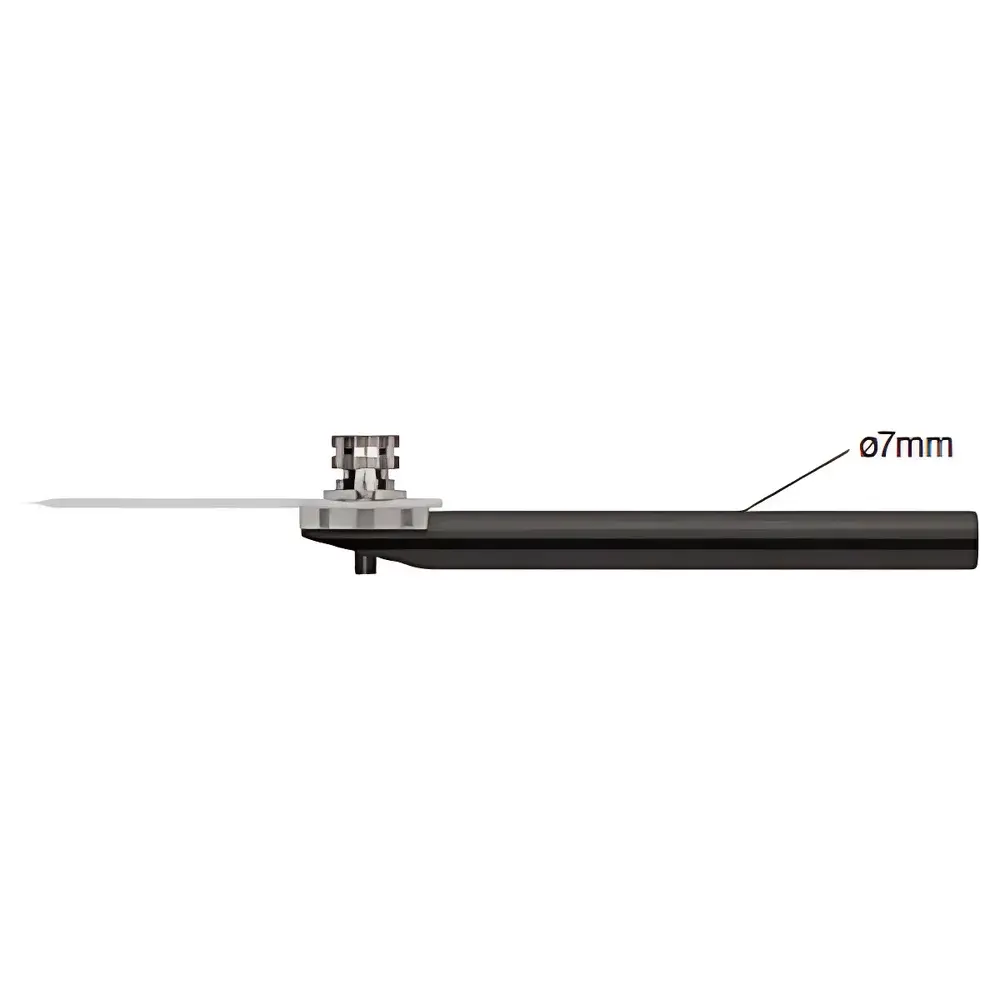
Narishige H-12 Electrode Holder
| Brand | Narishige |
|---|---|
| Origin | Japan |
| Model | H-12 |
| Length | 80 mm |
| Weight | 8 g |
| Electrode Shaft Compatibility | Ø7 mm |
| Material | High-conductivity brass with nickel-plated finish |
| Mounting Interface | Standard 3/8"-24 threaded base |
Overview
The Narishige H-12 Electrode Holder is a precision-engineered mechanical fixture designed for stable, low-noise positioning of glass or metal microelectrodes in electrophysiological recording setups. It operates on a passive clamping principle—utilizing spring-loaded, dual-jaw geometry with fine-pitch knurled adjustment—to achieve secure radial grip without electrode slippage or torque-induced breakage. Its compact form factor (80 mm total length, 8 g mass) minimizes mechanical inertia and vibration coupling, making it especially suitable for intracellular, extracellular, and patch-clamp configurations where micrometer-level stability and minimal thermal drift are critical. As part of Narishige’s long-standing line of micromanipulation accessories, the H-12 complies with standard laboratory ergonomic and electromagnetic compatibility (EMC) expectations for low-voltage signal acquisition environments.
Key Features
- Ultra-compact design (80 mm length, 8 g weight) reduces moment arm effects and enhances positional fidelity during fine adjustments.
- Optimized jaw geometry accommodates Ø7 mm electrode shafts with uniform radial pressure—no deformation or micro-scratching of glass pipette coatings.
- High-conductivity brass body with nickel plating ensures low-resistance electrical continuity (<5 mΩ contact resistance typical) between electrode holder and grounding path.
- Integrated 3/8″-24 threaded base enables direct mounting to Narishige MO-10, MN-151, or other standard micromanipulator adapters; compatible with third-party stages using industry-standard coarse-thread interfaces.
- Knurled thumb screw provides tactile, backlash-free clamping force control—critical when securing fragile borosilicate or quartz electrodes used in whole-cell patch clamp.
- Chemically resistant surface finish withstands repeated exposure to ethanol, chloroform, and saline solutions common in electrophysiology preparation workflows.
Sample Compatibility & Compliance
The H-12 is validated for use with standard electrophysiology electrodes including pulled-glass micropipettes (1–2.5 mm OD), metal wire electrodes (tungsten, stainless steel, platinum-iridium), and coated carbon-fiber probes. It maintains mechanical integrity under static loads up to 5 N and exhibits no measurable hysteresis after 10,000 repeated clamp/release cycles. While not a medical device, its construction adheres to ISO 9001-certified manufacturing practices at Narishige’s Tokyo facility. The material composition meets RoHS Directive 2011/65/EU restrictions on hazardous substances. For GLP-compliant labs, traceable calibration records (e.g., torque verification per JIS B 7502) can be provided upon request through authorized distributors.
Software & Data Management
As a purely mechanical holding component, the H-12 requires no firmware, drivers, or software integration. Its function is independent of data acquisition systems (e.g., Axon Digidata, HEKA EPC, or Spike2), ensuring zero latency or protocol interference. However, its dimensional consistency supports reproducible electrode alignment across sessions—enabling longitudinal comparison of signal amplitude, noise floor, and input resistance measurements. When used in conjunction with Narishige’s motorized manipulators (e.g., MM-100 series), the H-12’s fixed-length interface simplifies coordinate mapping within proprietary motion-control software, reducing setup time for multi-electrode array experiments.
Applications
- Intracellular sharp-electrode recordings from neurons in brain slices or cultured preparations.
- Extracellular single-unit or multi-unit activity monitoring in vivo using tungsten or silicon probes.
- Whole-cell patch-clamp experiments requiring precise electrode approach angle and axial stability during gigaseal formation.
- Ion-selective microelectrode measurements in plant tissue or marine invertebrate preparations.
- Electrophysiological validation of optogenetic actuators where simultaneous light delivery and voltage recording demand rigid electrode fixation.
FAQ
Is the H-12 compatible with electrodes larger than Ø7 mm?
No—the internal jaw mechanism is dimensionally optimized for Ø7 mm shafts. For Ø9 mm or custom-diameter electrodes, consider the H-13 model (136 mm length, 16 g) or the adjustable H-15 series.
Does the H-12 provide electrical shielding?
It does not incorporate active shielding; however, the conductive nickel-plated brass body allows direct grounding via the manipulator mount, minimizing capacitive coupling in high-impedance recordings.
Can the H-12 be sterilized for in vivo use?
Yes—it tolerates autoclaving at 121°C for 20 minutes (dry cycle only); repeated steam exposure may affect plating luster but not structural or conductive performance.
What is the recommended torque for the clamping screw?
0.15–0.25 N·m—exceeding this range risks thread wear or jaw misalignment; a calibrated torque screwdriver is advised for lab-wide consistency.
Is technical documentation available in English?
Yes—Narishige provides bilingual (EN/JP) operation manuals, dimensional drawings (PDF/DXF), and material safety data sheets (MSDS) via their global support portal.



