
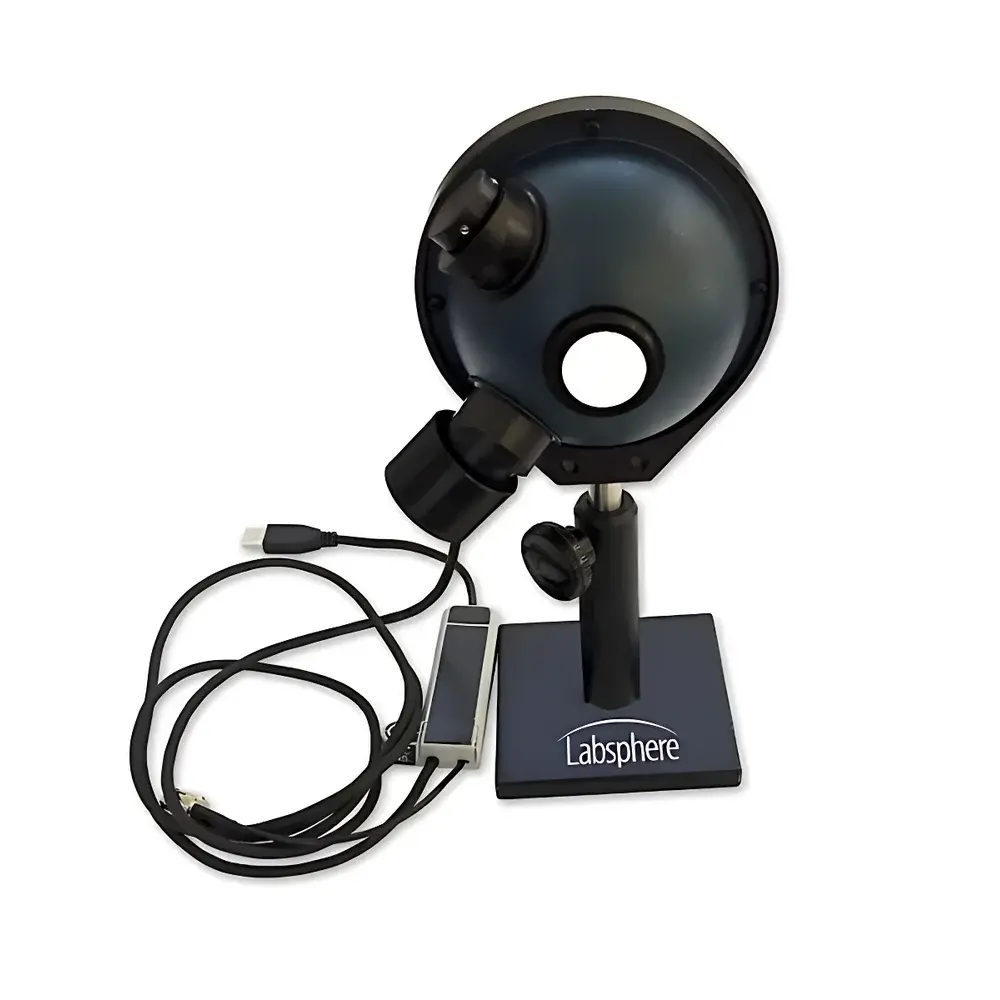
Labsphere LPMS Series Laser Power Measurement System with Integrating Sphere
| Brand | Labsphere |
|---|---|
| Origin | USA |
| Model | LPMS System |
| Spectral Range | 350–1700 nm (Si & InGaAs detectors) |
| Integrating Sphere Diameters | 2", 4", 6" |
| Coating Options | Spectraflect®, Spectralon®, Infragold® |
| Detector Options | Silicon (Si), Indium Gallium Arsenide (InGaAs) |
| Power Range | ~1 nW to >100 W (configuration-dependent) |
| Input Port Angle | 45° off-axis |
Overview
The Labsphere LPMS Series Laser Power Measurement System is an engineered solution for absolute, spatially integrated optical power quantification of divergent, collimated, or highly directional laser sources—including VCSELs, edge-emitting laser diodes, laser diode modules, and pulsed laser systems. Based on the fundamental principle of diffuse light integration within a spherical cavity, the system eliminates dependence on beam alignment, polarization state, spatial profile, or divergence angle—critical advantages over direct detector-based measurements. The integrating sphere’s geometry ensures uniform irradiance distribution across its inner surface, enabling high-reproducibility (<±0.5% typical repeatability) total radiant flux measurement independent of incident beam characteristics. Designed specifically for laser metrology, the LPMS architecture incorporates rigorous thermal management, low-noise analog signal conditioning, and precision aperture placement to minimize vignetting and stray-light contributions. All configurations are factory-calibrated against NIST-traceable standards in accordance with ISO/IEC 17025-accredited procedures, supporting compliance with ISO 11554, IEC 60825-1, and FDA 21 CFR Part 11 requirements for audit-ready documentation.
Key Features
- Three sphere diameters: 2-inch (5.08 cm), 4-inch (10.16 cm), and 6-inch (15.24 cm) options—optimized for dynamic range, spatial uniformity, and thermal load handling.
- Three proprietary diffuse coatings: Spectraflect® (broadband UV-VIS-NIR), Spectralon® (highest Lambertian reflectance >99% from 250 nm–2.5 µm), and Infragold® (enhanced NIR-MIR stability up to 20 µm).
- Dual-port configuration: Primary detector port positioned at 45° off-axis to suppress specular reflections; secondary port enables simultaneous spectral analysis via fiber-coupled spectrometer or auxiliary radiometric sensor.
- Modular detector selection: Silicon photodiodes (350–1100 nm) and extended-range InGaAs detectors (800–1700 nm or 800–1800 nm) with NIST-traceable responsivity curves provided per unit.
- Fiber-optic and free-space compatibility: Standardized SMA905 and FC/PC input adapters; optional beam-reducing apertures and ND filter mounts for high-power (>10 W) or ultra-low-power (<10 nW) applications.
- Thermally stable mechanical design: Aluminum housing with passive heat sinking; internal baffling minimizes inter-port crosstalk and backscatter artifacts.
Sample Compatibility & Compliance
The LPMS system accommodates a wide range of laser source geometries and output characteristics without requiring realignment or recalibration. It is validated for use with VCSEL arrays, single-mode and multimode laser diodes, fiber-coupled lasers, Q-switched and mode-locked pulsed lasers (with appropriate averaging), and broadband quasi-monochromatic sources. Each system includes full calibration data sheets listing spectral responsivity, linearity deviation (<±0.25%), angular response uniformity, and temperature coefficient (typically <0.01%/°C). Certificates of Calibration are issued under Labsphere’s ISO/IEC 17025:2017 accredited scope, ensuring traceability to NIST SRM 2210 and SRM 2211. Systems meet GLP/GMP documentation requirements, including full audit trails for calibration history, firmware versioning, and user-access logs when integrated with compliant data acquisition software.
Software & Data Management
Labsphere provides the LPMS Control Suite—a Windows-based application supporting real-time power monitoring, automated wavelength-swept calibration verification, statistical trending (min/max/mean/stdev), and export to CSV, XML, or PDF formats. The software implements IEEE 1588 Precision Time Protocol for synchronized multi-channel acquisition and supports programmable triggers for pulsed laser characterization. All raw analog outputs comply with IEEE 1451.2 smart transducer interface standards. When deployed in regulated environments, the suite supports 21 CFR Part 11-compliant electronic signatures, role-based access control, and immutable audit logs—including operator ID, timestamp, calibration status, and environmental metadata (ambient temperature/humidity if equipped with optional sensors).
Applications
- VCSEL array power uniformity mapping and lifetime testing in consumer electronics R&D
- Production-line L-I-V (light-current-voltage) characterization of laser diode modules
- ISO 11146-compliant M² measurement pre-filtering and beam energy normalization
- Medical laser safety validation per ANSI Z136.1 and IEC 60825-1
- NIR spectroscopy source stability monitoring (e.g., in pharmaceutical PAT applications)
- Defense-grade laser weapon system power verification under MIL-STD-461E EMI conditions
- Calibration transfer between primary standards laboratories and OEM manufacturing sites
FAQ
Is the LPMS system suitable for measuring pulsed lasers?
Yes—when configured with appropriate averaging time constants and peak-hold circuitry, the LPMS supports pulse widths from nanoseconds to continuous-wave operation. Pulse energy can be derived from average power and repetition rate.
Can I use my existing spectrometer with the LPMS secondary port?
Yes—the secondary port accepts standard 0.22 NA fiber inputs (SMA905 or FC/PC) and maintains calibrated throughput across the specified spectral range. Spectral irradiance corrections are applied automatically in post-processing.
What is the uncertainty budget for a typical LPMS calibration?
Expanded uncertainty (k=2) is ≤±1.8% for Si-based configurations and ≤±2.2% for InGaAs-based configurations across their respective spectral bands, as documented in the NIST-traceable certificate.
Do I need to recalibrate after changing the sphere coating or detector?
Yes—each detector/sphere/coating combination is individually calibrated. Swapping any component invalidates the original calibration; Labsphere offers re-certification services with full uncertainty reporting.
Is thermal drift compensated during long-duration measurements?
The system incorporates onboard temperature monitoring and applies real-time responsivity correction coefficients derived from thermal characterization data collected during NIST calibration.




