
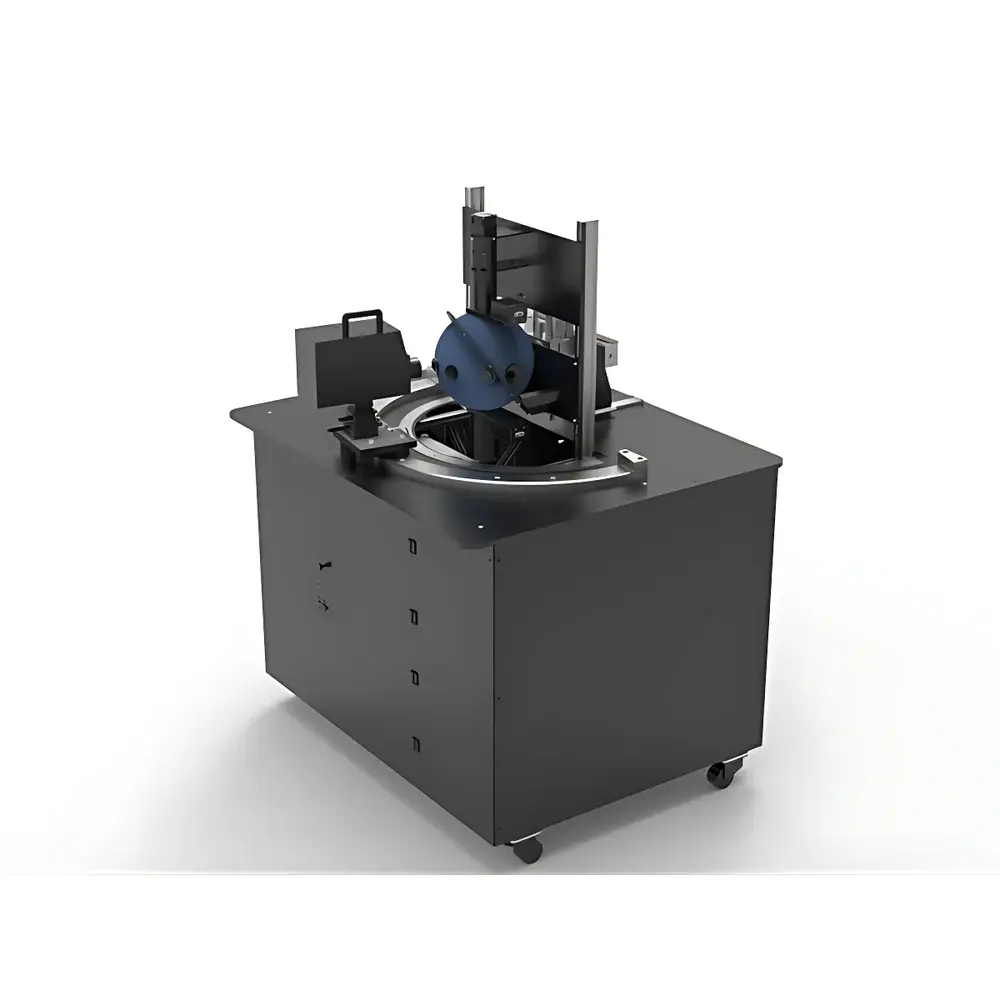
Labsphere ACR Ambient Contrast Ratio Test System
| Brand | Labsphere |
|---|---|
| Model | ACR |
| Origin | Shanghai, China |
| Light Source Type | Tunable Integrating Sphere Source (Xenon/Mercury-Hybrid Capable) |
| Illumination Geometry | Internal Illumination |
| Color Temperature Range | 2000 K – 10000 K (CCT-adjustable) |
| Spectral Output | Programmable to CIE Standard Illuminants (A, D50, D65, D75, etc.) |
| Luminance Range | 0.01 – 100,000 cd/m² (adjustable) |
| Viewing Angles | 0°, 15°, 30°, 45° (symmetrical left/right ports |
| Detector Platform | Motorized Linear Rail with Sub-millimeter Positioning Accuracy |
| Compliance Standards | ICDM, VESA DisplayHDR™, NIST IR 6738, ISO 9241-307, CIE S 023/E:2022 |
Overview
The Labsphere ACR Ambient Contrast Ratio Test System is a metrology-grade, turnkey optical instrument engineered for precise, repeatable quantification of ambient contrast ratio (ACR) under spectrally and photometrically controlled illumination conditions. It operates on the principle of spatially uniform, spectrally tunable irradiance delivery via a high-reflectance integrating sphere—ensuring Lambertian illumination with angular homogeneity better than ±1.5% across the test plane. Unlike conventional fixed-spectrum light boxes, the ACR system integrates a hybrid broadband source architecture capable of emulating both incandescent (Illuminant A), daylight (D50/D65/D75), and specialized spectral power distributions (SPDs) defined by CIE, ICDM, and VESA standards. This enables rigorous evaluation of display readability under realistic ambient lighting scenarios—including indoor office lighting, overcast daylight, direct noon sun, twilight, and even low-light starry-sky conditions—by independently controlling correlated color temperature (CCT), spectral irradiance profile, and photopic illuminance (up to 100,000 lux equivalent at sample plane). The system measures ACR as the ratio of luminance (Y, in cd/m²) between a full-white (100% RGB signal) and full-black (0% RGB signal) state of the display, recorded simultaneously under identical, stabilized ambient irradiance.
Key Features
- High-fidelity integrating sphere source with >98% Spectralon® coating, delivering spatial uniformity < ±1.2% over Ø300 mm test area
- Programmable spectral engine supporting CIE standard illuminants (A, C, D50, D65, D75) and user-defined SPDs via spectral calibration database
- Continuous CCT adjustment from 2000 K to 10,000 K with ±25 K stability over 8-hour operation
- Motorized linear rail stage for precision positioning of luminance meters (e.g., Konica Minolta CS-2000, PR-788, or comparable) with ±5 µm repeatability
- Modular viewing port configuration: standard 0°, 15°, 30°, and 45° symmetrical angles; optional custom port geometries available upon specification
- Integrated baffle-controlled light trap for selective measurement of specular vs. diffuse reflectance components per ISO 13660 and VESA EG-1002
- Pre-aligned, NIST-traceable calibration suite including sphere irradiance uniformity map, spectral radiance reference, and angular response validation report
Sample Compatibility & Compliance
The ACR system accommodates flat-panel displays ranging from smartphone-sized (≥50 × 50 mm) to large-format automotive HUDs (≤1000 × 600 mm) using configurable sample fixtures compliant with ICDM Display Measurement Standard v2.0 and VESA DisplayHDR™ Test Specification v1.2. Fixture options include motorized tilt stages (±15°), anti-vibration mounts, and ESD-safe clamping mechanisms compatible with OLED, LCD, MicroLED, and reflective e-ink modules. All optical paths conform to ISO 9241-307:2018 (Ergonomics of human-system interaction — Part 307: Analysis of visual display requirements) and support GLP-compliant audit trails when paired with validated software. System-level traceability aligns with NIST IR 6738 (Guidelines for Display Metrology) and supports FDA 21 CFR Part 11–compliant electronic records when integrated with authorized data acquisition platforms.
Software & Data Management
The ACR Control Suite (v4.3+) provides deterministic instrument orchestration via USB 3.0 and Ethernet interfaces. It enables synchronized control of sphere irradiance, CCT, viewing angle selection, detector positioning, and trigger-based luminance capture. Raw photometric data are stored in HDF5 format with embedded metadata (timestamp, calibration ID, illuminant ID, geometry tag, uncertainty budget). Export modules support CSV, MATLAB .mat, and ICDM-compliant XML schemas. Audit logging captures all parameter changes, user logins, calibration events, and hardware status transitions—fully compliant with ISO/IEC 17025:2017 clause 7.7 and FDA 21 CFR Part 11 requirements for electronic signatures and record retention. Optional API integration allows seamless linkage with automated test sequencers (e.g., NI TestStand, Keysight PathWave) in high-volume manufacturing environments.
Applications
- Quantitative ACR validation for smartphones, tablets, and e-readers under standardized ambient conditions (VESA DisplayHDR True Black, ICDM ACR-2022)
- Automotive HMI certification per ISO 15008 and UNECE R155 functional safety requirements for daylight readability
- Aerospace display qualification against RTCA DO-160 Section 21 (lighting effects) and SAE ARP4754A environmental stress testing
- R&D evaluation of anti-glare coatings, circular polarizers, and optical bonding efficacy under variable SPDs
- Correlation studies between perceptual contrast metrics (e.g., CQS, CRI Ra, TM-30 Rf/Rg) and measured ACR values
- Calibration verification of production-line optical testers using reference displays traceable to NIST SRM 2051
FAQ
What illuminants does the ACR system support natively?
The system includes factory-loaded spectral profiles for CIE Illuminants A, C, D50, D65, and D75, plus extended libraries for D55, F-series fluorescent spectra, and LED-specific SPDs—all calibrated against NIST-traceable reference lamps.
Can the system measure ACR for curved or flexible displays?
Yes—custom fixture kits with adaptive vacuum chucks and conformal alignment jigs are available for radius-of-curvature down to 500 mm; angular compensation algorithms correct for off-normal viewing geometry.
Is spectral irradiance data logged during each ACR measurement?
Yes—full 380–780 nm spectral irradiance scans (1 nm resolution) are captured pre- and post-measurement and embedded in the HDF5 output file alongside photometric results.
How is system uniformity verified and maintained?
Each unit ships with a sphere uniformity map generated using a calibrated imaging luminance meter; annual recalibration includes spatial irradiance mapping and spectral radiance verification per CIE Publication 127:2007.
Does the ACR system meet regulatory requirements for medical display testing?
While not FDA-cleared as a standalone device, its metrological architecture complies with DICOM PS3.14 Annex C and IEC 62563-1:2016 for ambient light influence assessment—making it suitable for Class II medical display validation workflows under QSR 21 CFR Part 820.



