
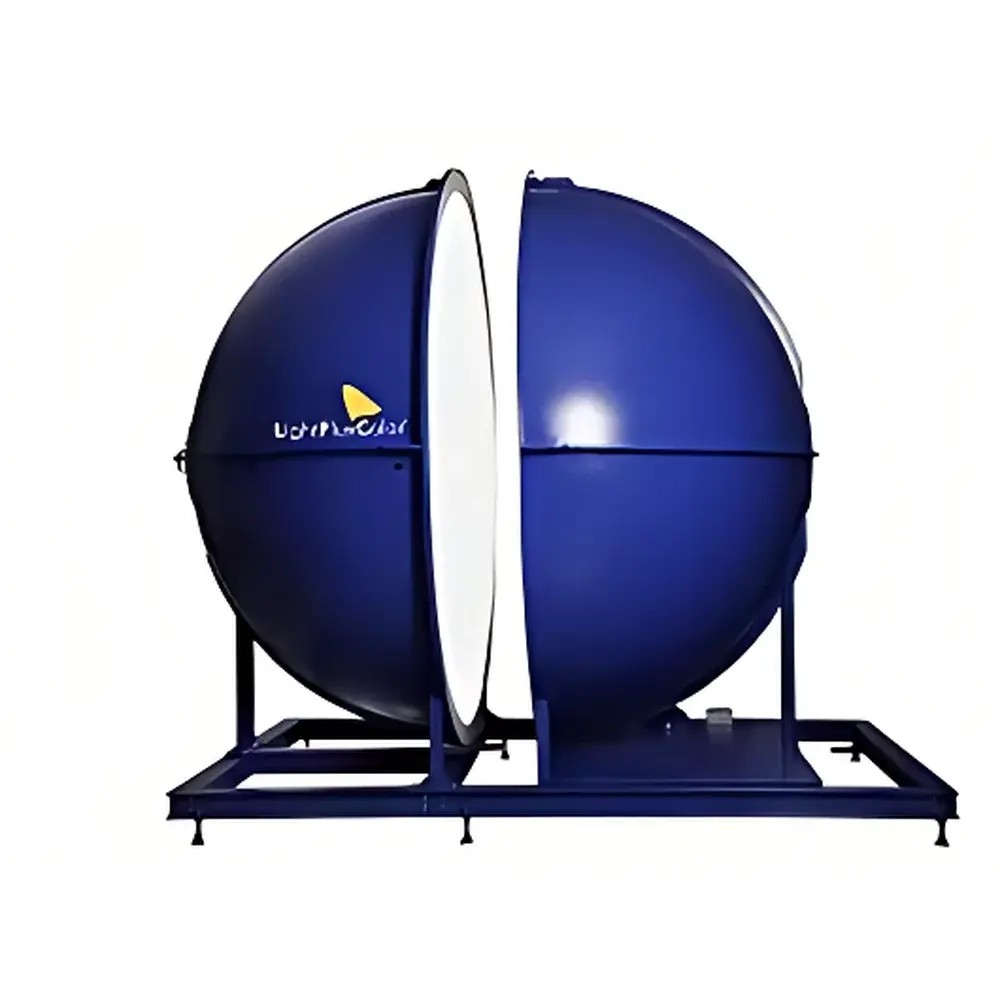
Labsphere LMS-3M 3-Meter Integrating Sphere for Photometric and Colorimetric Testing
| Brand | Labsphere |
|---|---|
| Origin | USA |
| Model | LMS-3M |
| Diameter | 3 m |
| Compliance | IESNA LM-79, LM-80, ENERGY STAR® Thermal Test Requirements |
| Internal Coating | Spectraflect® (≥98% diffuse reflectance, 400–700 nm) |
| Measurement Geometry | Configurable 4π or 2π via optional baffle & port reducer |
| Detector Compatibility | Multiple photometric and spectroradiometric sensors simultaneously |
| Mounting Flexibility | Upward, downward, or axial lamp orientation |
| Temperature Control | Integrated thermal monitoring module with inlet/outlet baffles |
| Structural Assembly | Field-installed modular design (wedge segments, base frame, fasteners) |
| Dimensions (packed) | ~3.3 × 2.3 × 1.6 m per crate |
| Required Site Conditions | Level floor, structural load capacity ≥500 kg/m² |
Overview
The Labsphere LMS-3M is a precision-engineered 3-meter integrating sphere system designed for full-spectrum photometric and colorimetric characterization of large-scale lighting products under controlled thermal and geometric conditions. Based on the fundamental principle of diffuse multiple-scattering integration, the LMS-3M utilizes a high-Lambertian, spectrally neutral Spectraflect® coating (≥98% diffuse reflectance across 400–700 nm) to homogenize radiant flux from spatially complex sources—ensuring uniform irradiance at all detector positions. Its 4π measurement architecture enables total luminous flux (lumens), correlated color temperature (CCT), color rendering index (CRI), spectral power distribution (SPD), and luminous efficacy determination in strict accordance with IESNA LM-79-19 and LM-80-15 test protocols. Unlike smaller spheres, the 3-meter diameter minimizes wall effects and self-absorption errors, particularly critical for high-power LED arrays, OLED panels, HID lamps, and luminaires up to 2 meters in maximum dimension.
Key Features
- Modular 3-meter spherical cavity constructed from rigid aluminum alloy segments with precision-machined knife-edge interfaces for optical continuity and mechanical stability.
- Dual-mounting configuration support: standardized upward-facing lamp base for traditional SSL packages and downward-facing socket interface for integrated luminaires and troffers.
- Thermally isolated port baffles with integrated temperature monitoring—enabling real-time ambient and wall-temperature tracking to satisfy ENERGY STAR® thermal stabilization requirements (e.g., 25 ± 1°C wall temperature during measurement).
- Configurable geometry: factory-default 4π operation supports total flux integration; optional port reducers and internal baffles allow conversion to 2π mode for directional source testing per IESNA TM-21 or CIE S 025/E:2015.
- Multi-detector compatibility: simultaneous installation of calibrated photometers (e.g., ILT1700), spectroradiometers (e.g., CAS 140D), and auxiliary reference sensors without cross-talk or vignetting.
- Integrated thermal management subsystem—including inlet/outlet ducts, passive heat-sink mounting provisions, and optional active air circulation modules—to maintain thermal equilibrium during extended burn-in and photometric acquisition cycles.
Sample Compatibility & Compliance
The LMS-3M accommodates light sources ranging from single-die high-power LEDs mounted on metal-core PCBs to fully assembled architectural luminaires measuring up to 2000 mm in length or diameter. It supports board-level testing (bare emitters with thermal sinks), driver-integrated modules, and complete fixtures—including those with asymmetric optics, diffusers, or secondary reflectors. All measurements comply with IESNA LM-79-19 (Electrical and Photometric Measurements of Solid-State Lighting Products), LM-80-15 (Measuring Lumen Maintenance of LED Light Sources), and ENERGY STAR® Program Requirements for Integral LED Lamps (Version 2.1). The system’s Spectraflect® coating meets ASTM E275-22 specifications for reflectance standard materials, and its geometric configuration satisfies CIE Publication No. 84 (1989) recommendations for integrating sphere performance validation.
Software & Data Management
The LMS-3M integrates seamlessly with Labsphere’s proprietary TruColor™ software suite and third-party platforms including Instrument Systems’ CAS140D control software and Photonics’ LightSpex™. Data acquisition supports NIST-traceable calibration workflows, automated spectral averaging (≥100 scans), and real-time correction for detector nonlinearity, stray-light contribution, and thermal drift. Audit trails comply with FDA 21 CFR Part 11 requirements when paired with validated computing environments. Export formats include IES LM-63, EULUMDAT (.ldt), CIE 15:2018-compliant SPD CSV, and CIE 13.3-1995 chromaticity reports—enabling direct import into lighting simulation tools (e.g., Dialux, AGi32) and regulatory submission portals.
Applications
- End-of-line photometric certification of commercial and industrial LED luminaires per DLC, DesignLights Consortium, and EU Ecodesign Regulation (EU) 2019/2020.
- Development-stage evaluation of thermal-optical coupling in high-flux COB and multi-chip LED modules.
- Validation of lumen maintenance projections under LM-80-compliant aging protocols.
- Calibration transfer between primary national metrology institutes (NMIs) and accredited third-party test labs.
- Research into spectral shift mechanisms in phosphor-converted white LEDs under varying junction temperatures.
- Verification of compliance with IEC TR 62778 (Blue Light Hazard assessment) using spectroradiometric data acquired within the sphere.
FAQ
What are the site preparation requirements for field installation of the LMS-3M?
A level, vibration-isolated concrete floor with minimum load-bearing capacity of 500 kg/m² is required. Six L-bracket mounting points must be anchored to structural slabs; alignment tolerances must not exceed ±0.5 mm over the full 3-meter radius.
Can the LMS-3M perform both absolute and relative spectral measurements?
Yes—when used with an NIST-traceable reference lamp and calibrated spectroradiometer, it delivers absolute spectral irradiance (W/m²/nm) and relative SPD normalization. Relative measurements (e.g., CCT shift vs. drive current) require no recalibration between runs.
Is the Spectraflect® coating resistant to UV degradation during long-term operation?
Spectraflect® exhibits negligible degradation after >10,000 hours of exposure to broadband visible and near-UV radiation (365–400 nm) at typical operating irradiance levels (<10 W/m²), as verified per ISO 11341:2019 accelerated weathering protocols.
How does the system ensure measurement repeatability across different operators and lab environments?
Through hardware-enforced geometric constraints (fixed detector positions, baffle locations, and port apertures), firmware-locked calibration coefficients, and software-managed SOP enforcement—including mandatory thermal stabilization checks and dark-current subtraction routines prior to each acquisition cycle.



