
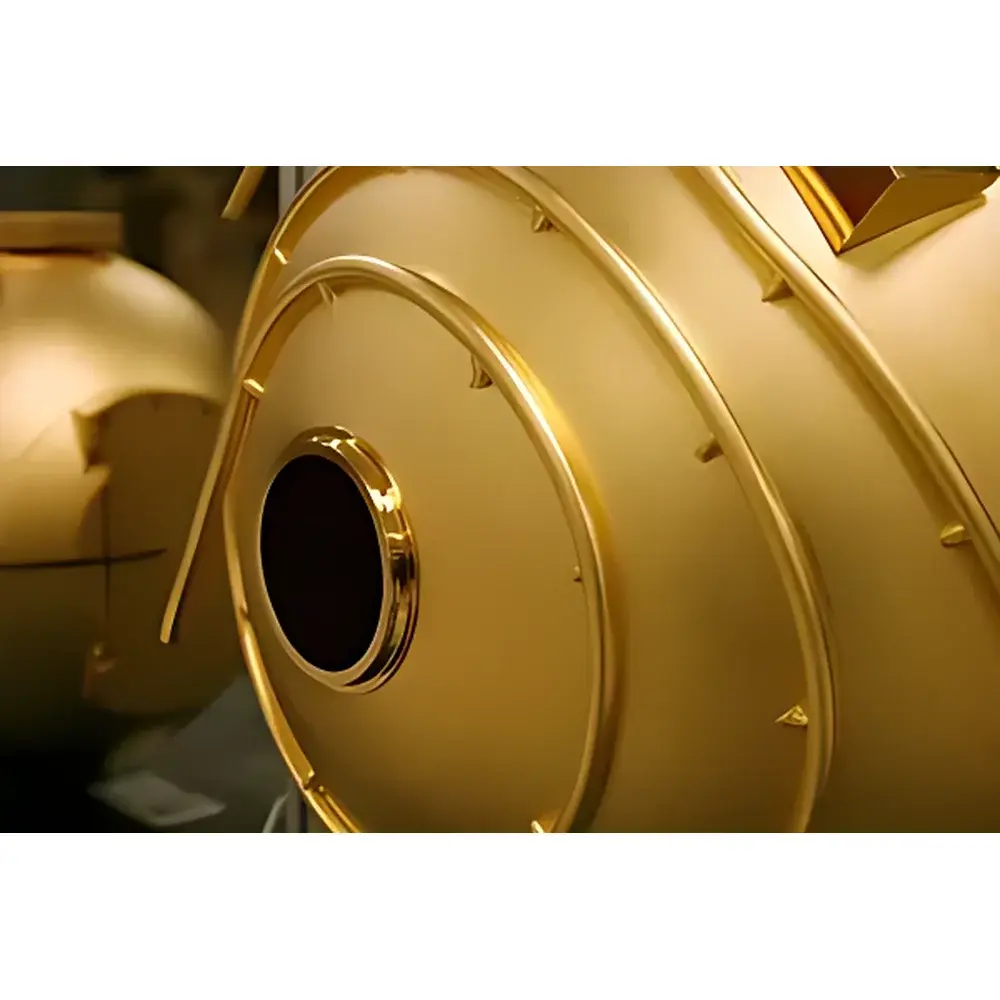
INFRAGOLD® Gold-Deposited Diffuse Reflectance Coating by Labsphere
| Brand | Labsphere |
|---|---|
| Origin | USA |
| Model | INFRAGOLD® |
| Laser Damage Threshold | ≥19.3 J/cm² @ 10.6 µm (CO₂, 10 ns pulse) |
| Substrate Compatibility | Aluminum, Nickel, Iron, Copper, Tungsten |
| Application Range | 250 nm – 25 µm (peak performance: 1000 nm – 12 µm) |
Overview
INFRAGOLD® is a high-performance, electrodeposited gold-based diffuse reflectance coating engineered for precision optical calibration and radiometric measurement in near-infrared (NIR) to mid-infrared (MIR) spectral regions. Unlike conventional evaporated or sputtered gold films—whose specular reflectance dominates—INFRAGOLD® is chemically formulated and processed to yield a highly isotropic, Lambertian scattering surface with exceptional spectral stability across 1000 nm to 12 µm. Its underlying mechanism relies on controlled nanostructured gold morphology embedded in a robust, low-outgassing matrix, enabling uniform photon scattering while maintaining high absolute reflectance (>94% at λ ≥ 1000 nm). This makes INFRAGOLD® particularly suitable for applications demanding traceable, spatially uniform, and environmentally stable reference standards—including integrating spheres, collimator baffles, calibration targets, and spaceborne optical bench components.
Key Features
- High diffuse reflectance: ≥94% (measured at λ = 1000–12000 nm), certified traceable to NIST and NRC primary standards
- Lambertian angular response: Bidirectional Reflectance Distribution Function (BRDF) conforms to ideal cosine law (±1.5% deviation over ±80° viewing cone)
- Ultra-low vacuum outgassing: Compliant with ASTM E595; total mass loss (TML) < 0.5%, collected volatile condensable materials (CVCM) < 0.05%—validated for spacecraft and ultra-high-vacuum instrumentation
- High laser damage resistance: ≥19.3 J/cm² threshold under 10.6 µm, 10 ns CO₂ laser pulses; enhanced further with active cooling (e.g., water-cooled sphere walls or target mounts)
- Chemical and thermal stability: Resists oxidation up to 300°C in inert atmosphere; unaffected by repeated cleaning with IPA, acetone, or mild alkaline solutions
- Substrate versatility: Adheres uniformly to machined aluminum (6061-T6), nickel-plated surfaces, stainless steel, copper, and tungsten substrates without interfacial delamination
Sample Compatibility & Compliance
INFRAGOLD® is applied via proprietary electrochemical deposition directly onto finished metal substrates—eliminating need for adhesives or binders that degrade IR performance. It meets stringent requirements for ISO/IEC 17025-accredited calibration labs and supports GLP-compliant workflows. The coating’s NIST-traceable reflectance calibration certificate includes full spectral data (250–25000 nm), uncertainty budget per ISO/IEC Guide 98-3 (GUM), and measurement geometry documentation (d/0°, 8° acceptance angle). For aerospace applications, it satisfies ECSS-Q-ST-70-02C (European Space Agency) and NASA-STD-6002B outgassing specifications. All production batches undergo spectral validation using double-monochromator FTIR spectrophotometry with calibrated Si, InGaAs, and MCT detectors.
Software & Data Management
While INFRAGOLD® itself is a passive optical material, its metrological value is fully leveraged within calibrated optical systems integrated with Labsphere’s SpectraSuite™ and SphereOptics™ software platforms. These tools support automated BRDF mapping, time-stamped reflectance drift monitoring, and audit-ready reporting compliant with FDA 21 CFR Part 11 (electronic signatures, change control logs, and secure user access tiers). Reflectance datasets are exportable in ASTM E275-compliant CSV and HDF5 formats, enabling direct ingestion into MATLAB®, Python (via PyVISA + NumPy), or LabVIEW™ environments for custom radiometric modeling and uncertainty propagation analysis.
Applications
- Radiometric and photometric calibration of FTIR spectrometers, hyperspectral imagers, and quantum cascade laser (QCL) systems
- Integrating sphere inner coatings for NIR-MIR source characterization (e.g., blackbody emitters, LED arrays, synchrotron beamlines)
- Reference standards for satellite sensor pre-flight validation (e.g., VIIRS, MODIS, Sentinel-3 SLSTR)
- Baffling and stray-light suppression in cryogenic optical benches and interferometric testbeds
- Primary transfer standards in national metrology institutes (NMIs) performing spectral irradiance scale dissemination
- Target plates for laser-induced damage threshold (LIDT) intercomparison studies under ISO 21254
FAQ
Is INFRAGOLD® suitable for UV-VIS applications?
No—its reflectance drops below 90% below 1000 nm due to intrinsic gold absorption; for UV-VIS-NIR broadband use, consider Labsphere’s Spectralon® or Duraflect® coatings.
Can INFRAGOLD® be reapplied or repaired onsite?
No—recoating requires controlled electrochemical plating infrastructure and NIST-traceable post-processing validation; field repair is not supported.
Does the coating require periodic recalibration?
Yes—while highly stable, annual re-characterization is recommended for ISO/IEC 17025 compliance; Labsphere offers certified recalibration services with updated uncertainty budgets.
What surface roughness is required prior to INFRAGOLD® application?
Ra ≤ 0.4 µm for optimal scatter uniformity; substrates must be degreased, acid-etched, and electrocleaned per MIL-STD-171F prior to plating.
Is INFRAGOLD® compatible with cryogenic cycling?
Yes—validated for 50+ thermal cycles between 4 K and 300 K with no microcracking or adhesion loss when applied to OFHC copper or aluminum 6061-T6 substrates.




