
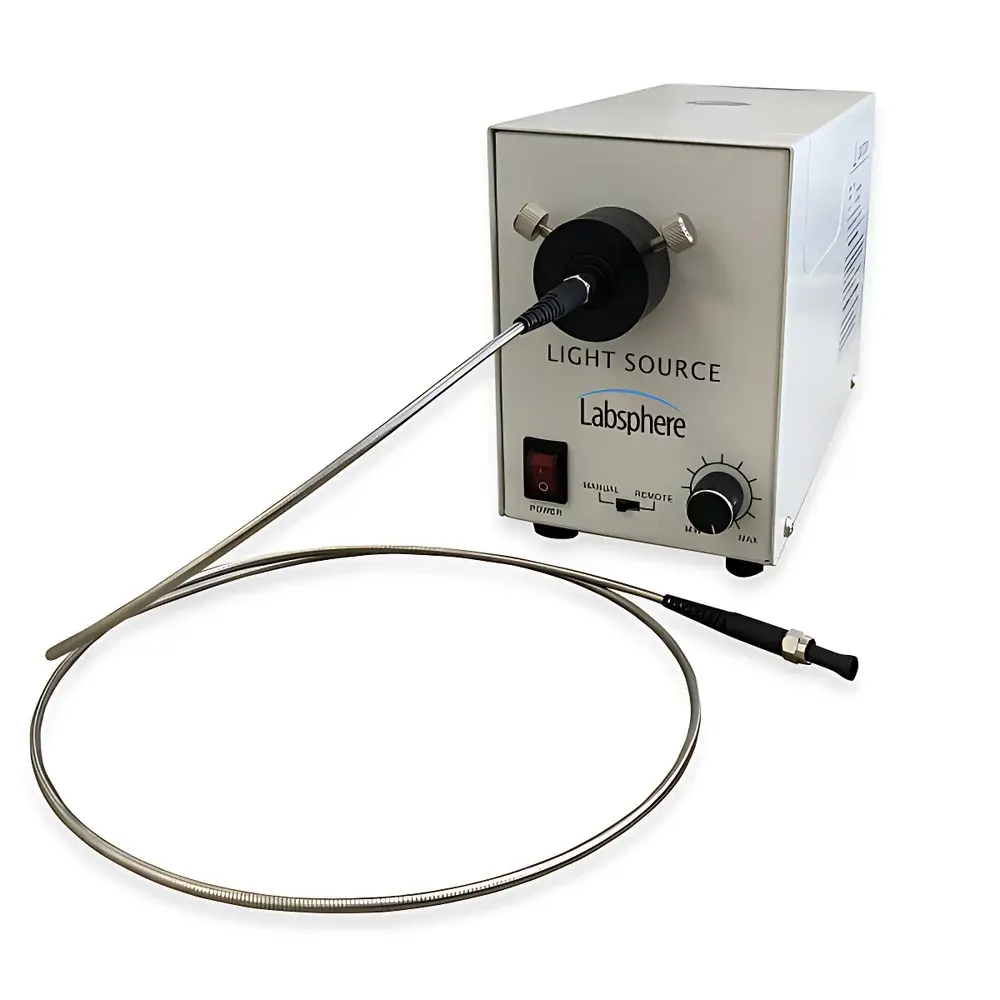
Labsphere FOL-150-S Fiber-Coupled Tungsten-Halogen Light Source
| Brand | Labsphere |
|---|---|
| Model | FOL-150-S |
| Light Source Type | Quartz-Tungsten-Halogen (QTH) |
| Output Power | 150 W |
| Spectral Range | 350 nm – 1000 nm (QTH core), extended usable range 400 nm – 1600 nm via fiber transmission |
| Fiber Interface | SMA 905 connector |
| Integrated Hot Mirror | Yes |
| Compatibility | Designed for Labsphere integrating spheres (e.g., RSA, UV-VIS-NIR series) |
| Cooling | Forced-air convection |
| Dimensions (H×W×D) | 140 × 220 × 320 mm |
| Weight | 4.8 kg |
| Regulatory Compliance | CE, RoHS, UL-listed power supply |
Overview
The Labsphere FOL-150-S Fiber-Coupled Tungsten-Halogen Light Source is an engineered illumination module optimized for precision reflectance and transmittance measurements in laboratory and quality control environments. Based on a stabilized 150 W quartz-tungsten-halogen (QTH) lamp, it delivers high-radiance, spatially uniform broadband output across the visible and near-infrared spectrum. Its spectral emission profile—peaking in the 350–1000 nm region with usable extension to 1600 nm via low-OH silica optical fiber—ensures compatibility with spectroradiometric and photometric applications requiring stable, reproducible irradiance. Unlike free-space lamp housings, the FOL-150-S integrates a collimated SMA 905 fiber-coupling interface, enabling direct, alignment-free connection to Labsphere’s family of integrating spheres—including single-beam (e.g., RSA-100) and dual-beam (e.g., UV-VIS-NIR-200) configurations. The built-in hot mirror suppresses infrared thermal load at the fiber exit, minimizing sample heating and improving measurement stability during long-duration acquisitions.
Key Features
- 150 W stabilized QTH lamp with active temperature regulation and current feedback control for <±0.2% intensity stability over 1 hour
- SMA 905 fiber output port with calibrated coupling efficiency (>75% into 600 µm core, NA 0.22)
- Integrated dichroic hot mirror (cut-on ~1100 nm) to reduce IR-induced thermal drift in downstream optics and detectors
- Front-panel digital display and rotary encoder for intuitive lamp intensity adjustment (0–100% in 0.1% increments)
- Programmable analog voltage input (0–10 V) for external intensity control and synchronization with spectrometer trigger signals
- Forced-air cooling system with thermal cutoff protection and audible alarm for overtemperature events
- UL-certified switching power supply (100–240 VAC, 50/60 Hz) with EMI filtering compliant with IEC 61000-3-2 Class A
Sample Compatibility & Compliance
The FOL-150-S is designed for use with solid, liquid, and thin-film samples in reflectance (diffuse/specular) and transmittance (normal/diffuse) configurations. It supports ASTM E275, ISO 2813, ISO 7724-2, and CIE Publication 15 methodologies when paired with appropriate integrating sphere geometries and calibrated reference standards (e.g., Labsphere Spectralon® SRM). The source meets GLP-relevant operational requirements—including audit-trail-capable intensity logging when integrated with Labsphere’s TruBeam™ software—and complies with FDA 21 CFR Part 11 data integrity guidelines when used in validated pharmaceutical or medical device testing workflows. All electrical and optical safety design adheres to IEC 61010-1 (Measurement Category II) and IEC 62471 (Photobiological Safety, Risk Group 1).
Software & Data Management
The FOL-150-S operates as a hardware-controlled peripheral within Labsphere’s TruBeam™ v4.x platform. Through USB 2.0 communication, TruBeam enables real-time intensity monitoring, scheduled ramping profiles, and synchronized acquisition triggering with supported spectrometers (e.g., Ocean Insight QE Pro, Avantes AvaSpec). Instrument metadata—including lamp hours, thermal status, and calibration timestamp—is embedded in exported .csv and .jdx spectral files. For enterprise integration, TruBeam supports OPC UA server export, allowing seamless data ingestion into LIMS (e.g., LabVantage, Thermo SampleManager) and MES systems. Firmware updates are delivered via signed binary packages with SHA-256 verification.
Applications
- Diffuse reflectance spectroscopy of pigments, coatings, and textiles per ASTM D2244 and ISO 11664-4
- NIR transmittance analysis of polymer films and pharmaceutical blister packs (USP <857>)
- Calibration validation of hyperspectral imaging systems using NIST-traceable reflectance standards
- Colorimetric evaluation of LED packaging materials under standardized CIE Illuminant A conditions
- Stability testing of optical filters and anti-reflective coatings across 400–1600 nm
- Quantitative analysis of biological tissue optical properties in preclinical research setups
FAQ
What is the recommended warm-up time before radiometric calibration?
Allow 30 minutes of continuous operation at nominal intensity to achieve thermal equilibrium and spectral stabilization.
Can the FOL-150-S be used with non-Labsphere integrating spheres?
Yes—provided the sphere features an SMA 905 input port and accepts collimated fiber input with ≤12° acceptance angle; users must verify spectral throughput and étendue matching independently.
Is the lamp replaceable by the end user?
Yes—the QTH lamp (Labsphere P/N LAMP-QTH-150W) is field-replaceable using standard torx tools; full replacement procedure and alignment instructions are included in the service manual.
Does the unit support analog modulation for pulsed measurement modes?
No—it provides DC-stabilized output only; for modulated illumination, external mechanical choppers or electro-optic modulators are required.
How often should factory recalibration be performed?
Annual recalibration is recommended for ISO/IEC 17025-accredited labs; traceable spectral irradiance calibration certificates (NIST-traceable) are available upon request.






