
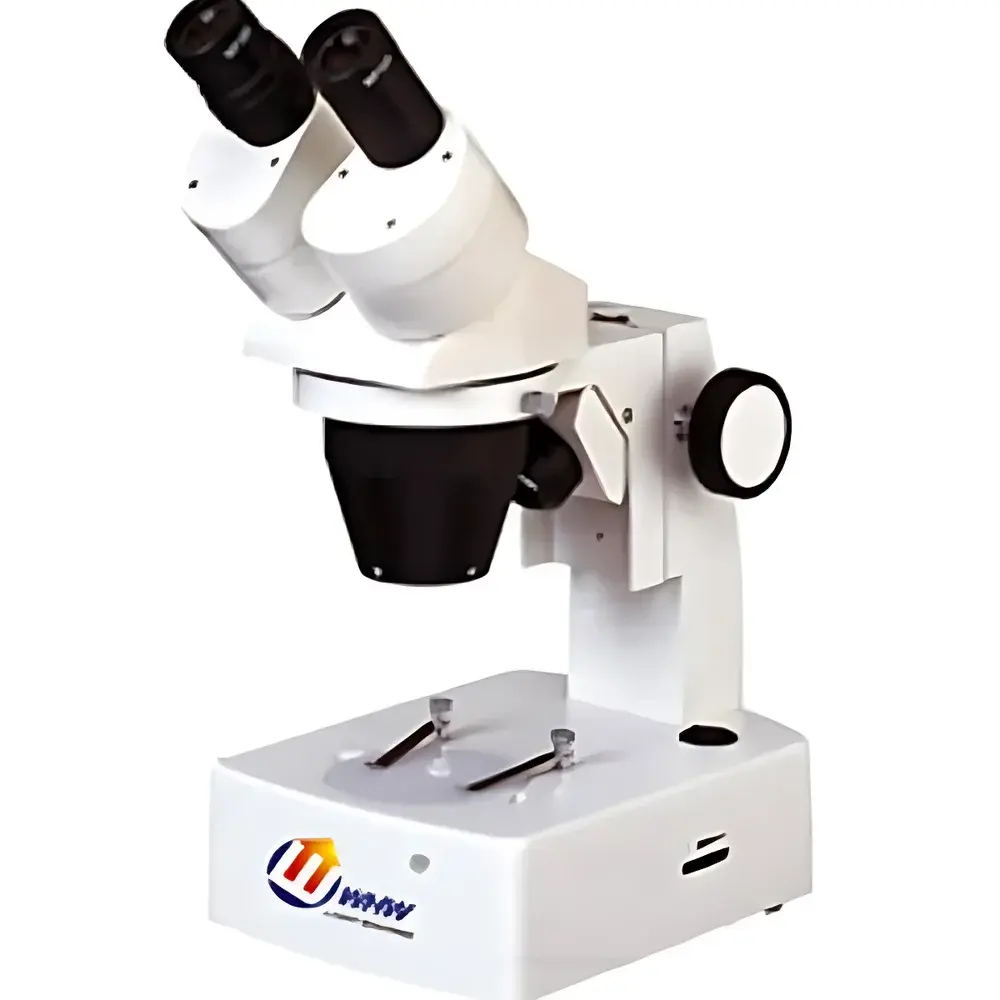
YANRUN SM-3C Fixed-Magnification Stereo Microscope
| Brand | YANRUN |
|---|---|
| Origin | Shanghai, China |
| Manufacturer Type | Direct Manufacturer |
| Product Origin | Domestic (China) |
| Model | SM-3C Fixed-Magnification Stereo Microscope |
| Mounting Type | Upright |
| Total Magnification | 20×, 40× |
| Eyepieces | Wide-Field 10× (Φ20 mm) |
| Objectives | 2×, 4× |
| Field of View | Φ10–Φ5 mm |
| Working Distance | 88 mm |
| Vertical Travel Range | 88 mm ≤ H < 130 mm |
| Base Dimensions | 215 × 160 × 60 mm |
| Illumination | Dual LED-free Halogen — Top Light: 12 V, 10 W with Reflector Cup, Dimmable |
| Bottom Light | 12 V, 10 W Halogen, Dimmable |
| Overall Dimensions | 230 × 160 × 380 mm |
| Optional Eyepiece | Graticule Eyepiece 10× (Φ20 mm), Scale Value: 0.1 mm per Division |
| Image Analysis System | Not Integrated |
Overview
The YANRUN SM-3C Fixed-Magnification Stereo Microscope is an upright, dual-illumination stereoscopic optical instrument engineered for routine visual inspection, quality control, and manual sample manipulation in industrial, educational, and light metallurgical environments. Unlike zoom-type stereo microscopes, the SM-3C employs a fixed-magnification optical path based on Galilean optics, delivering high image fidelity, consistent depth of field, and minimal parallax across its two discrete magnification settings—20× and 40×. Its design prioritizes mechanical stability and ergonomic usability, with a rigid cast-aluminum base and coaxial vertical focusing mechanism ensuring repeatable positioning during extended observation sessions. The microscope operates on a true stereoscopic principle: separate optical paths for left and right eyes provide natural three-dimensional perception, essential for tasks requiring spatial judgment—such as solder joint assessment, PCB inspection, or metallographic surface evaluation. While not classified as a high-resolution metallurgical microscope per ASTM E3-22 (which mandates reflected-light Köhler illumination and objective correction for immersion media), the SM-3C satisfies basic ISO 8579-1:2021 requirements for visual examination equipment used in non-destructive testing (NDT) workflows where gross feature identification—not submicron grain analysis—is the primary objective.
Key Features
- Rigid upright configuration with precision-machined base (215 × 160 × 60 mm) and stable column assembly supporting 88 mm minimum working distance and 42 mm vertical travel range (88 mm ≤ H < 130 mm)
- Dual independent halogen illumination system: top-mounted 12 V, 10 W lamp with reflector cup for oblique surface contrast enhancement; bottom-mounted 12 V, 10 W lamp for transmitted-light observation of semi-transparent specimens
- Fixed-magnification optical train using matched 2× and 4× achromatic objectives paired with wide-field 10× eyepieces (Φ20 mm field number), yielding calibrated total magnifications of 20× and 40× with minimal chromatic aberration
- Optimized working distance of 88 mm—sufficient to accommodate standard sample holders, tweezers, and basic micro-manipulators without collision risk
- Optional calibrated graticule eyepiece (10×, 0.1 mm per division) enables rapid comparative dimensional estimation under standardized lighting conditions
Sample Compatibility & Compliance
The SM-3C accommodates specimens up to 120 mm in height and 100 mm in lateral dimension within its stage envelope. It supports both opaque and translucent samples—including machined metal parts, printed circuit boards, polymer components, mineral chips, and botanical sections—when paired with appropriate lighting modes. While it lacks motorized stage control or DIC/fluorescence capability, its mechanical robustness and thermal stability meet IEC 61000-6-2:2019 immunity requirements for laboratory electromagnetic environments. The instrument complies with general safety standards EN 61010-1:2010 for electrical equipment used in laboratory settings. No integrated image capture or digital output is provided; therefore, it does not fall under FDA 21 CFR Part 11 or EU Annex 11 regulatory scope for electronic records. However, when used in GLP-compliant QC labs, manual logbook entries referencing magnification setting, illumination mode, and observed features satisfy traceability requirements per ISO/IEC 17025:2017 Clause 7.8.2.
Software & Data Management
The SM-3C is a purely optical, analog instrument with no embedded electronics, firmware, or connectivity interfaces. It does not include proprietary software, drivers, or data export functionality. All observations are documented manually—via handwritten notes, annotated sketches, or external camera systems mounted via C-mount adapters (sold separately). For laboratories implementing digital documentation protocols, third-party USB microscopes or DSLR adapters may be integrated into existing LIMS or QMS platforms, but such configurations require validation per internal SOPs and do not constitute manufacturer-supported functionality.
Applications
- Visual inspection of solder joints, wire bonds, and component placement in electronics manufacturing (IPC-A-610 Class 2 compliance support)
- Preliminary assessment of casting porosity, weld bead geometry, and surface defects in low-magnification metallurgical screening
- Assembly verification in precision mechanical and medical device production lines
- Educational demonstration of stereoscopic vision principles and basic optical path alignment
- Forensic toolmark comparison at macroscopic scale (e.g., screwdriver impressions, fracture surfaces)
- Biological specimen dissection and sorting where depth perception outweighs resolution demands
FAQ
Is the SM-3C suitable for quantitative metallographic analysis per ASTM E112?
No. Quantitative grain size measurement requires high-numerical-aperture objectives, precise stage micrometers, and standardized illumination per ASTM E112–22. The SM-3C provides qualitative visualization only.
Can I attach a digital camera for documentation?
Yes—via optional C-mount adapter (not included); however, calibration for pixel-to-micron conversion must be performed externally and validated per lab SOP.
Does the microscope support fluorescence or polarized light observation?
No. It lacks filter sliders, analyzer modules, or excitation light sources required for these techniques.
What is the warranty coverage and service support structure?
YANRUN provides a 12-month limited warranty covering material and workmanship defects; technical support is available via email and remote diagnostics for mechanical alignment issues.
Is the halogen illumination compliant with RoHS Directive 2011/65/EU?
Yes—the lamps meet exemption 7a (lead in high-melting-temperature type solders) and are CE-marked for use in EU markets.



