
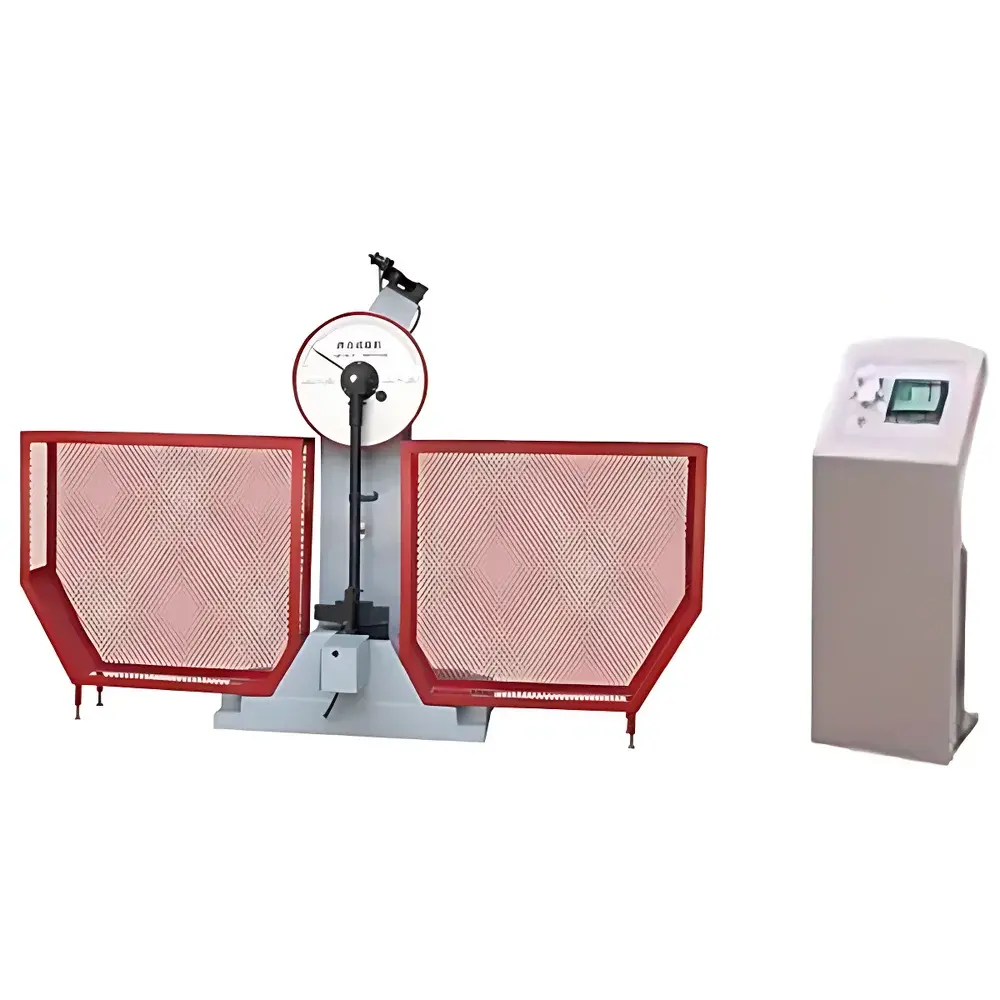
YANRUN JBS-300Z Digital Semi-Automatic Charpy Impact Testing Machine
| Brand | YANRUN |
|---|---|
| Origin | Shanghai, China |
| Manufacturer Type | Direct Manufacturer |
| Model | JBS-300Z |
| Impact Energy | 150 J / 300 J |
| Impact Velocity | 5.2 m/s |
| Compliance | GB/T 229–2007, GB/T 3803–2002 |
| Control System | Microcontroller-Based Digital Measurement & Display |
| Output | Printed Test Reports (Absorbed Energy, Pendulum Lift Angle, Mean Value) |
Overview
The YANRUN JBS-300Z Digital Semi-Automatic Charpy Impact Testing Machine is a precision-engineered pendulum-type impact tester designed for standardized Charpy V-notch and U-notch impact testing of metallic materials in quality control, metallurgical research, and materials certification laboratories. It operates on the principle of gravitational potential energy conversion: a calibrated pendulum of known mass and length is raised to a defined height, then released to strike a notched specimen supported in a three-point bending configuration. The energy absorbed by the specimen during fracture is calculated from the difference between initial and residual pendulum heights—measured via high-resolution angular transduction and microcontroller-based digital signal processing. This instrument meets the mechanical and metrological requirements specified in GB/T 3803–2002 (Verification of Pendulum Impact Testing Machines) and supports test execution per GB/T 229–2007 (Metallic Materials — Charpy Pendulum Impact Testing), ensuring alignment with internationally recognized test methodologies used in steel mills, foundries, third-party inspection labs, and R&D facilities.
Key Features
- Semi-automatic operation with integrated microcontroller-based measurement system: real-time acquisition and digital display of absorbed impact energy (J), pendulum lift angle (°), and statistical mean values across multiple specimens.
- Modular frame architecture with cantilevered pendulum suspension—enhancing mechanical stability and minimizing torsional error during impact.
- U-shaped pendulum hammer body optimized for aerodynamic consistency and repeatable energy transfer; interchangeable impact blades secured via precision-threaded fasteners for rapid blade replacement and traceable calibration.
- Three-point simply supported beam fixture with automatic specimen feeding mechanism and end-face locating pins—ensuring consistent notch alignment relative to the striker and minimizing positioning-induced scatter in results.
- Full-height safety enclosure with interlocked protective mesh—compliant with laboratory mechanical hazard mitigation protocols and enabling safe operation during high-energy (300 J) tests.
- Thermal-stable base casting and vibration-damped mounting feet—reducing environmental influence on pendulum swing repeatability and long-term zero drift.
Sample Compatibility & Compliance
The JBS-300Z accommodates standard Charpy specimens per GB/T 229–2007: 10 mm × 10 mm × 55 mm (full-size), as well as sub-sized variants (e.g., 10 mm × 7.5 mm × 55 mm and 10 mm × 5 mm × 55 mm) using optional anvil inserts. Specimen notch types include V-notch (45°, 2 mm depth, 0.25 mm root radius) and U-notch (5 mm or 2 mm depth). All mechanical components—including pendulum moment of inertia, knife edge radius (2–2.5 mm), and anvil span (40 ± 0.2 mm)—are verified against GB/T 3803–2002 dimensional tolerances. While primarily aligned with Chinese national standards, the machine’s geometric and dynamic parameters are functionally equivalent to ISO 148-1:2016 and ASTM E23–22 requirements for pendulum impact testers, facilitating cross-referenced reporting in multi-standard environments.
Software & Data Management
The embedded microcontroller firmware provides local data storage for up to 500 test records, including specimen ID, energy absorption, failure mode annotation (ductile/brittle), and timestamp. Integrated thermal printer outputs hard-copy reports containing raw values, arithmetic means, coefficient of variation (CV%), and operator ID—supporting basic GLP documentation needs. Data export is available via RS-232 serial interface to external PCs running custom or lab-wide LIMS software. Though the unit does not implement FDA 21 CFR Part 11-compliant electronic signatures or audit trails natively, its deterministic measurement logic, non-volatile memory retention, and printed output traceability satisfy foundational GMP-aligned record-keeping expectations for routine QC applications.
Applications
- Quality assurance of structural steels, pressure vessel alloys, and weld metal deposits in manufacturing and fabrication facilities.
- Toughness evaluation of heat-treated components (quenched & tempered, normalized, annealed) across temperature ranges from –60 °C to +60 °C when paired with environmental chambers.
- Metallurgical process validation—monitoring embrittlement effects induced by aging, hydrogen exposure, or irradiation.
- Educational use in university materials science laboratories for hands-on instruction in fracture mechanics fundamentals and standard test protocol adherence.
- Third-party inspection services requiring documented compliance with GB, ISO, or ASTM impact testing clauses in material certifications.
FAQ
What standards does the JBS-300Z comply with?
It is verified per GB/T 3803–2002 and configured for testing per GB/T 229–2007. Its mechanical specifications align with ISO 148-1:2016 and ASTM E23–22.
Can it test sub-sized Charpy specimens?
Yes—using optional anvil and support block kits, it accommodates 10 × 7.5 mm and 10 × 5 mm cross-sections per GB/T 229–2007 Annex A.
Is calibration certificate included?
A factory verification report is supplied; users must perform periodic verification using certified reference specimens per GB/T 3803–2002 Section 6.
Does it support low-temperature testing?
The base unit operates at ambient temperature; cryogenic testing requires integration with a certified environmental chamber and low-temp specimen handling tools.
What maintenance is required?
Monthly visual inspection of knife edge wear, annual pendulum moment-of-inertia verification, and biannual lubrication of pivot bearings per manufacturer guidelines.



