
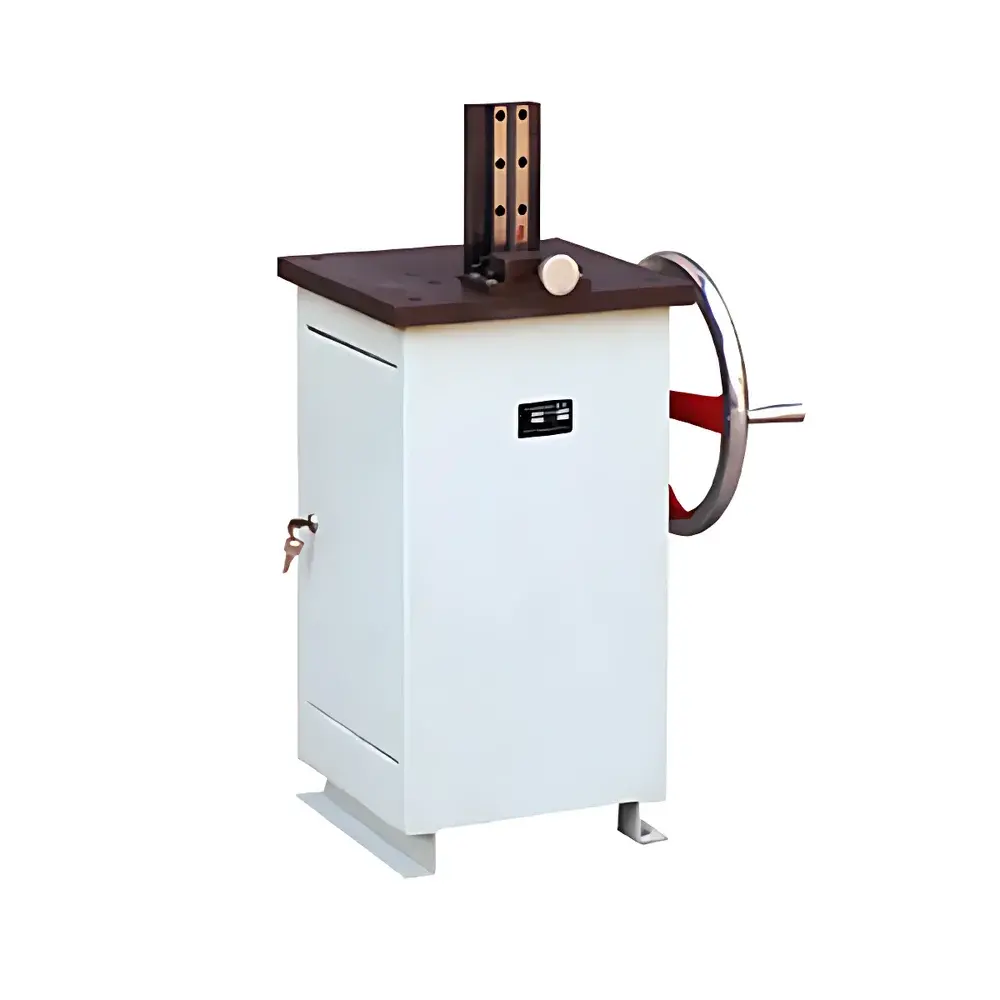
YANRUN CSL-1 Manual Notching Machine for Charpy & Izod Impact Testing
| Brand | YANRUN |
|---|---|
| Origin | Shanghai, China |
| Manufacturer Type | Direct Manufacturer |
| Model | CSL-1 |
| Sample Dimensions Supported | 10×10×55 mm, 10×7.5×55 mm, 10×5×55 mm |
| Notch Types | V-notch (GB/T 229–2007, ISO 148-1:2016 compliant) and U-notch (2 mm root radius, GB/T 229–2007) |
| Notching Stroke | 350 mm |
| Feed Rate | 2.5 mm/min |
| Overall Dimensions (L×W×H) | 350×350×700 mm |
| Net Weight | 80 kg |
Overview
The YANRUN CSL-1 Manual Notching Machine is a precision-engineered benchtop apparatus designed exclusively for the consistent, repeatable preparation of standardized notches in metallic impact test specimens—specifically for Charpy and Izod impact testing per internationally recognized standards. Unlike automated or motorized systems, the CSL-1 employs a manually actuated, mechanically stabilized pulling mechanism that ensures deterministic control over cutting force, feed progression, and tool engagement angle. This architecture eliminates variability introduced by servo response lag or inconsistent motor torque, making it particularly suited for laboratories requiring strict adherence to GB/T 229–2007 and ISO 148-1:2016 specimen geometry tolerances. The machine supports two standardized notch configurations: the 45° V-notch with 0.25 mm root radius (commonly used in Charpy V-notch testing), and the 2 mm radius U-notch, both of which are critical for evaluating fracture toughness, ductile-to-brittle transition behavior, and material homogeneity under dynamic loading conditions.
Key Features
- Manual pull-type operation ensures full operator control over notch depth, feed consistency, and tool dwell—eliminating electronic drift or calibration dependency.
- Interchangeable V-notch and U-notch (2 mm radius) pull-type cutters, each manufactured to ISO 8486-2 tolerance class H6 for dimensional fidelity and edge repeatability.
- Rigid cast-iron base and linear guide rails minimize deflection during notching, maintaining ±0.05 mm positional accuracy across the full 350 mm stroke.
- Dedicated specimen clamping fixture accommodates standard Charpy bar dimensions: 10×10×55 mm, 10×7.5×55 mm, and 10×5×55 mm—with adjustable stops to ensure consistent notch centering relative to the specimen mid-length plane.
- Feed rate fixed at 2.5 mm/min—optimized to balance chip evacuation efficiency and surface finish quality (Ra ≤ 1.6 µm on notch flank surfaces), directly supporting compliance with GB/T 229–2007 surface roughness requirements.
Sample Compatibility & Compliance
The CSL-1 is validated for use with ferrous and non-ferrous metallic specimens up to HB 350 hardness, including carbon steels, low-alloy steels, stainless steels, aluminum alloys, and titanium grades commonly tested in metallurgical QA/QC and materials R&D labs. All notched specimens produced meet the geometric specifications outlined in GB/T 229–2007 (equivalent to ASTM E23–22 Annex A1) and ISO 148-1:2016. Notch depth, angle, root radius, and symmetry are verified using certified optical profile projectors or coordinate measuring machines traceable to NIM (National Institute of Metrology, China) standards. The machine itself does not require CE marking or UL certification, as it functions solely as a mechanical sample preparation tool—not an impact testing system—and therefore falls outside the scope of Machinery Directive 2006/42/EC when used in conjunction with separately certified pendulum impact testers.
Software & Data Management
The CSL-1 operates without embedded firmware, software, or digital interfaces. As a purely mechanical notching device, it produces no electronic data logs, audit trails, or instrument-generated metadata. This design aligns with GLP-compliant environments where manual process documentation is mandated: operators record notch type, specimen ID, date/time, cutter serial number, and visual inspection pass/fail status in bound laboratory notebooks or LIMS-integrated paperless workflows. For laboratories subject to FDA 21 CFR Part 11 or ISO/IEC 17025 accreditation, the absence of software obviates validation requirements for electronic records—reducing qualification burden while preserving full traceability through documented procedural adherence.
Applications
- Preparation of Charpy V-notch specimens for ASTM E23, ISO 148, and GB/T 229 impact energy evaluation in steel mill QA laboratories.
- U-notch specimen fabrication for legacy Izod testing protocols and comparative fracture morphology studies.
- Reference specimen production for inter-laboratory round-robin testing programs coordinated under CNAS (China National Accreditation Service) or ILAC-MRA frameworks.
- Educational use in university metallurgy and mechanical engineering labs where hands-on understanding of notch sensitivity and stress concentration effects is emphasized.
- On-site maintenance workshops supporting field verification of impact tester calibration specimens.
FAQ
Does the CSL-1 support automated feed or programmable notch positioning?
No. The CSL-1 is strictly manual; feed is advanced via calibrated handwheel rotation, and positioning relies on mechanical stops and vernier-scaled indicators.
Can the machine accommodate non-standard specimen cross-sections (e.g., 8×8 mm)?
Only the three standardized dimensions specified—10×10×55 mm, 10×7.5×55 mm, and 10×5×55 mm—are supported via its fixed clamping geometry. Custom fixtures are not available from the manufacturer.
Is cutter resharpening or replacement covered under warranty?
Cutting tools are consumables. The standard warranty covers structural integrity and mechanical function of the base unit for 12 months; pull-type cutters are supplied with initial delivery but excluded from warranty coverage.
What metrological documentation accompanies the CSL-1 upon shipment?
Each unit ships with a Factory Calibration Certificate referencing measurement of stroke linearity (±0.1 mm over 350 mm) and base flatness (≤0.02 mm/m), verified using Class 0 granite surface plates and dial indicators calibrated to NIM-traceable standards.



