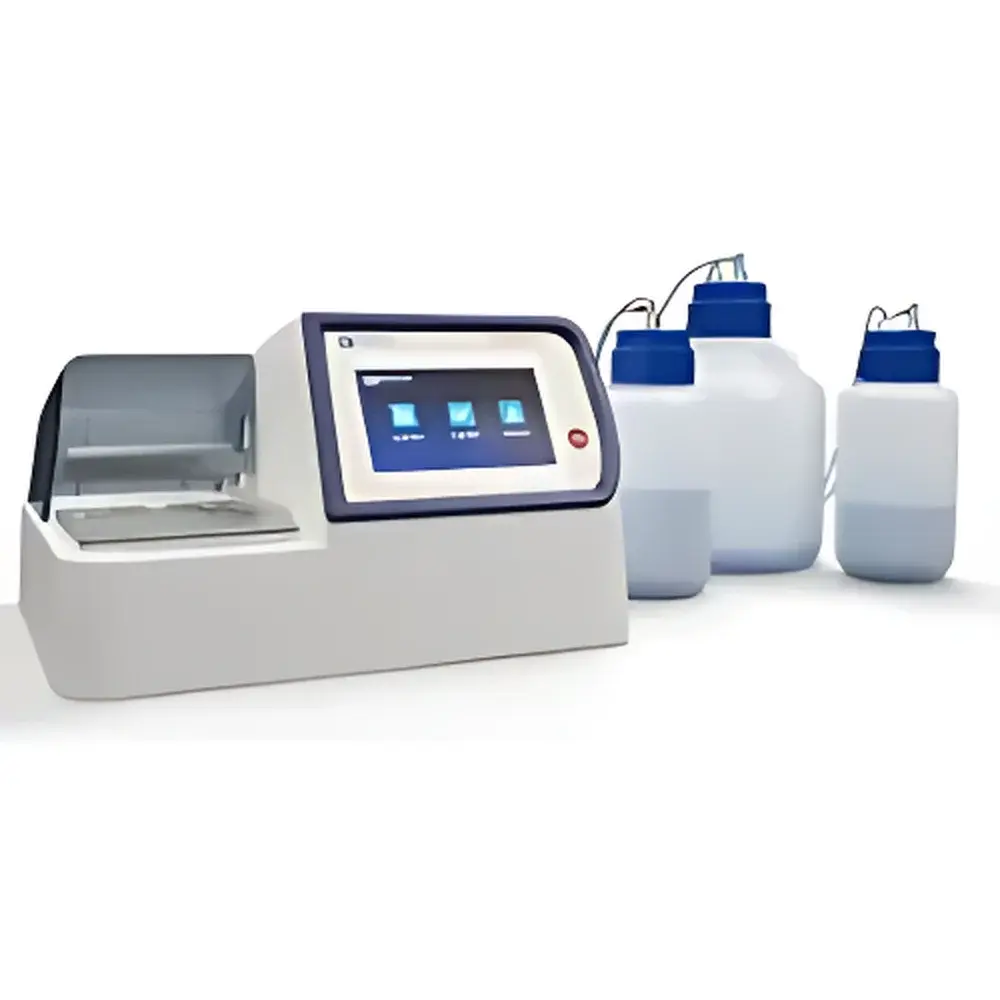
Molecular Devices MultiWash-C Automated Microplate Washer
| Brand | Molecular Devices |
|---|---|
| Model | MultiWash-C |
| Type | Automated Microplate Washer |
| Plate Format | 96-well (flat-bottom, U-bottom, V-bottom) |
| Dispense Volume Range | 50–3000 µL (in 50 µL increments) |
| Accuracy & Precision @ 300 µL | ≤3% |
| Residual Volume | ≤1 µL/well |
| Wash Cycle Time (3 cycles, 3000 µL/well) | <90 s (12-channel head), <125 s (8-channel head) |
| Oscillation | 3 adjustable frequencies |
| Aspiration/Dispense Speed | 3-speed control |
| Onboard Storage | 100 programs, up to 99 steps per program |
| Dimensions (W×H×D) | 46 × 30 × 40 cm |
| Weight (packed) | 13 kg |
| Power Input | 100–240 V, 50–60 Hz |
| Integrated Sensors | Liquid level detection for 2 × 4 L wash bottles and 1 × 10 L waste bottle |
| Compliance | Designed for GLP-compliant ELISA workflows |
| Software | Standalone touchscreen interface, no external PC required |
Overview
The Molecular Devices MultiWash-C is a compact, standalone automated microplate washer engineered for high-reproducibility washing in enzyme-linked immunosorbent assay (ELISA), cell-based assays, and other 96-well plate-based immunoassay workflows. It operates on a precision fluidic architecture utilizing positive-pressure dispensing and vacuum-assisted aspiration—eliminating the need for external vacuum pumps or compressed air sources. The system employs cross-well aspiration via an 8- or 12-channel wash head to minimize residual volume and ensure uniform removal of unbound reagents across all wells. Its integrated pump design delivers quiet, stable operation within standard laboratory bench space, while the sealed fluid path reduces aerosol generation and cross-contamination risk. Designed specifically for compatibility with Molecular Devices’ family of microplate readers—including the SpectraMax i3x, Paradigm, and VersaMax platforms—the MultiWash-C supports end-to-end automation-ready assay protocols without requiring third-party integration.
Key Features
- Full-touch 7-inch color graphical user interface (GUI) with intuitive icon-driven navigation—no external PC, keyboard, or mouse required
- Dual 4 L wash solution reservoirs and one 10 L waste container, each equipped with optical liquid-level sensors for real-time status monitoring and low-fluid alerts
- Onboard storage for up to 100 customizable wash protocols; each protocol supports up to 99 discrete steps including dispense, soak, aspiration, and orbital shaking
- Three independent speed controls for dispensing, aspiration, and wash head movement—enabling fine-tuned optimization for diverse plate chemistries and coating matrices
- Three-level orbital agitation with adjustable frequency to enhance detergent efficacy during incubation phases
- Automatic tubing maintenance cycle—including priming, rinsing, and air-drying sequences—to prevent salt crystallization and biofilm accumulation in fluidic pathways
- Compact footprint (46 × 30 × 40 cm) and lightweight design (13 kg packed) for flexible placement in biosafety cabinets, cleanrooms, or shared core facilities
Sample Compatibility & Compliance
The MultiWash-C is validated for use with standard 96-well microplates manufactured from polystyrene or polypropylene, including flat-bottom, U-bottom, and V-bottom configurations. Its adaptive wash head alignment and programmable dispense/aspiration profiles accommodate variations in well geometry and surface treatment—critical for maintaining binding integrity in high-sensitivity ELISA formats. All operational parameters—including volume accuracy (≤3% CV at 300 µL), residual volume (≤1 µL/well), and cycle repeatability—are verified under ISO 8655-6 (volumetric apparatus calibration) and aligned with ASTM E2656-18 guidelines for microplate washer performance validation. The instrument’s audit-trail-capable firmware supports GLP and GMP environments through timestamped protocol execution logs and user-access-controlled parameter locking—facilitating compliance with FDA 21 CFR Part 11 when paired with validated LIMS or electronic lab notebook (ELN) systems.
Software & Data Management
The embedded firmware provides full local control via the onboard touchscreen, eliminating dependency on external computing infrastructure. Protocol creation follows a hierarchical workflow: users define base parameters (plate type, channel count, volumes), then sequence discrete actions (e.g., “dispense 200 µL PBS → incubate 30 s → aspirate → shake at 300 rpm for 10 s”). Each protocol is assigned a unique alphanumeric ID and retains metadata such as creation date, last modification, and operator ID. Export functionality supports CSV-formatted logs of executed runs—including start/end timestamps, actual dispense volumes (via internal flow sensor feedback), and error codes—for traceability in quality review. While not natively network-connected, the system supports manual data archival via USB export, enabling integration into centralized QC databases compliant with ISO/IEC 17025 documentation requirements.
Applications
- Routine ELISA washing in clinical diagnostics, biopharmaceutical QC, and academic research labs
- Cell-based assays requiring gentle yet thorough buffer exchange (e.g., calcium flux, cAMP, reporter gene assays)
- Immunoprecipitation and magnetic bead-based cleanups where consistent wash stringency impacts signal-to-noise ratios
- High-throughput screening (HTS) support when deployed alongside compatible microplate readers in semi-automated workflows
- Regulatory submissions requiring documented washing consistency—particularly in USP , ICH Q5E, and EP 2.6.17 contexts
FAQ
Does the MultiWash-C require external vacuum or pressure sources?
No. It integrates a brushless diaphragm pump for aspiration and a precision peristaltic pump for dispensing—operating independently of facility utilities.
Can wash protocols be transferred between instruments?
Yes. Protocols are exportable via USB drive in encrypted binary format and can be imported onto other MultiWash-C units running identical firmware versions.
Is the system compatible with non-Molecular Devices microplate readers?
While optimized for seamless handoff with Molecular Devices readers (e.g., automatic plate positioning recognition), it functions as a standalone washer with any 96-well plate-compatible reader via manual plate transfer.
How often does the system require maintenance?
Daily: visual inspection of tubing and reservoirs. Weekly: execution of the built-in “Tubing Rinse” maintenance cycle. Annually: certified recalibration of volumetric delivery against gravimetric standards per ISO/IEC 17025.
What safety certifications does the instrument hold?
It complies with IEC 61010-1 (Safety Requirements for Electrical Equipment for Measurement, Control, and Laboratory Use) and carries CE marking for the European Economic Area. EMC conformity is verified to EN 61326-1.